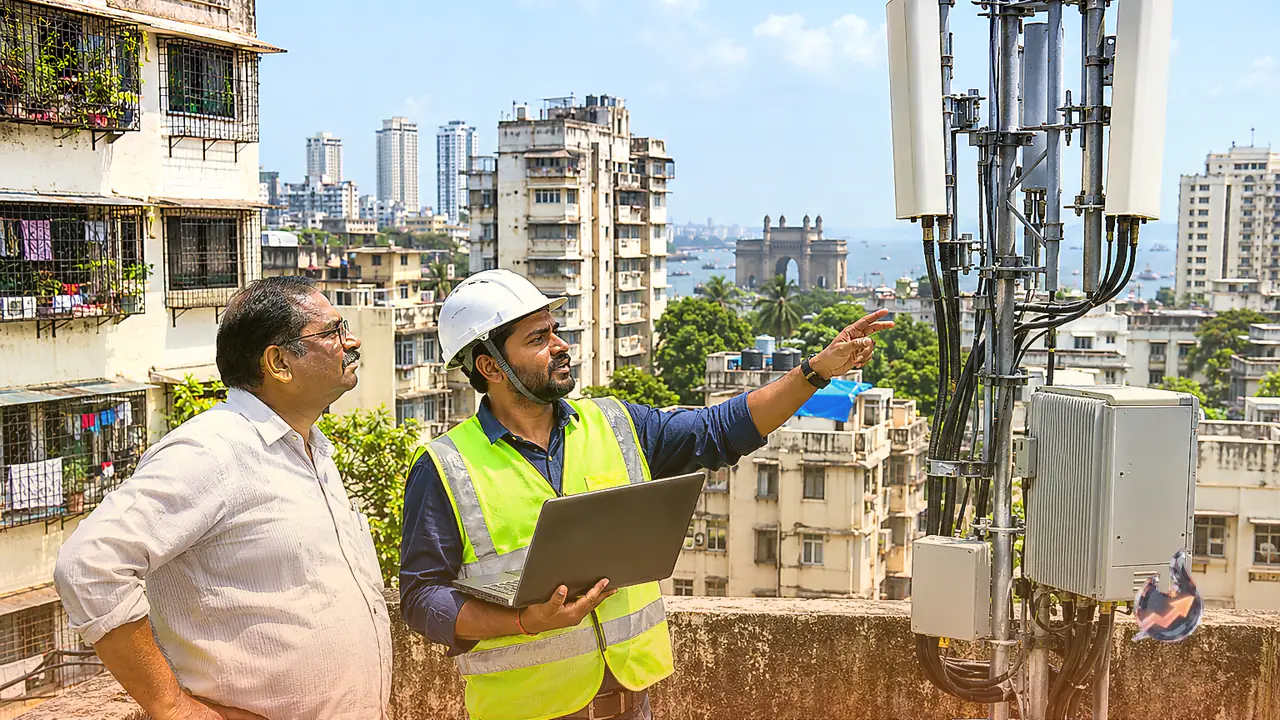

Expanding mobile networks require companies to place towers in more locations. Owners of suitable rooftops, vacant plots or buildings may be able to lease space for that infrastructure and receive regular rent. In some locations, payments could reach 50,000 rupees to 1 lakh rupees a month or more. That is not a fixed return for every property: the offer depends on the company’s coverage needs, the site and the building’s capacity.
The arrangement is being considered as one way to earn long-term rent from extra property. The spread of 5G is prompting telecom companies to extend their infrastructure into new areas. Demand for sites may be higher in metropolitan and commercial districts, while network expansion is also under way in smaller cities and rural areas. Suitable land or rooftops in those places may therefore also be considered.
Who installs towers and what sites need
Mobile service providers do not carry out every tower installation themselves. Companies that specialize in towers and telecom infrastructure also take part. Indus Towers, American Tower Corporation, Summit Digital Infrastructure and Tower Vision are among the companies named in this sector. They lease rooftops or land and install towers along with associated equipment. Property owners therefore need to approach a relevant tower company about a potential site.
A rooftop installation generally needs at least 500 square feet of open space. For a vacant plot, around 2000 square feet is considered preferable. Space alone is not enough: the building must be strong enough to bear the tower and its equipment. A company may conduct a technical survey before proceeding. That assessment considers network coverage, the population nearby, the building’s height and the local need for signal coverage. The process moves forward only if the company finds the location suitable for its requirements.
From application to lease
Property owners interested in applying can use the relevant tower company’s official website. The form asks for the property location, the size of the rooftop or plot and contact details. A technical team may then visit the site to assess whether installation is practical. If the location is accepted, the company and owner can sign a lease. Such agreements may commonly run for 10 to 15 years, or for longer.
Applicants may be asked for documents confirming ownership and identity. These can include the land or house registration, tax receipts, Aadhaar, PAN and bank account details. A structural safety certificate may also be needed to confirm that the building can bear the load. If the property is part of a society or apartment complex, a no-objection certificate from the RWA or local administration may be required in some cases. Lease terms are settled only after the company checks the submitted documents.
Rent varies by location
Monthly payments for a tower site vary. In large cities such as Delhi, Mumbai, Bengaluru and Hyderabad, rent may range from 50,000 rupees to 1 lakh rupees. The stated range for smaller cities is 20,000 rupees to 40,000 rupees a month. In rural areas, potential earnings may be 10,000 rupees to 20,000 rupees per month. These figures depend on the location and the company’s needs; they should not be treated as a guaranteed offer for a particular property.
A lease may include a provision to raise the rent every few years, allowing payments to increase over the term. The tower company generally bears electricity and maintenance costs. Owners should read the agreement carefully for the rent, the timing of any increases and who is responsible for expenses, since those terms determine both the income and the obligations attached to the property.
Watch for fraudulent offers
Fraudulent offers have also emerged around tower installations. Some people use the name of a fake company to demand a registration fee or security deposit from property owners. Genuine tower companies generally do not ask owners to pay money in advance. If someone requests payment for government approval, tax or file charges, the company and offer should be verified first. Applying through an official company website or an authorized channel is the safer route.
Before paying anything, owners should confirm that the contact belongs to the company and that the website is official. A promise to install a tower or an estimate of potential earnings is not itself proof that a site has been approved. The company needs to survey the location and review the property documents. Until those steps take place, an approach should not be treated as a confirmed lease offer.
Network growth could increase demand
The expansion of 5G requires more towers than earlier networks. Rising data consumption and a growing number of internet users are also pushing companies to strengthen coverage in new areas. For those reasons, demand for rooftops and land for tower sites could increase in the coming years.
For owners of vacant properties in suitable locations, leasing space is a possible source of long-term rental income. Experts consider a rooftop or plot in a good location a way to earn more stable rent from property. Actual rent, site suitability and lease duration will still depend on the company’s survey and the agreement’s terms. The opportunity is linked to network expansion, but no single rental rate applies to every property.