




















In the village of Ahiron ka Bas, located in the Didwana-Kuchaman district, farmer Bhanwarlal Yadav has demonstrated that agricultural transformation begins with innovative thinking. By integrating modern and natural farming methodologies, he has not only drastically reduced his farming expenses but also created a roadmap for others in his community. Today, his vermicompost model is a significant topic of discussion among regional farmers.
Inspiration from Gujarat
Bhanwarlal Yadav had the opportunity to join a study group organized by the Department of Agriculture, which included farmers from the Nagaur district. During visits to Gujarat, Maharashtra, and Madhya Pradesh, he closely observed modern natural farming practices and earthworm manure production. Impressed by these experiments, he decided to shift away from chemical farming immediately upon his return and fully transitioned toward organic agriculture.
The Beginning of Vermicompost
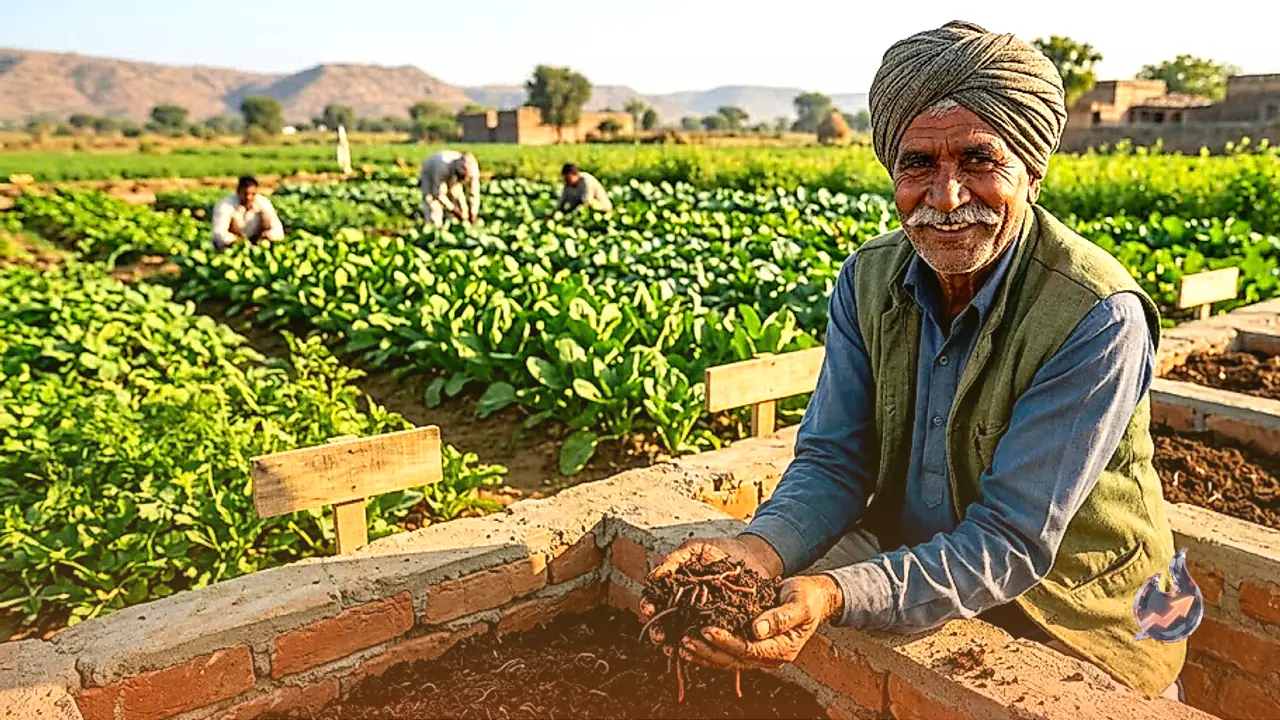
In the 2012-13 period, he initiated the production of vermicompost on his land. He constructed six beds, each 18 feet long and 3 feet wide, to facilitate the process. He sourced high-quality red earthworms from Bikaner to convert cow and buffalo dung into organic manure. These original earthworms have multiplied over the years, serving as the foundation for his consistent manure production.
Bhanwarlal explains that each bed is filled with approximately 20 quintals of dung, upon which the earthworms are released. Within roughly three months, this waste transforms into high-quality vermicompost. The process requires specific care, including keeping the beds in a shaded area and lightly watering them every two to three days to maintain necessary moisture levels. Since extreme temperatures pose a lethal threat to the worms, he ensures strict monitoring to maintain a favorable environment.
Reduced Costs and Improved Yields
From his six beds, Bhanwarlal produces about 120 quintals of organic manure in a single cycle. Out of his total 40 bighas of agricultural land, he utilizes his home-produced vermicompost on approximately 10 bighas annually. He notes that the regular application of this organic manure is continuously enhancing soil quality and has led to a positive shift in crop productivity.
His experience indicates that once earthworm manure is applied, there is no need for chemical fertilizers for roughly three years. A quantity of 100 kg of vermicompost is sufficient for one bigha of land. This practice effectively lowers cultivation costs, improves soil fertility, and results in better crop quality and quantity. Consequently, he now considers organic farming far more beneficial compared to the traditional chemical-based methods.
A Catalyst for Change
Today, Bhanwarlal Yadav is recognized not just as a successful farmer but as a role model for the region. He actively raises awareness, encouraging fellow farmers to prepare vermicompost and adopt natural farming practices. He believes that if farmers prepare organic manure using local resources, agriculture will become more sustainable, cost-effective, and environmentally friendly. His success story has become a beacon of hope for many farmers in the surrounding areas.