





















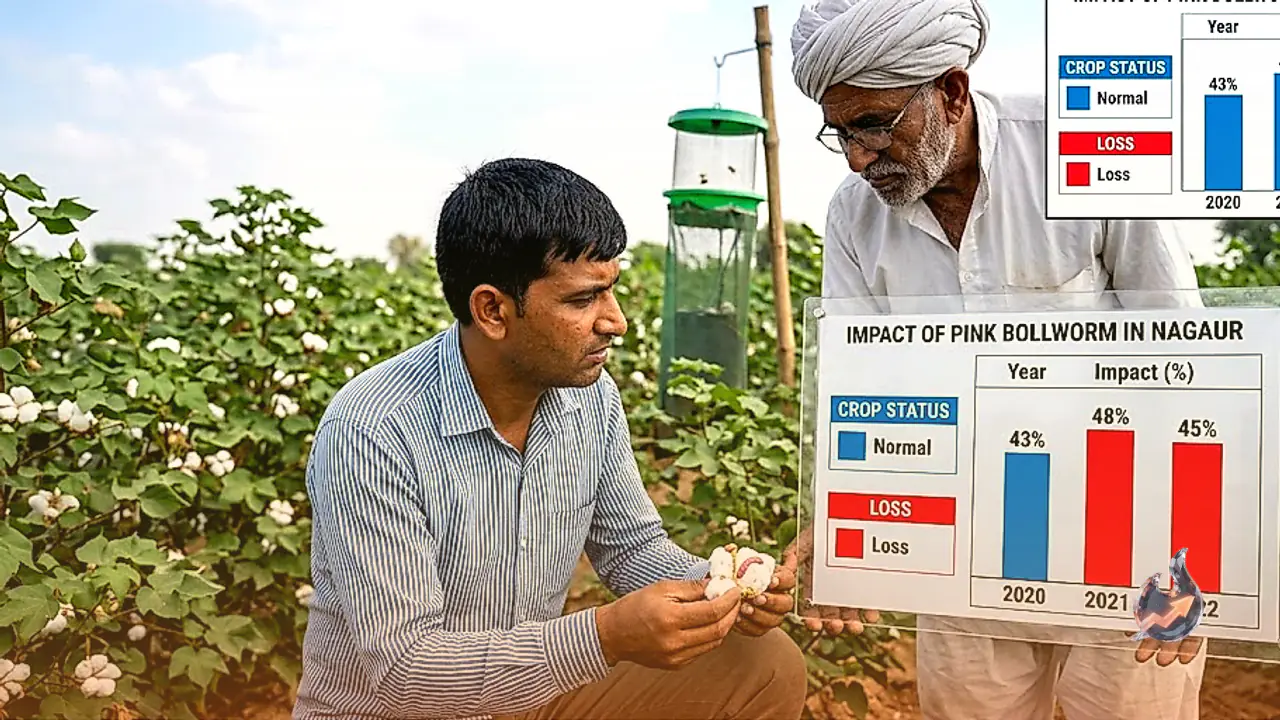

Following a season of abundant monsoon rainfall in Nagaur, the cotton crop initially appeared highly promising, bringing relief to local farmers. However, shifting climatic conditions and increased humidity levels have ushered in a fresh challenge for the region. The cotton crop is now under threat from an infestation of pink bollworm. The Department of Agriculture has identified Merta and Degana as particularly sensitive areas, urging farmers in these regions to adopt immediate preventive measures to secure their fields from significant damage.
Crop Statistics and Economic Impact
Cotton serves as a primary cash crop for farmers throughout the district. This year, the total area sown with cotton spans 62,000 hectares, a figure that surpasses the average over the preceding six years. Historical data indicates that the district typically averages around 60,000 hectares of cotton cultivation, resulting in an annual production of approximately 88,000 metric tons. Given these figures, agricultural experts warn that any delay in managing the pink bollworm outbreak could severely impact both the total production volume and the financial returns for farmers.
The Destructive Nature of the Pink Bollworm
According to Shankarram, an official with the Department of Agriculture in Nagaur, the pink bollworm is recognized as one of the most dangerous pests affecting cotton crops. The life cycle of the pest is particularly insidious; the female moth lays eggs on the flowers and cotton bolls. Upon hatching, the larvae immediately tunnel into the interior of the boll. Once inside, they feed on the seeds and fibers, effectively hollowing out the crop from within. The primary difficulty in detection lies in the fact that the boll appears perfectly normal from the exterior, making it nearly impossible for farmers to identify the infection in its early stages. If left unchecked, this pest has the potential to destroy 70 to 80 percent of the total harvest.
Preventive Measures for Farmers
Agricultural officials strongly advocate for the use of pheromone traps, which are considered the most effective and environmentally friendly method for monitoring and controlling the pink bollworm. These traps consist of a plastic container equipped with a specific chemical lure. The scent emitted by the lure attracts the male moths, trapping them and thereby disrupting the reproductive cycle of the pest. This significantly reduces the population of the insects. Experts advise farmers to install 15 to 20 pheromone traps per hectare approximately 40 to 45 days after sowing. With each trap costing between 50 and 60 rupees, the total expenditure per bigha remains manageable at roughly 200 to 300 rupees. By maintaining vigilance and adopting these scientific methods early in the season, farmers can effectively protect their cotton crops and ensure a successful harvest.