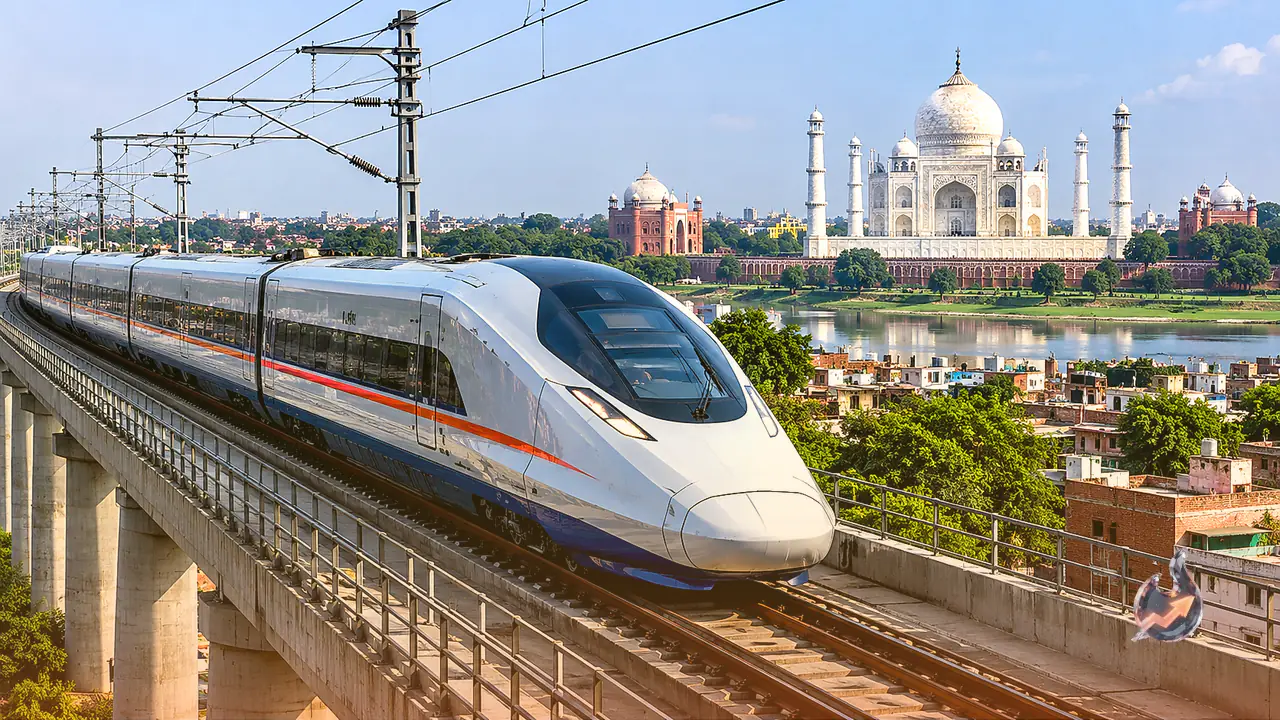

Another bullet train project has been planned, though public attention on this major announcement remained relatively muted due to the prolonged wait for high-speed trains in the country. When people heard the news, many simply assumed it referred to standard semi-high-speed services like the existing Vande Bharat trains. However, this is not the case. Aside from the ongoing Mumbai-Ahmedabad bullet train project being built in partnership with Japan, the government has now approved a brand-new plan to run a bullet train from Delhi.
The Proposed Northern Bullet Train Corridor
According to the route blueprint, the train will originate in Delhi and travel through Agra, Kanpur, Lucknow, Ayodhya, and onward to Varanasi, forming the first section of the network. From Varanasi, the route will extend further toward Prayagraj, Patna, and Siliguri, eventually terminating in Guwahati. At present, everything exists solely on paper, and actual construction work is still a long way off.
Limitations of Existing Tracks and Vande Bharat
Services like Vande Bharat operate on the existing rail network inherited largely from routes laid down during the British era. While the network has undergone various upgrades over the decades—such as doubling or quadrupling tracks and electrification—the foundational routes remain largely unchanged. Consequently, semi-high-speed trains like Vande Bharat can only reach maximum speeds of slightly over 150 km/h because the legacy tracks cannot handle higher velocities safely.
Complex Infrastructure Requirements for Bullet Trains
A true bullet train operates at more than double that speed, targeting over 300 km/h, which is far too fast for conventional tracks to withstand. At such high velocities, level crossings are entirely impossible, and even stray animals wandering onto the tracks could cause catastrophic accidents. Therefore, a completely separate rail line must be constructed, utilizing elevated viaducts on pillars in many areas and underground tunnels in others. Where tracks run at ground level, heavy fencing must be installed on both sides, much like modern urban metro systems. Building this requires constructing an entire dedicated corridor rather than just laying down new tracks.
Entirely Indigenous Technology and Construction
While Vande Bharat trains cap out at 160 to 180 km/h and lose time due to frequent stops, the proposed bullet train relies on creating a dedicated corridor built using entirely domestic technology. Essential construction materials such as pillars and girders will be manufactured in Indian factories, and Indian engineers will handle the design. In contrast, the Mumbai-Ahmedabad corridor is being constructed using Japanese technology. The total length of this entirely new line will span approximately 1,500 kilometers.
Hurdles Facing the First Bullet Train Project
The country's inaugural bullet train project between Mumbai and Ahmedabad, undertaken with Japanese collaboration, has encountered multiple obstacles. Initial delays stemmed from land acquisition issues, which were further compounded by the COVID-19 pandemic. Additionally, because Japan is providing substantial loans for the project, there was a persistent push from the Japanese side to source all equipment, rolling stock, and carriages directly from Japan. However, India opted to source equipment from other nations as well and is now manufacturing certain train components locally, which required time to harmonize with Japanese specifications. Consequently, operations on initial sections are now anticipated to commence by the end of 2027. Learning from these delays, the government has decided that the new Delhi bullet train initiative will be developed entirely by India without foreign technical partnerships.
Three Planned Sections and Commute Times
The project is structured into three main sections: Delhi to Varanasi, Varanasi to Siliguri, and Siliguri to Guwahati. Once completed, the travel times will shrink dramatically. The journey from Delhi to Agra will take less than an hour, while Lucknow will be accessible in two and a quarter hours. Travel from Delhi to Varanasi will take roughly three and a half hours, and Patna will be reached in four and a half hours. Furthermore, the grueling 30 to 35-hour journey to Guwahati is planned to be reduced to just 8 hours. Ticket pricing has not yet been discussed, as the new line remains in the planning phase.
High-Speed Travel Comparable to Air Travel
Globally, bullet train fares are compared not with conventional trains but with airline pricing. Reaching Varanasi or Patna from Delhi in three and a half to four and a half hours rivals the convenience of flying. Although a flight itself does not take four hours between Delhi and Patna, the additional time spent traveling to out-of-town airports and arriving hours early for security checks often makes air travel more time-consuming overall. Consequently, bullet train tickets are expected to be expensive, reflecting the massive multi-trillion-cost of building a dedicated corridor with elevated specialized tracks free from freight traffic or standard crossings, alongside the high manufacturing cost of specialized rolling stock.