
The implementation of modern highway management technologies across India has delivered substantial financial and operational gains. Across seven major toll plazas where Multi-Lane Free Flow (MLFF) technology has been introduced, vehicles no longer need to stop for even a single second to pay highway user fees. Despite the total absence of physical boom barriers and concrete toll booths, the National Highways Authority of India (NHAI) has registered a sharp increase of nearly 20 percent in its net collections. The transition to non-stop digital tolling demonstrates that eliminating highway friction simultaneously enhances revenue compliance, reduces operational overheads, and expands highway capacity.
Seven Key Plazas Deliver Over 89 Crore Rupees in Incremental Revenue
Official data compiled by NHAI reveals that net toll revenue generated from these seven barrier-free locations rose by 19.84 percent following the rollout of the MLFF framework. Collections across these plazas reached approximately 538.95 crore rupees, compared to 449.72 crore rupees recorded in the corresponding period of the previous year. By transitioning to this high-speed automated model, the authority secured an additional 89.23 crore rupees in net revenue. Vehicles pass under electronic sensors at cruising speeds while the required user charges are processed instantly from linked digital accounts without human contact.
Paranur Plaza in Tamil Nadu Leads Growth Charts
The revenue impact across different geographical corridors shows consistent gains, with Tamil Nadu witnessing the steepest improvement. The Paranur toll plaza recorded a net revenue growth of 26.95 percent, representing the largest jump among all monitored locations. In Rajasthan, the Manoharpura toll station posted an increase of 24.51 percent, closely followed by the Mundka plaza in Delhi at 23.55 percent. The Choryasi toll plaza in Gujarat delivered a 23.06 percent gain in net collections. Significant increases were also observed in northern corridors, with Gharaunda in Haryana expanding by 17.39 percent, Shahjahanpur in Uttar Pradesh rising by 16.57 percent, and Daulatpura in Rajasthan climbing by 15.66 percent.
Underlying Factors Driving Revenue Expansion Without Barriers
The growth of toll revenue in an environment free of physical gates rests on three clear structural factors. The first is the total eradication of highway congestion, which unlocks the full transit capacity of the road network and increases overall transaction volumes. Historically, numerous motorists diverted to alternate local paths or narrow service lanes simply to bypass long queues and delays at traditional plazas. With traffic flowing smoothly on the main carriageway, commercial and private vehicles now consistently choose the primary highway, resulting in a substantially higher vehicle count.
The second major contributor is the steep drop in the recurring cost of toll operations. Traditional plazas require extensive on-site personnel, booth management teams, high continuous power consumption, and frequent maintenance of mechanical boom barriers. Eliminating human intervention at the point of transit has sharply cut collection costs, thereby widening NHAI's net operating margins. The third component is rigorous digital auditing and complete operational transparency, which has plugged revenue leakages and unauthorized passages that occasionally compromised older systems.
Mechanics of Multi-Lane Free Flow Architecture
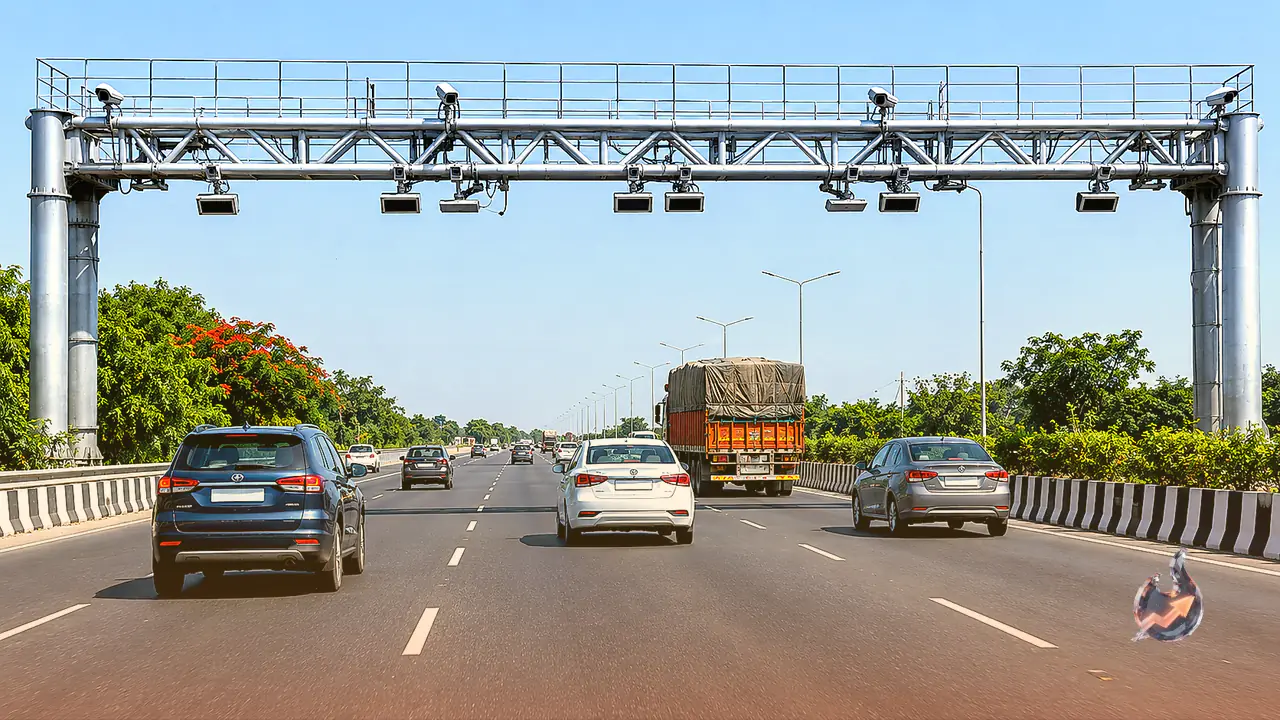
The Multi-Lane Free Flow architecture enables vehicles across all highway lanes to maintain their normal traveling pace without decelerating or lining up behind physical gates. Rather than channeling traffic into partitioned concrete islands, the roadway remains wide and uninterrupted. Overhead gantries spanning the width of the highway house advanced sensors, high-speed optical cameras, and electronic radio readers capable of tracking multiple moving targets simultaneously. When an automobile crosses the detection zone, the equipment immediately logs its category and registration particulars, prompting an automated deduction from the associated user account.
This design specifically targets the elimination of traffic bottlenecks, which remain a primary cause of travel inefficiency on national corridors. When thousands of commuters are forced to brake, idle in queues, and accelerate repeatedly, vast amounts of productive time are lost alongside wasted fuel worth crores of rupees. Unhindered free-flow motoring stabilizes vehicular momentum, trims travel durations, conserves fuel, and significantly lowers tailpipe emissions generated during prolonged stop-and-go idling.
AI-Powered Vehicle Fingerprinting Counters Evasion Tactics
Anticipating that the lack of physical barriers might encourage toll evasion, some motorists attempted to bypass charges by covering, obscuring, or tampering with their registration plates. To counter these deliberate evasions, NHAI deployed Artificial Intelligence tools alongside optical readers. The toll gantries now feature AI-driven vehicle fingerprinting systems that analyze unique physical parameters such as body color, make, model specifications, dimensional proportions, and distinctive body contours to form an indelible digital profile of each passing automobile.
Once generated, this visual profile is cross-verified against the centralized VAHAN database. Even if a vehicle operator conceals the registration plate, the matching algorithm resolves the vehicle's true identity and links it back to the legitimate registered owner. This automated verification eliminates loopholes and ensures that every vehicle utilizing the highway corridor is accurately cataloged.
Enforcement and Digital Recovery Protocols
To preserve financial compliance under a barrier-free operating model, NHAI has structured an enforceable recovery mechanism. In scenarios where toll charges fail to deduct due to zero account balances or where drivers deliberately attempt to skip payment obligations, automated enforcement protocols take over. Electronic penalty notices and formal payment reminders are dispatched directly to the registered mobile numbers and residential addresses of delinquent vehicle owners. This systematic tracking ensures comprehensive revenue recovery without disrupting the high-speed movement of compliant traffic.