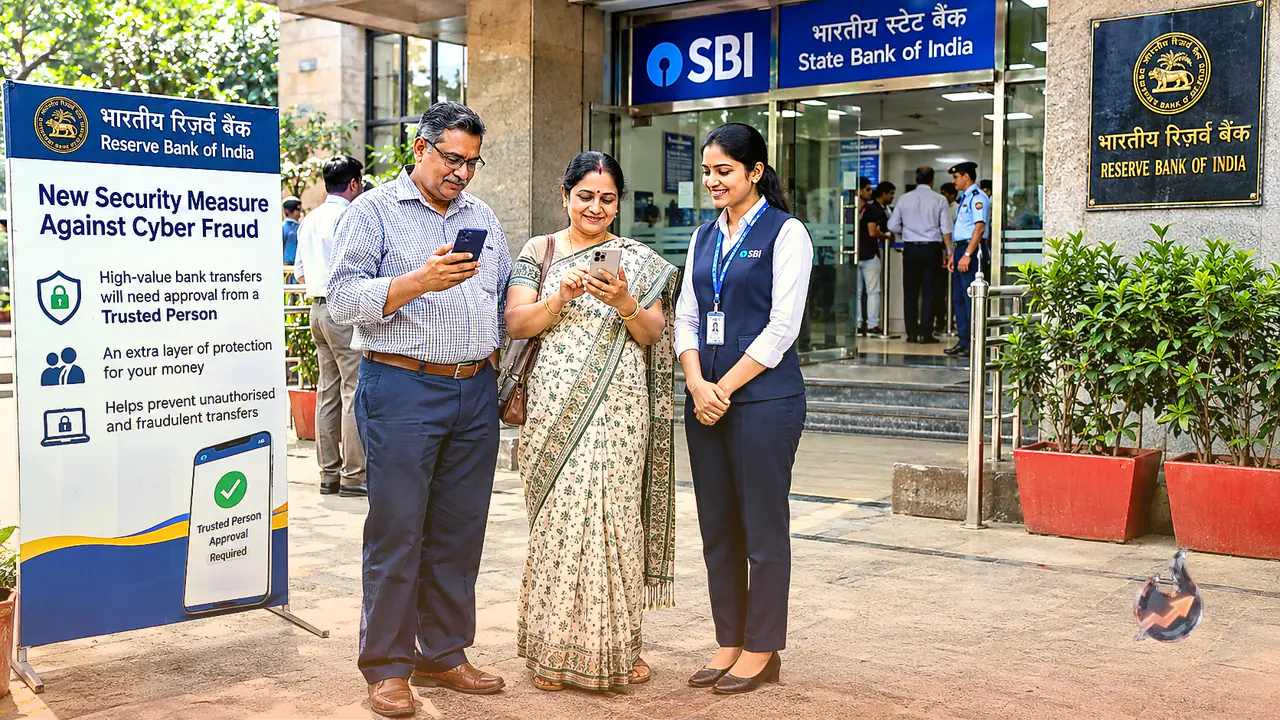

With the exponential growth of online transactions across India, cyber criminals have increasingly deployed sophisticated techniques ranging from phishing and malicious APK files to elaborate digital arrest threats. In response to these rising risks, the Reserve Bank of India has put forward comprehensive proposals designed to place defensive tools directly into the hands of account holders. Central to this proposed framework are two interrelated mechanisms: a user-activated stop switch and an opt-in trusted person mechanism. Together, these tools are structured to interrupt suspicious fund movements before money leaves the banking perimeter.
The Stop Switch Mechanism As An Emergency Kill Button
The proposed stop switch functions as an immediate panic button for any bank account. Whenever an account holder suspects that their mobile handset has been compromised by spyware, that they inadvertently tapped a fraudulent web link, or that unauthorized individuals are attempting to access their banking credentials, they can activate this feature instantly. Engaging the stop switch places a complete and immediate freeze on outgoing transactions from the account.
Once the stop switch is activated, not a single rupee can be debited through newly initiated transactions. Cyber criminals attempting to move funds using compromised passwords or intercepted one-time passwords find the withdrawal channels entirely shut. Furthermore, the banking system will strictly prohibit the registration of the affected bank account on any third-party UPI applications while the stop switch is active. This restriction effectively blocks fraudsters from generating a fresh UPI PIN on another device to siphon off deposits.
Continuity Of Vital Banking Operations During Activation
The central bank has deliberately structured the stop switch architecture to avoid paralysing essential banking functions while an emergency lock is in place. Crucially, incoming fund transfers remain completely unaffected when the switch is turned on. Salaries, pensions, incoming business receipts, government benefits, and general credits will continue to settle into the account without interruption.
Similarly, pre-existing commitments established before the emergency activation will proceed as scheduled. Recurring payments, standing instructions for mutual funds or utility bills, mandatory banking administrative charges, loan equated monthly instalments, and institutional lien markings will execute normally. Once the user verifies that their devices and credentials are fully secured, they can deactivate the stop switch through a defined banking authentication protocol, restoring standard transaction privileges.
Guarding Against Digital Arrest Through The Trusted Person Model
Organized syndicates have increasingly targeted vulnerable individuals, especially senior citizens, using coercive psychological tactics commonly known as digital arrest to force victims into transferring their savings. To dismantle this vulnerability, the Reserve Bank of India has formulated the Trusted Person Mechanism. Under this proposed system, account holders can designate a reliable family member, such as a spouse, parent, sibling, or adult child, as their trusted authority for major transactions.
Enrollment in this mechanism is entirely voluntary. If a user opts in, they establish a personal threshold for electronic fund transfers, such as 50,000 rupees. Whenever an electronic payment exceeding that chosen ceiling is initiated from the account, the banking system will automatically halt immediate execution and dispatch a real-time notification to the registered trusted person.
The One-Hour Decision Window And Mandatory Authorization
The alert received by the designated trusted person contains comprehensive transaction details, explicitly outlining the precise amount of the transfer and the full identity of the beneficiary account. The trusted person is granted a strict one-hour operational window to either approve or reject the request. The financial institution will only release the funds if that individual confirms the transfer within the allotted timeframe.
If the trusted person identifies the transaction as fraudulent, unusual, or suspicious, they can immediately reject it, causing the payment to terminate on the spot. Furthermore, if the trusted person fails to respond within the one-hour window, the banking infrastructure automatically cancels the transaction as a protective safeguard. This mandatory delay provides critical breathing room for senior citizens or victims under severe psychological duress, breaking the coercive cycle created by fraudsters.
Defining Boundaries And Confidentiality For The Trusted Person
The regulatory design establishes strict functional and legal boundaries for the trusted person to safeguard customer autonomy and privacy. Appointing a trusted person does not grant that individual any ownership rights over the underlying assets. The designee does not become a joint account holder, does not acquire nominee status, and is not designated as an authorized signatory.
The trusted person cannot initiate withdrawals, debit the account, or view sensitive financial portfolios such as available account balances, fixed deposit holdings, mutual fund investments, or insurance coverages. Their operational role is strictly confined to granting or withholding consent for transfers that breach the customer's specified threshold. To ensure system integrity, the trusted person must maintain a mobile phone number distinct from the primary phone number linked to the customer's account. Standard daily low-value payments, such as routine retail UPI transactions, remain entirely unaffected by this mechanism unless they surpass the user-defined ceiling.
Granular Custody Over Digital Payment Channels
Many customers register for mobile banking and internet banking services upon opening an account but rarely use them in day-to-day life. Dormant or underutilized payment routes frequently turn into vulnerable entry points for cyber intruders. To mitigate this exposure, banks will be required to offer self-service controls enabling customers to toggle individual digital channels on or off at will.
For instance, an individual who conducts financial activities primarily through retail debit cards or basic UPI can maintain internet banking in a deactivated state permanently. As long as that digital channel is toggled off, no outgoing debits can be authorized through it. If a specific need for internet banking arises, the user can temporarily re-enable the channel using secure verification, complete their transaction, and switch it off immediately afterward.
Multi-Tier Limits And Automated Time Windows
To provide layered financial defense, the proposed framework empowers bank customers to configure transaction limits across four distinct tiers. First, customers can determine a single transaction limit, restricting the maximum amount that can leave the account in a single operation. Second, users can configure a beneficiary daily limit, which places an upper cap on how much money can be transferred to a specific individual or entity within 24 hours. For example, even if an account holder has an aggregate daily transfer capacity of several lakhs, capping a specific recipient at 20,000 rupees prevents any transfer to that party beyond that amount in a single day.
Third, channel-wise daily limits allow customers to assign independent expenditure caps to mobile banking, net banking, or point-of-sale systems. Fourth, a combined daily ceiling governs aggregate digital outflows across all electronic methods combined. Beyond quantitative limits, customers will also be allowed to establish time-based blackouts. A user can schedule their electronic banking rails to remain locked between 11:00 PM and 6:00 AM, effectively neutralizing unauthorized nocturnal transfers while the account holder is asleep.