


















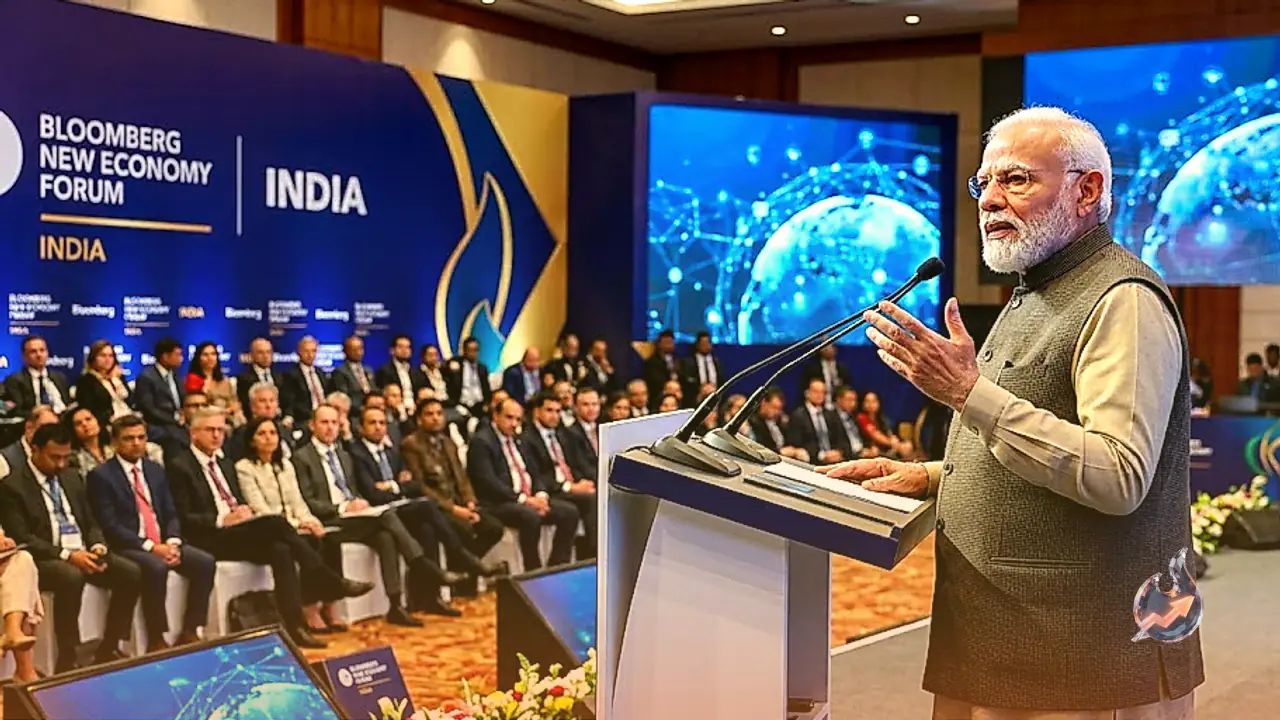

In an era defined by the exponential rise of artificial intelligence, data wealth, and cutting-edge innovation, the broader philosophy governing the use of technological power has taken center stage. Delivering an address at the Bloomberg New Economy Forum, hosted in India for the first time, Prime Minister Narendra Modi highlighted that the paramount concern today is not merely who holds institutional influence, but rather the exact intent with which that authority is exercised. If the dividends of modern breakthroughs remain sequestered within privileged enclaves, the essential promise of technological progress remains unfulfilled. The ultimate ambition of digital tools must be to unlock practical opportunities and elevate the personal capabilities of millions across society.
Prime Minister Narendra Modi emphasized human empowerment as the foundational core of governance. Technology, structured data, human knowledge, and institutional research have coalesced into formidable drivers of modern civilization. Consequently, leadership across sectors bears an obligation to deploy these instruments toward improving the quality of ordinary life and broadening public capacities. He raised the pivotal question of whether technological advancement exists to elevate a narrow group or to dismantle barriers for the wider public. Access to knowledge and economic prosperity, he argued, delivers lasting value only when it actively strengthens collective capacity rather than concentrating advantages in a few hands.
Fostering Self-Reliance and the Eradication of Poverty
Addressing the relationship between the state and its citizens, Prime Minister Narendra Modi observed that while governmental authorities naturally wield administrative power, their mandate should never be to cultivate dependency on the administrative machinery. Sound public policy must strive to make individuals resilient, capable, and self-sufficient, a philosophy that forms the bedrock of India's current trajectory. Driven by this structural approach, the nation succeeded in lifting 250 million individuals out of poverty over the past ten years. This massive socio-economic transition represents a population figure far exceeding the entire national headcount of multiple sovereign countries across the globe.
The Mother of Democracy and an Expansive Public Discourse
Drawing attention to India's pluralism and deep-seated culture of open debate, Prime Minister Narendra Modi described the nation as the mother of democracy. Freedom of thought and uninhibited public dialogue remain deeply embedded in daily life. This rich societal tapestry is reflected in the peaceful coexistence of more than 100 spoken languages. The country's vibrant media landscape encompasses roughly 80,000 registered newspapers and periodicals, alongside more than 1,000 satellite television channels delivering news and perspectives around the clock.
The digitization of civic interaction has further expanded this democratic space, with India now home to more than 500 million YouTube users and upwards of 500 million Instagram users. Citizens engage in spirited exchanges across varied subjects, navigating divergent viewpoints and testing policy ideas. The rapid adoption of digital infrastructure in recent times has acted as an unprecedented catalyst, deepening citizen participation and making democratic dialogue more accessible to all sections of the populace.
Expanding Artificial Intelligence Beyond Human Borders to Animal Welfare
Examining the humanitarian potential of emerging technologies, Prime Minister Narendra Modi pointed to the AI Impact Summit staged in India, an initiative that received significant praise from Bloomberg. The discussions at the summit extended well past conventional human applications, delving into practical ways in which artificial intelligence can be utilized to protect wildlife and improve animal welfare. He remarked that as India expands its scientific and technological capabilities, the resulting benefits will not remain confined within national borders, but will serve the broader interests of humanity and global well-being.
Achieving Paris Agreement Energy Commitments Nine Years Early
Reiterating India's track record on ecological stewardship, Prime Minister Narendra Modi recalled the targets established under the landmark Paris climate agreement. In 2015, the country pledged that by the year 2030, non-fossil fuel energy sources would comprise 40 percent of its total installed electric power generation capacity. Through accelerated project commissioning and focused policy execution, India achieved this clean energy benchmark in November 2021, nine full years ahead of the 2030 target date. With this milestone, India secured the distinction of becoming the first G20 member nation to accomplish that clean energy goal.
Ancient Heritage and the Contemporary Vision of Inclusive Progress
Reflecting on the ethics of leadership, Prime Minister Narendra Modi remarked that the ultimate legacy of any individual or entity possessing knowledge, financial resources, or institutional strength rests upon how responsibly those assets are applied. The genuine virtue of strength lies exclusively in its moral deployment. He underscored that India's multi-millennial civilizational values have consistently taught that power finds its highest expression in shielding the vulnerable and lifting others. Contemporary governance in the country continues to draw inspiration from this ethos, striving to turn technological breakthroughs into instruments of widespread human upliftment as global forums gather on Indian soil to discuss the future of the world economy.