


















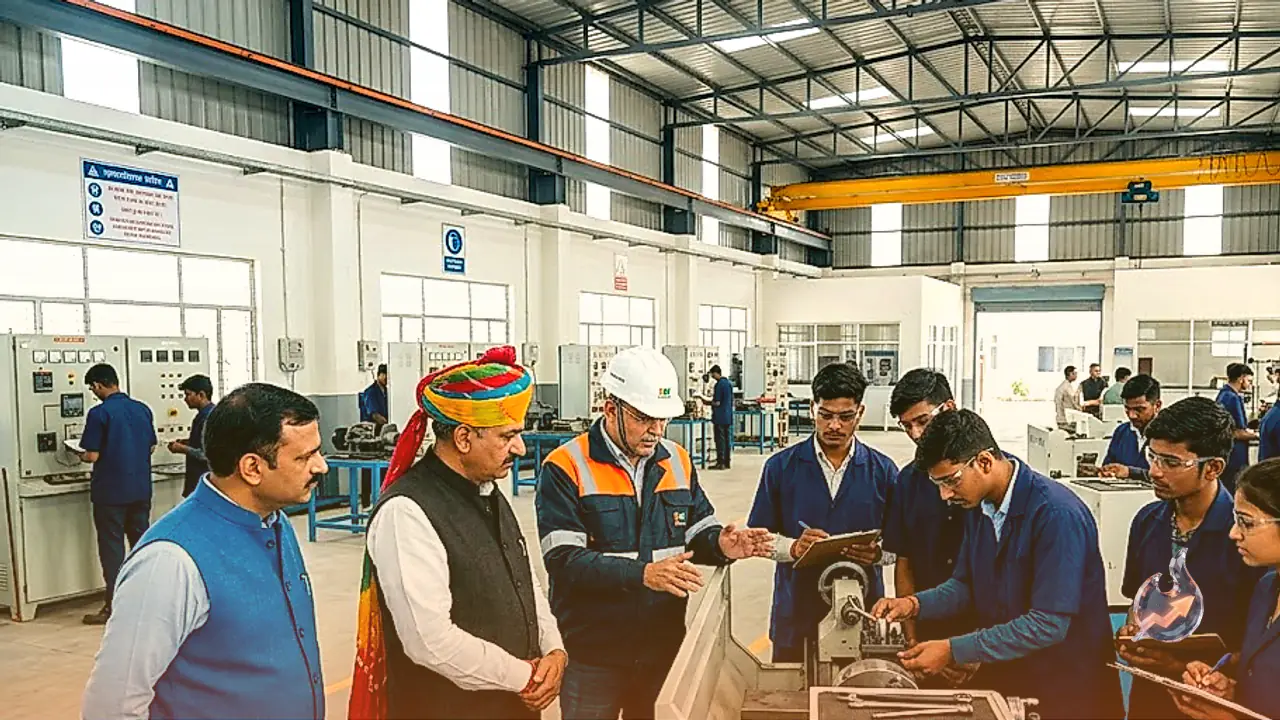

A major initiative has been set in motion to modernize industrial and vocational education in Rajasthan, aligning young job seekers directly with the operational needs of modern factories. Under the Pradhan Mantri Skilling and Employability Transformation through Upgraded ITIs initiative, widely known as the PM-SETU scheme, a strategic investment plan worth Rs 241 crore has received formal sanction for the Bhiwadi cluster. This development program aims to overhaul government industrial training institutes by replacing outdated facilities with smart classrooms, advanced testing laboratories, and high-quality digital learning tools. The proposal secured clearance from the National Steering Committee following sustained initiatives spearheaded by Chief Minister Bhajan Lal Sharma.
Following this central approval, a formal tripartite shareholder agreement was executed among the Union government, the state government of Rajasthan, and the designated anchor industry partner. With this step, Rajasthan has become the first state in the country to execute such a shareholder pact under this national scheme. The central objective extends beyond structural repairs and civil work on campus buildings; it is targeted at recalibrating the technical education ecosystem to feed thriving local industries. Given the concentrated industrial activity around Bhiwadi and the National Capital Region in sectors such as automotive manufacturing, electronics assembly, industrial engineering, and construction, this revamped infrastructure aims to supply a steady stream of job-ready technicians directly to production lines.
Bhiwadi Central Hub To Connect Four Surrounding Spoke Centers
The operational framework of the PM-SETU initiative relies on a hub-and-spoke setup. Under this arrangement, Government ITI Bhiwadi will serve as the central hub facility, while four neighboring training centers—Government ITI Alwar, Government ITI Neemrana, Government ITI Tijara, and Government ITI Kishangarhbas—will be integrated as spoke institutions. By linking these campuses, the advanced machinery, digital curriculum modules, and specialized testing facilities developed at the primary Bhiwadi campus will be directly accessible to trainees enrolled across all four spoke locations. This resource-pooling approach ensures that students in smaller nearby towns receive the same standard of technical instruction without duplicating capital costs across every site.
HG Infra Engineering Limited has been designated as the anchor industrial partner for the Bhiwadi cluster, bringing private-sector operational expertise with an emphasis on heavy infrastructure and construction engineering. In addition, recognizing the manufacturing dynamics of the surrounding NCR belt, institutions across the cluster will introduce modern curricula covering advanced manufacturing, industrial automation, and specialized engineering trades. The training philosophy prioritizes practical shop-floor immersion and real-world work experience over purely theoretical classroom lectures.
Co-Investment Structure Between Governments And Industry
The financial deployment across the cluster utilizes a shared-funding model between public authorities and private enterprise. For each designated cluster, the Union government is slated to contribute approximately 50 percent of the overall capital requirements, while the state government provides roughly 33 percent. The remaining outlay of approximately 17 percent will be injected directly by the participating industrial partner. Operational oversight of each cluster will be anchored in a dedicated Special Purpose Vehicle formed specifically to manage ongoing training standards and facility upkeep.
In this Special Purpose Vehicle, the anchor corporate partner will hold a controlling equity stake of 51 percent, giving industry practitioners the operational agility needed to maintain commercial standards. Meanwhile, the central government and the Rajasthan state government will each hold identical 24.5 percent equity portions. This governance formula ensures that public educational institutions remain permanently synchronized with evolving market practices, reducing the disconnect between academic certifications and the functional skills demanded by contemporary employers.
Statewide Blueprint Spanning 12 Regional Clusters
The overhaul of technical training institutes is designed to scale across the entirety of Rajasthan through a total of 12 proposed hub-and-spoke clusters. Following the green light granted to the initial Bhiwadi project, authorities have initiated the bidding process to select anchor industry partners for the remaining 11 clusters outlined in the state master plan.
The remaining 11 clusters are earmarked across major industrial and urban nodes, encompassing Jaipur, Jodhpur, Kota, Bharatpur, Banswara, Balotra, Bikaner, Bhilwara, Kotputli, Sikar, and Pali. Across these regional centers, government-run vocational institutes will undergo systemic hardware and curricular modernization. The overarching objective is to convert Rajasthan into a hub of skilled industrial manpower, ensuring that expanding manufacturing facilities find certified, specialized talent within the state while boosting employment opportunities for youth.