



















A few years ago, imagining technical and medical education without the mandatory requirement of English seemed nearly impossible. While school education could easily be completed in one's mother tongue, the moment students stepped into professional courses like MBBS or BTech, difficult technical terminology in English created massive hurdles. Many brilliant students hailing from small towns and rural areas felt completely alienated in an English-dominated academic environment and consequently fell behind in their careers.
This linguistic barrier in technical education remained a persistent challenge, holding back numerous gifted minds from fulfilling their true potential. However, the times are steadily changing, and several premier institutions across the country have begun offering MBBS and BTech degree programs in Hindi and other regional languages. The medium of acquiring knowledge should never serve as a yardstick to measure a student's inherent capability. Initiated in Madhya Pradesh, this transformative movement has successfully expanded its roots into Uttar Pradesh, Chhattisgarh, Rajasthan, and Bihar. On the occasion of Hindi दिवस, it is vital to examine how this progressive step is empowering young aspirants.
Why Teaching Engineering and Medicine in Hindi Matters
The core objective behind introducing this linguistic shift in technical education goes far beyond a simple translation of words. It aims to inspire every single child in the remotest corners of the nation to dream big and muster the courage to achieve those goals in their native language. Going forward, a student's lack of fluency in English will no longer act as an obstacle to their professional success.
Mastering Concepts Easily Through Mother Tongue Instruction
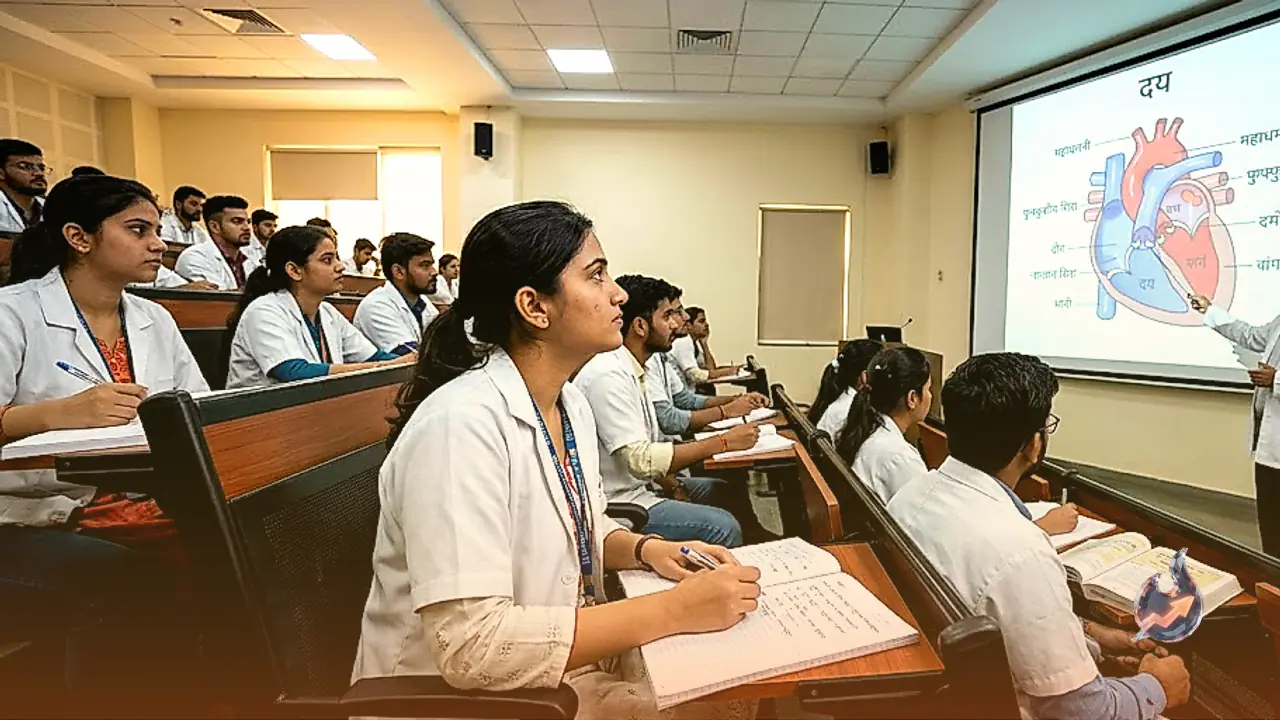
Previously, pursuing medical and engineering education meant endlessly memorizing thick volumes of English textbooks. Students frequently found themselves bogged down by complex technical jargon, which often overshadowed their actual comprehension of the core subject matter. Now that education is becoming accessible in Hindi, grasping difficult concepts and thinking about them practically has become remarkably streamlined. When a student reads human anatomy or foundational engineering principles in their native tongue, their overall academic confidence receives a tremendous boost.
Key Contributions from AICTE and National Book Trust
Turning this vision into a ground reality required immense collaborative effort, spearheaded heavily by AICTE and the National Book Trust. These bodies worked together to translate and publish standard first- and second-year textbooks for medical and engineering streams in Hindi. Several engineering institutions and NITs located in Uttar Pradesh, Madhya Pradesh, and Rajasthan now grant students the flexibility to choose between Hindi and English mediums depending on their personal comfort. This development has successfully curbed the dropout rate in higher education while opening fresh avenues of professional triumph for students from the Hindi belt.
Balancing Regional Learning with Global Market Demands
Opting for education in one's mother tongue by no means implies that English has lost its relevance entirely. For advanced research, global connectivity, and competitive professional environments, a working knowledge of English remains extremely important. Keeping this in mind, the majority of technical schools have positioned the Hindi medium option as an accessible bridge. Learners can comfortably absorb difficult technical concepts in their regional language while simultaneously keeping pace with professional English terminology needed for the broader corporate world.


