






















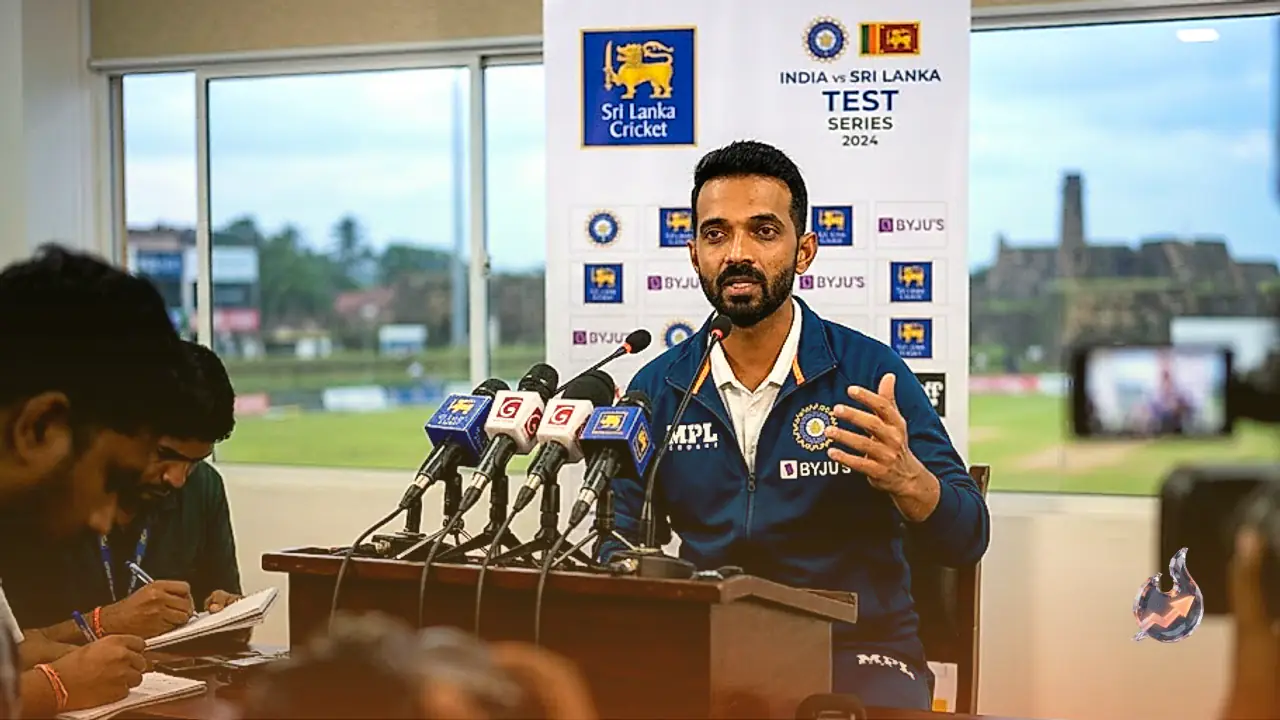

Ahead of Team India's two-match Test series in Sri Lanka beginning August 15 in Galle, former captain Ajinkya Rahane has shared key advice for the visiting batters. Drawing from his extensive international experience, Rahane stressed that staying proactive and adopting an attacking approach against Sri Lankan spinners will be critical to achieving success. Rahane, who recently announced his retirement, reflected on his past performances in an interview facilitated by ETPL, highlighting that passive or overly defensive play on Sri Lankan pitches often works to the bowler's advantage.
Navigating Sri Lankan Pitches and Quality Spinners
Recalling the playing conditions in the island nation, Ajinkya Rahane noted that pitch surfaces on the opening day of a Test match in Sri Lanka are generally very conductive to good batting. However, as the match progresses, the tracks tend to assist spin significantly. He emphasized that batters must endeavor to stay on top of the opposition bowlers right from the start rather than allowing them to dictate terms. Sri Lanka possesses high-quality spin bowlers in their ranks who thrive in familiar home conditions. Beating any home team on their own turf is invariably a tough task, which is why Rahane urged Indian players not to take the opposition lightly and to execute clear, individual game plans proactively throughout the Test series.
Memories from the 2017 Series Triumph
Ajinkya Rahane played a pivotal role during India's 3-0 Test series sweep in Sri Lanka back in 2017. During that tour, his masterful batting against both pace and spin saw him aggregate over 200 runs, featuring one century and one half-century. Reflecting on that successful campaign, he underscored how placing continuous pressure on the home bowlers disrupts their rhythm and creates scoring opportunities even on challenging surfaces.
The Growing Influence of T20 on Test Cricket
Discussing the broader evolution of the sport, Rahane pointed out how the rapid rise and popularity of T20 cricket have reshaped the dynamics of Test match batting. In the contemporary era, numerous cricketers transition seamlessly between T20 and Test formats, bringing an inventive mindset to the longer version of the game. Innovative shots such as scoops, laps, switch hits, and reverse sweeps are now executed with high frequency in red-ball cricket. Rahane viewed this stylistic transformation as a highly positive development that reflects the dynamic progression of modern cricket over recent years.
Evolving Bowling Tactics and Rapid Format Switching
Beyond batting, Rahane also highlighted how fast bowlers have upgraded their tactical repertoire in Test cricket. Modern seamers regularly employ seam-up techniques, wobble seam deliveries, and even attempt pinpoint yorkers in Test matches—a sight rarely seen on a consistent basis in earlier eras except from a select few speedsters. With high demands across all formats, players are required to continually enhance their technical skills. Furthermore, adaptibility has become paramount, as players often switch from Test cricket to T20 or ODI matches within a short span of a week, making quick mental adjustment the key to sustained success.