























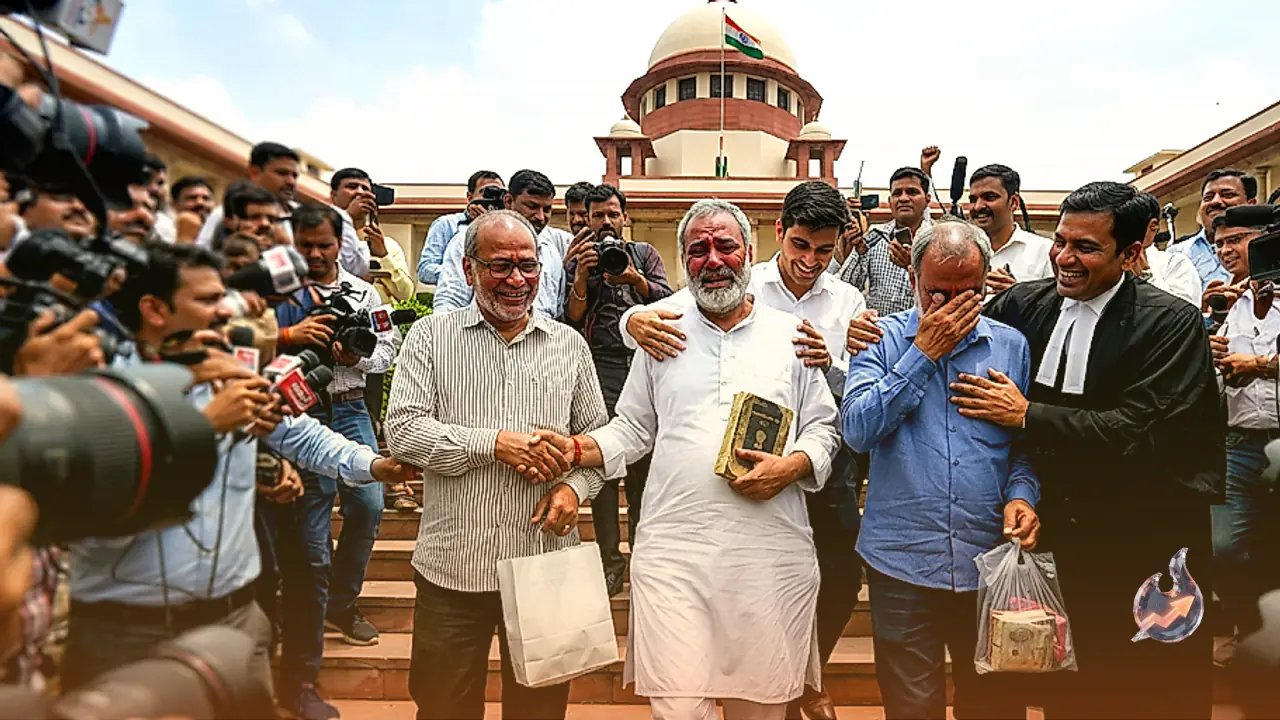

In a significant verdict, the apex court has ordered the acquittal of three individuals who had been serving life imprisonment in a two-decade-old criminal case. Setting aside the previous order of the Calcutta High Court, the Supreme Court ruled that the prosecution completely failed to substantiate the charges and that no concrete evidence was brought on record. A bench comprising Justice Rajasekhar Mantha and Justice Anuj Singh raised sharp questions regarding the police investigation and the findings of the lower courts. The court pointed out that when medical reports clearly indicated a different age for the victim, such crucial scientific indicators should not have been overlooked. The case dates back to 2006, and the accused had spent long years behind bars.
Serious flaws in investigation and lack of medical proof
During the proceedings, the bench emphasized that under Section 376 of the Indian Penal Code, establishing serious allegations requires solid and reliable medical evidence. The court clarified that mere registration of charges cannot lead to a conviction unless the prosecution proves the offense beyond a shadow of doubt. The bench noted that the investigation conducted in the matter was extremely superficial. The police neither seized the clothes worn by the victim at the time of the alleged incident nor sent them for forensic examination, which constitutes a fundamental part of standard investigative procedures.
Contradiction regarding age determination and bone tests
The court expressed deep astonishment at how the trial court arrived at the conclusion that the victim was thirteen years old. Citing the case records, the bench highlighted that the bone marrow test report had estimated the victim's age to be between fifteen and seventeen years. Despite this scientific finding, the lower court arbitrarily fixed a different age. The judges observed that an individual of that age group would naturally have offered some resistance during an assault, which would have resulted in visible physical injuries.
Review of physical evidence and witness testimonies
The Supreme Court closely scrutinized the statements of witnesses, pointing out that the victim, her mother, and the examining doctor all clearly stated that there were no injury marks on the victim's body. The court noted that arriving at a finding of sexual assault without any corroborating physical trauma or medical backing is legally unsustainable. Furthermore, the bench clarified that the mere failure of the defense counsel to cross-examine prosecution witnesses cannot automatically translate into the guilt of the accused, as the primary burden of proof always rests squarely on the prosecution.
Overturning of previous judicial orders
Concluding its detailed judgment, the Supreme Court stated that the evidence on record was nowhere near sufficient to sustain the conviction of the petitioners. The orders passed earlier by the lower judiciary and the high court reflected a failure to properly weigh the evidentiary gaps. This ruling, delivered on November 13, paves the way for the freedom of the three men who had endured long incarceration. The judgment serves as a vital reminder of the strict evidentiary standards required in criminal jurisprudence.