























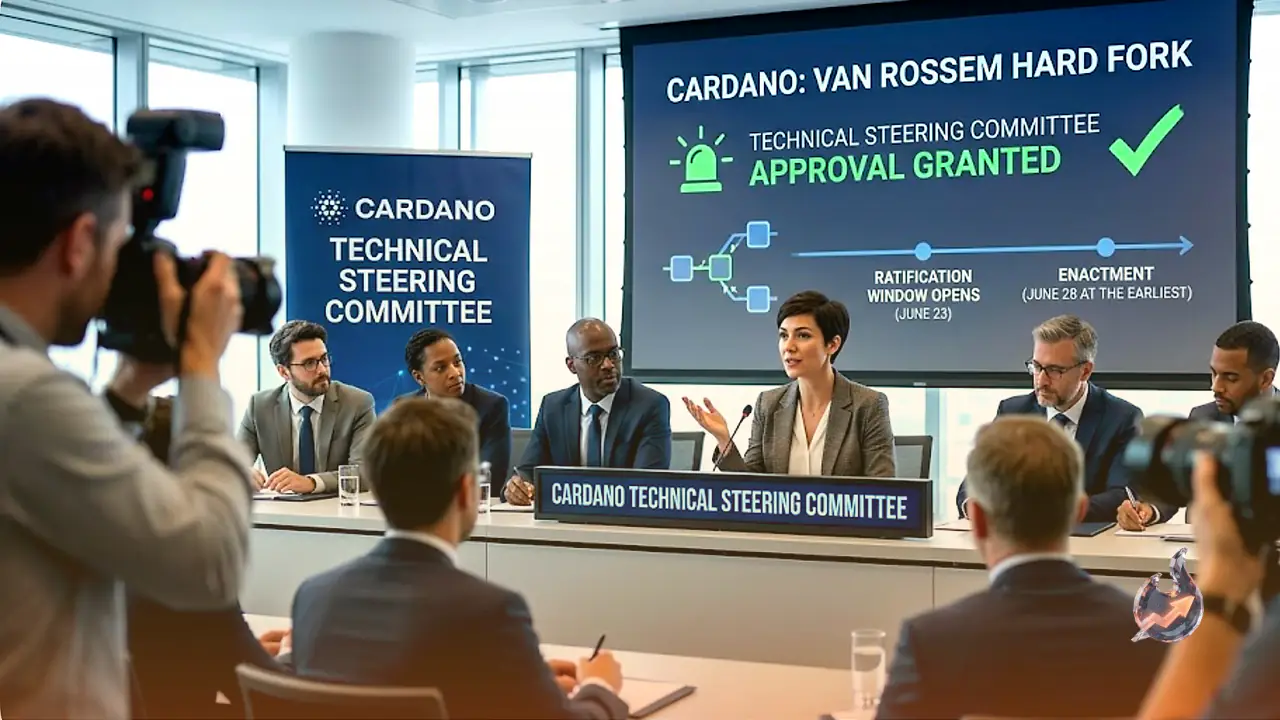

The van Rossem hard fork on the Cardano network has moved decisively closer to launch. The Hard Fork Working Group completed a positive Mainnet go/no-go assessment on June 15. The Technical Steering Committee followed up the next day on June 16, ratifying that assessment and formally confirming that all mandatory readiness criteria had been satisfied. With that declaration, the committee recommended advancing the proposal to an on-chain governance action.
The Timeline: Key Dates From Late June Through July
The governance schedule now places June 23 as the earliest possible ratification date, with June 28 as the earliest the hard fork could be enacted on the network. Current expectations, however, suggest that both milestones are more likely to arrive later in the governance action lifecycle. Ratification could extend as late as July 18, with corresponding enactment dates running through July 23.
Node Readiness Numbers Keep Moving in the Right Direction
On the infrastructure side, adoption of the required software continues to grow. PoolTool data shows that 62% of nodes are now self-reporting as running v11.0.1, an 8% jump compared to the previous week. At the same time, 81% of block production in the current epoch is already occurring on Protocol Version 11, a 5% improvement over recent figures.
Cexplorer's hard fork readiness metrics add further weight to this picture. Roughly 89% of all block production over the past five days was generated by v11 nodes, a 4% increase, signaling that the broader ecosystem is closing in on the adoption threshold needed for a smooth transition.
Hydra 2.2.0 Arrives With Partial Fanout
This week also brought the release of Hydra 2.2.0, and its standout addition is Partial Fanout. Before this update, the number of UTxOs a Hydra head could hold was strictly bounded by whatever could fit inside a single fanout transaction. Partial Fanout removes that ceiling entirely, creating meaningful new headroom for scalability within Cardano's Layer 2 infrastructure.