
















TrendKia
AllLiveNational
World
All World
PakistanChinaAmericaEuropeAsiaMiddle EastLatin America
Politics
Uttar Pradesh
Uttar Pradesh
Uttar PradeshBiharMadhya PradeshRajasthanDelhiMaharashtraGujaratPunjabHaryanaWest BengalTamil NaduKeralaKarnatakaTelanganaAndhra PradeshJharkhandChhattisgarhOdishaAssamUttarakhandHimachal PradeshJammu & KashmirGoaChandigarhPuducherry
Travel
Travel
Business
MarketMoneyAutoBenefitsSuccess StoriesCryptoAI
Sports
CricketTennisFootball
EntertainmentMovies, TV & celebrities
BollywoodOTTBhojpuriMovie ReviewsTVHollywood
TechnologyGadgets, apps & innovation
AccessoriesLaunch & ReviewDIY
HealthHealth, fitness & wellness
LifestyleFashion, relationships & lifestyle
Fashion & BeautyCultureRelationshipsTrendsParenting
FoodRecipes, food & restaurants
ReligionFaith, belief & spirituality
FestivalsVastuSpirituality
Astrology
AriesTaurusGeminiCancerLeoVirgoLibraScorpioSagittariusCapricornAquariusPisces
TravelDestinations & travel guides
Travel Tips
EducationJobs, exams & results
VacanciesAdmissionExamResultsCareer
Live
National
World
Pakistan China America Europe Asia Middle East Latin America
Politics
Business
Market Money Auto Benefits Success Stories Crypto AI
Sports
Cricket Tennis Football
Entertainment
Bollywood OTT Bhojpuri Movie Reviews TV Hollywood
Technology
Accessories Launch & Review DIY
Health
Lifestyle
Fashion & Beauty Culture Relationships Trends Parenting
Food
Religion
Festivals Vastu Spirituality
Astrology
Aries Taurus Gemini Cancer Leo Virgo Libra Scorpio Sagittarius Capricorn Aquarius Pisces
Travel
Travel Tips
Education
Vacancies Admission Exam Results Career
Uttar Pradesh Bihar Madhya Pradesh Rajasthan Delhi Maharashtra Gujarat Punjab Haryana West Bengal Tamil Nadu Kerala Karnataka Telangana Andhra Pradesh Jharkhand Chhattisgarh Odisha Assam Uttarakhand Himachal Pradesh Jammu & Kashmir Goa Chandigarh Puducherry
About Contact Privacy Cookies Terms Advertise
TrendKia logo Hindi • English News Platform

TrendKia

Fast • Fresh • Always Trending

TrendKia is a free bilingual Hindi–English news platform — trending stories from India and around the world. Sign in with Google to comment and follow topics.

About Us
TrendKia news app preview
TrendKia
AboutContactPrivacyCookiesTermsAdvertise
A Los Angeles Gallery Wants Your Heartbeat To Help Paint Its AI RainforestCulture
1 hour ago· 3

A Los Angeles Gallery Wants Your Heartbeat To Help Paint Its AI Rainforest

Dataland, a new museum in downtown Los Angeles built by artist Refik Anadol, drew more than 10,000 visitors in two weeks with an installation that turns visitors' heartbeats and movements into an ever-changing AI-generated rainforest.

Meera JoshiMeera JoshiRelationships & Wellness Correspondent 8 min read For AI
Share

A gallery in downtown Los Angeles is trying to prove that art generated by artificial intelligence can be more than a five-second clip stitched together from a text prompt. Dataland, billed as the world's first "museum of AI arts," opened its doors on June 20 and drew more than 10,000 visitors within its first two weeks, according to cofounder Refik Anadol, the artist behind the gallery's technological installations exploring the bond between humans and machines. Anadol built the space with his studio partner Efsun Erkılıç, and its flagship exhibit is designed to answer, once and for all, whether a machine can feel the people standing in front of it. Dataland positions itself as an answer to a broader argument raging across the creative world about whether artificial intelligence belongs in art at all, and Anadol wants his gallery to be proof that a serious answer is possible.

An immersive rainforest built from five petabytes of raw data

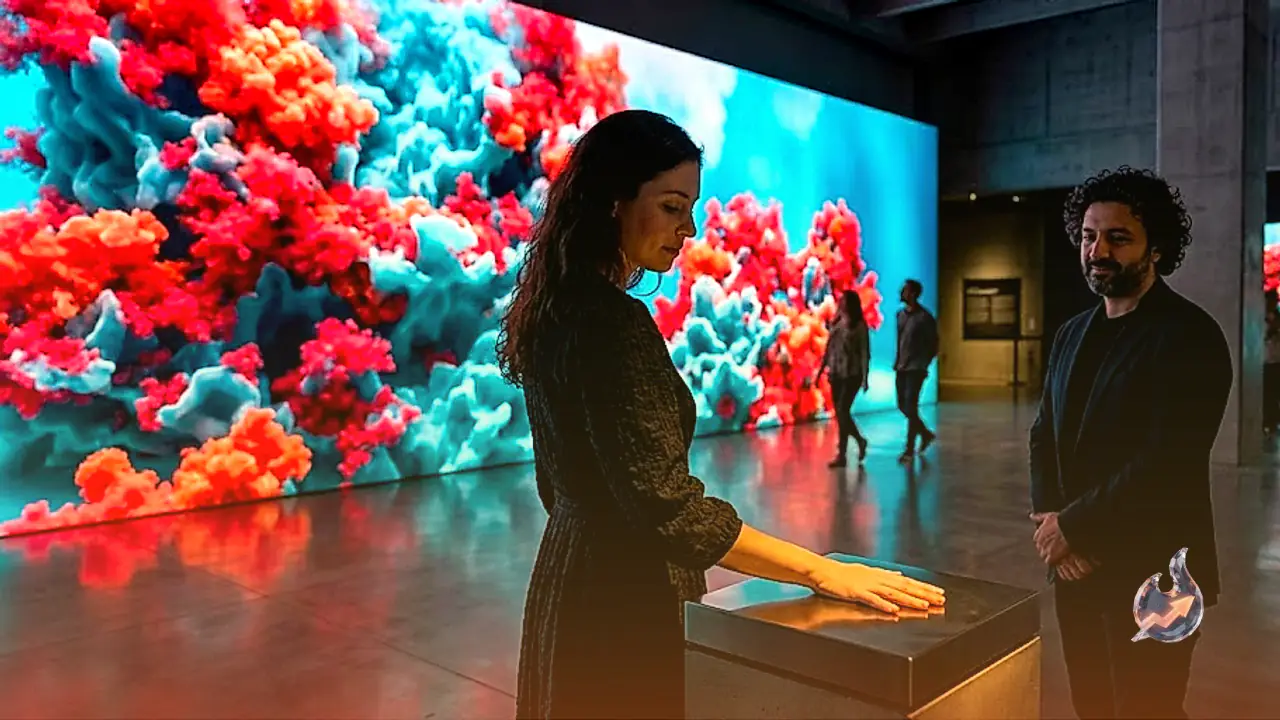
The centerpiece of Dataland's opening show is Machine Dreams: Rainforest, an immersive architectural installation that Anadol calls his most ambitious work to date. Interactive digital displays across the space respond directly to visitors' movements and to biometric data collected through wearable devices, generating constantly shifting images and soundscapes. All of it is drawn from Anadol's Large Nature Model, an AI system trained on natural science archives supplied by respected research institutions, including the Smithsonian.

Building that model took three years of work from scratch, with Anadol and his team traveling to the Amazon and other rainforests to gather raw material that would later feed the system's hallucinated versions of those landscapes. "For three years, we started from scratch and trained our own AI models, and we worked with our own data sets," Anadol says. The result, he says, is "5 petabytes worth of raw data that we collected by ourselves." He is especially proud that this trove was gathered with the consent and participation of researchers, a deliberate contrast to the backlash and lawsuits major Silicon Valley AI firms have faced over what many creators call unlicensed, extractive use of their work as training data.

Anadol adds that Google DeepMind gave Dataland access to "experimental low-energy" resources, letting the gallery run on Google Cloud while maintaining what he calls "sustainable compute." That relationship traces back to 2016, when Anadol became the first person awarded the Google Artists and Machine Intelligence Artist Residency. The point matters because the enormous computing power behind modern AI systems has drawn its own criticism over energy use, and Anadol is keen to show that an ambitious, always-on installation like this one doesn't have to come at that cost.

Answering the skeptics who call AI art "slop"

Anadol knows exactly what he is up against. The phrase "AI art" is a nonstarter for many creatives and critics who see it as shorthand for the generative "slop" that has spread across visual media. He doesn't dismiss that reaction. "I mean, 100 percent, the majority is right," he says, adding that when people hear the term "AI art," "their first assumption is like, prompt engineering, or a bunch of eight-second clips." His answer isn't to argue with that perception but to build something that sits entirely outside it. "The reason for Dataland is to understand and explain and explore, and tell the world that there is not only one option," he says.

A waiver, a smartwatch and the smell of trees

Machine Dreams: Rainforest makes its case for AI as a tool for entirely new kinds of artistic engagement, and Anadol says it's the first of his projects where "it is impossible to record what it feels like." That claim holds up. Entry involves a somewhat fiddly process: signing a waiver, using a specialized app, then receiving a smartwatch and a U-shaped plastic collar worn across the shoulders. As the devices calibrate, the shoulder harness releases the exhibit's first striking scent, the unmistakable smell of trees, filling a hypermodern downtown building with the impression of a forest that shouldn't exist inside it.

The largest gallery in the exhibit is otherwise empty aside from a couple of pillars, with ultravivid fusions of nature scenes and computer-chip textures moving across the walls and floor in a 40-minute cycle of shifting effects. Those effects respond, in part, to the movement of everyone standing in the room. Walking in during a sequence simulating heavy rain and thunder reveals a watery circle trailing each visitor's feet, which stretches into an aqueous streak when they walk faster. Waving a hand in front of the falling droplets bends their paths, and the biosensor releases the clean scent of a summer storm to match.

Choosing to be tracked, or choosing to be a ghost

Visitors can move through the installation as a "ghost," skipping the biosensors entirely, but Anadol says the wearables, modified from medical-grade devices, let people leave a temporary fingerprint on the work. "For almost 5,000 years, we as humanity, we look at artworks and we feel something," he says. "At Dataland, as a laboratory of imagination, our first deep question is: Can artwork feel us back?"

Asked whether the devices tracked a trip to the restroom, Anadol laughs it off. "No, no, no, no, the restroom has zero connection," he says. He adds that the museum "forgets" a visitor's data the moment they leave, although it remains accessible to that visitor through a personal token handed out at the exit. "Data is a form of memory," Anadol says, and Dataland tries to treat it with that kind of respect. "So it's the opposite," he says, "of what we have in the whole world," where invasive surveillance has become routine.

A hummingbird flight and a look behind the algorithm's curtain

Further into the museum sits the Infinity Room, where visitors follow a glittery hummingbird soaring over a fantastical neon forest, an aerial sequence reminiscent of the flight scenes in the Avatar films, disorienting enough at points that the shifting point of view can throw off your balance. Next door, the Latent Gallery pulls back the curtain on the Large Nature Model itself. At one console, visitors can scroll through the model's training data by category. Selecting "Frogs" turns the wall ahead into a massive grid of frog photographs pulled directly from the system's dataset, a deliberate demonstration of how much verifiable material sits underneath the dreamlike images shown elsewhere in the museum.

Anadol says he wanted visitors to glimpse the sheer scale of information behind the installation's surreal, often impossible recombinations of real nature. The Smithsonian's Encyclopedia of Life alone supplied data on more than 2 million species. "These are the places where we demystify our algorithms, demystify our data sets, demystify our training experiments," he says, adding that he wanted to see "what happens if we go next-level and tell the audience and the visitors exactly the reason for that machine dream or hallucination."

Hallucination as the point, not a flaw

That word, hallucination, is deliberate, and it's also what separates Dataland's debut show from the ultra-realistic AI-generated images and deepfakes feeding today's misinformation problem. "It's about the idea of a machine that falls in love with nature, that's the rainforest, and we enter the machine dreams as a concept where we smell the machine's hallucinations, we taste the machine dreams, we hear millions of bird songs that are impossible to hear in a human world," Anadol says. The Large Nature Model may draw on real scientific libraries and real-time weather data, but the environment it constructs from those building blocks remains, in almost every respect, entirely alien.

The Sanctuary: an artwork that exists once and disappears

The exhibit closes with the Sanctuary, a concept Anadol has been developing for several years. As a group of visitors enters the room, the biometric information collected from each person, including heart rate, skin temperature, the path they took through Dataland and the pace of their walk, is combined to generate a swirling, abstract, three-dimensional representation of the room's collective energy. That representation is never seen again once it forms, making every visit to the Sanctuary a one-time event that can't be repeated or recreated.

Anadol says the gallery treats "emotion as an input" throughout the exhibit, and he's been struck by how often the biosensors detect goosebumps on visitors, which he calls an "incredibly relevant" sign that the sensory experience is landing. "The artwork can feel this information," he says. "I saw people with tears, I saw people with joy, I saw people with excitement," he adds. "And I think, if that's not art, what is art?"

"This is all about being human, not about AI"

That kind of visitor reaction is exactly what Anadol needs to win over skeptics who doubt artificial intelligence has anything to offer the creative arts. He doesn't frame the technology as a production shortcut but as a way to rediscover something essentially human. "This is all about being human at the end, not about AI," he says of Dataland and Machine Dreams: Rainforest. "It's just an incredible tool, but the messaging and the context and the meaning is still all about being human."
What this means for you

This matters most for art lovers, technology watchers and anyone curious about what AI can genuinely add to creative work.

  • For art and tech enthusiasts: Anyone wanting to see AI's creative potential now has a real, ticketed destination where biometric data and movement directly shape the artwork in front of them.
  • For those concerned about data and privacy: Anyone wary of how AI firms source training data gets a concrete example of a project built with researcher consent, where a visitor's biometric data is deleted the moment they leave the gallery.

Inspiration & Lessons

Refik Anadol's achievement isn't just about opening a gallery, it's about listening to criticism instead of dismissing it, and using that criticism to build something better.

  • Instead of rejecting critics outright, Anadol acknowledged that most objections to "AI art" are fair, and then used that as the starting point for a more thoughtful project.
  • Spending three years patiently building his own data and model from scratch shows that meaningful results demand time and effort, not shortcuts.
  • Making sure the training data was gathered with researchers' consent and participation shows that ambitious work doesn't have to skip over ethics.
  • Opening up the process itself to visitors, such as letting them browse training data in the Latent Gallery, shows that transparency is one of the strongest ways to earn trust.

Questions & Answers

When did Dataland open and how many visitors has it drawn so far?
Dataland opened on June 20 and drew more than 10,000 visitors within its first two weeks.
Who built Dataland?
Artist Refik Anadol built it together with his studio partner Efsun Erkılıç.
What AI model powers the Machine Dreams: Rainforest installation?
It runs on Anadol's Large Nature Model, trained on natural science archives from institutions including the Smithsonian.
How much data and time went into building that model?
The team spent three years collecting 5 petabytes of raw data themselves, traveling to the Amazon and other rainforests to gather it.
What is Google's connection to Dataland?
Google DeepMind gave the gallery access to experimental low-energy resources so it can run sustainably on Google Cloud, and Anadol became the first recipient of the Google Artists and Machine Intelligence Artist Residency back in 2016.
Is visitors' biometric data kept safe at the gallery?
Anadol says the museum forgets a visitor's data the moment they leave, though it stays accessible to that visitor later through a personal token given out at the exit.
Do visitors have to wear the biosensor devices?
No, visitors can move through the entire exhibit as a "ghost" without wearing the biosensors.
What happens in the Sanctuary room?
When a group of visitors enters, their combined biometric data generates a swirling, abstract, three-dimensional representation of the room's collective energy, which disappears forever once it forms.
Meera Joshi
About the authorMeera JoshiRelationships & Wellness Correspondent Jammu and kashmir
ExpertiseRelationships, Mental Health, Wellness, Lifestyle, Dating, Marriage, Emotional Well-being, Self-Development, Mindfulness, Work-Life Balance

Meera Joshi is a Relationships & Wellness Correspondent covering modern relationships, mental well-being, lifestyle, and personal development. She writes insightful stories on emotional health and human connection.

Meera Joshi is a Relationships & Wellness Correspondent specializing in lifestyle journalism focused on relationships, mental health, emotional well-being, and personal development. She covers topics such as modern dating, marriage, communication, self-growth, mindfulness, and work-life balance. With a compassionate and research-driven approach, Meera explores the psychological and social aspects of human relationships, offering readers practical insights and relatable perspectives. Her reporting aims to help audiences navigate emotional challenges, build healthier relationships, and improve overall well-being in today’s fast-paced world.

View full profile ↗
#Culture#AIArt#Dataland#RefikAnadol#LosAngelesGallery#MachineDreamsRainforest#BiometricTechnology#GoogleDeepMind#ImmersiveArt

Comments 0

Sign in to join the conversation.

Sign in

No comments yet — be the first.

Wall Street's Big Bet on AMZN: Where Could Amazon Stock Land Between 2026 and 2028?Market1
Wall Street's Big Bet on AMZN: Where Could Amazon Stock Land Between 2026 and 2028?
Three Indian Sailors Killed in Gulf of Oman Strike: Shashi Tharoor Tears Into US Over 'Insensitive' Statement, Presses Jaishankar TooPolitics2
Three Indian Sailors Killed in Gulf of Oman Strike: Shashi Tharoor Tears Into US Over 'Insensitive' Statement, Presses Jaishankar Too
FCC's 'Know Your Customer' Plan Could End Anonymous Phones — Plus the Week's Biggest Breaches and BustsSecurity3
FCC's 'Know Your Customer' Plan Could End Anonymous Phones — Plus the Week's Biggest Breaches and Busts

Latest news straight to your inbox

The day's big stories, in one email.

TrendKia बाज़ारAdvertisementमानसून सेल — हर चीज़ पर 50% तक छूटTrendKia बाज़ारअभी खरीदें →
Citizen journalism

Become a TrendKia journalist

Voice of the people

Share news, photos and videos from your area with TrendKia and let your voice reach the nation. Every citizen a journalist.

Join now
CH 01 LIVE
TrendKia TV ON AIR

Related stories

Ten Years After Its Debut Trailer, Pokémon Go Finally Stages Its Times Square Mewtwo ShowdownCulture 2
Ten Years After Its Debut Trailer, Pokémon Go Finally Stages Its Times Square Mewtwo Showdown
20 hours ago
How a Cunning Jackal's Lies Destroyed the Unbreakable Bond Between Lion King Pinglak and Bull SanjivakCulture 2
How a Cunning Jackal's Lies Destroyed the Unbreakable Bond Between Lion King Pinglak and Bull Sanjivak
4 days ago
A 75 year old collector in Jaipur has spent five decades assembling India's rarest currency notesCulture 2
A 75 year old collector in Jaipur has spent five decades assembling India's rarest currency notes
4 days ago
Padma Vibhushan Folk Legend Teejan Bai, Who Rose From Poverty to Fame With Pandwani, Passes Away at 70Culture 3
Padma Vibhushan Folk Legend Teejan Bai, Who Rose From Poverty to Fame With Pandwani, Passes Away at 70
6 days ago
A Journalist Embedded With Nigeria's Online Romance Scammers, And Wrote A Book About ItCulture 4
A Journalist Embedded With Nigeria's Online Romance Scammers, And Wrote A Book About It
6 days ago
Babu Devkinandan built this Varanasi mansion and then walked away from it forever, here's whyCulture 2
Babu Devkinandan built this Varanasi mansion and then walked away from it forever, here's why
7 days ago
A Bikaner Collector Has Kept 147 Years Of India's Postal History Alive In His PostcardsCulture 2
A Bikaner Collector Has Kept 147 Years Of India's Postal History Alive In His Postcards
8 days ago
Generations-old craft: why Uttarakhand's Lohaghat iron kadhai still refuses to breakCulture 2
Generations-old craft: why Uttarakhand's Lohaghat iron kadhai still refuses to break
8 days ago