





















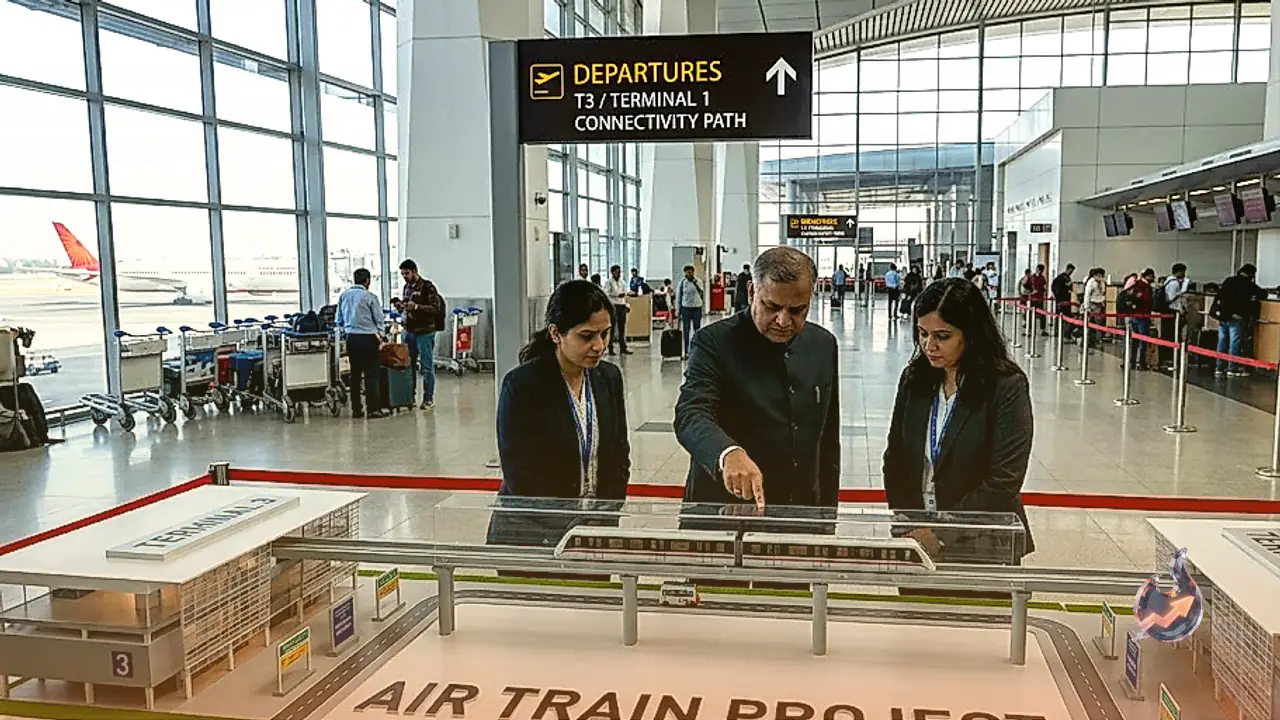

Transit between terminals at Indira Gandhi International Airport is set to become substantially faster and smoother with the planned rollout of an Automated People Mover (APM) system. Serving the country's busiest aviation hub, the dedicated driverless train network carries an estimated project budget of around Rs 3,500 crore. Construction work on this transit link is expected to commence next year. Once ground is broken, the engineering project will require roughly 30 months to complete, putting the expected delivery timeline at 2030.
A 7.3-Kilometre Corridor with Six Strategic Stations
The proposed air train alignment will stretch across a total distance of 7.3 kilometres to establish rapid inter-terminal movement. Out of the full length, an elevated structure will make up 5.3 kilometres, while the remaining 2 kilometres will run along the ground level. The corridor will feature six designated stations along its route, directly connecting Terminal 1 and Terminal 3 with Aerocity, the Airport Metro station, and the airport cargo zone. Once functional, passengers will be able to travel from one end of the alignment to the other in approximately 12 to 13 minutes.
Service reliability has been structured around frequent availability, with trains scheduled to run every 10 minutes. Projections indicate that the facility will handle around 55,000 travelers daily in its debut year of operation. As terminal footfall and transit adoption increase, daily usage is forecasted to hit roughly 85,000 passengers at peak capacity.
Design Finalisation and Multimodal Transit Links
Pradeep Panicker, Chief Executive Officer (CEO) of Delhi International Airport Limited (DIAL), shared key development updates on the APM infrastructure. According to Pradeep Panicker, designing work for the transit system is currently in full swing following the onboarding of an appointed project consultant. The structural and operational design is currently being finalized ahead of the scheduled construction rollout, which is estimated to span roughly 30 months.
The APM network will integrate closely with the existing Airport Metro infrastructure situated in Aerocity. Pradeep Panicker stated that the APM station will sit directly adjacent to the existing metro station, though there is no proposal to build a direct platform-to-platform interchange between the two facilities. Beyond this immediate link, Aerocity is planned to connect with the Golden Line currently under construction as well as the proposed Sarai Kale Khan-Alwar RRTS transit corridor, creating broader transit connectivity across the National Capital Region.
Terminal 3 Upgrades to Match Surging Passenger Traffic
DIAL's master plan extending through 2036 outlines significant infrastructure additions to handle surging aviation demands. Even after accounting for passenger diversions once the Noida International Airport becomes operational, annual passenger volumes at IGI Airport are expected to touch around 12.9 crore. Across all three primary airports serving Delhi-NCR, total passenger handling capacity is projected to reach approximately 16 crore annually by 2036. Passenger demand at IGI alone is anticipated to reach 10.7 crore by 2030, against a planned airport capacity of 12.1 crore travellers by that benchmark year.
To support this expanding volume, Terminal 3 is slated for considerable physical expansions. Plans call for constructing a brand-new Pier-E dedicated to domestic fliers at T3. Inside the terminal, airport authorities will add more check-in counters and widen the baggage reclaim belts located in the arrivals hall. Outside the building, both the departure and arrival forecourts at Terminal 3 will undergo widening work. Vehicle lanes at the departure drop-off area will increase from three to five lanes, while pick-up lanes at the arrival forecourt will expand from four to six lanes.
Pedestrian Tunnel Progress and Cargo Expansion
Pedestrian connectivity near Terminal 2 is also undergoing immediate improvements. Civil work is actively underway on an underground pedestrian walkway tunnel designed to link Terminal 2 directly with the Airport Metro station, with completion anticipated soon. Concurrently, freight infrastructure is receiving focused planning as annual cargo throughput is projected to climb to 17 lakh metric tonnes by 2036. The present cargo handling facility has an operating capacity of approximately 18 lakh tonnes annually, and comprehensive expansion plans are already prepared to absorb long-term logistics growth.