
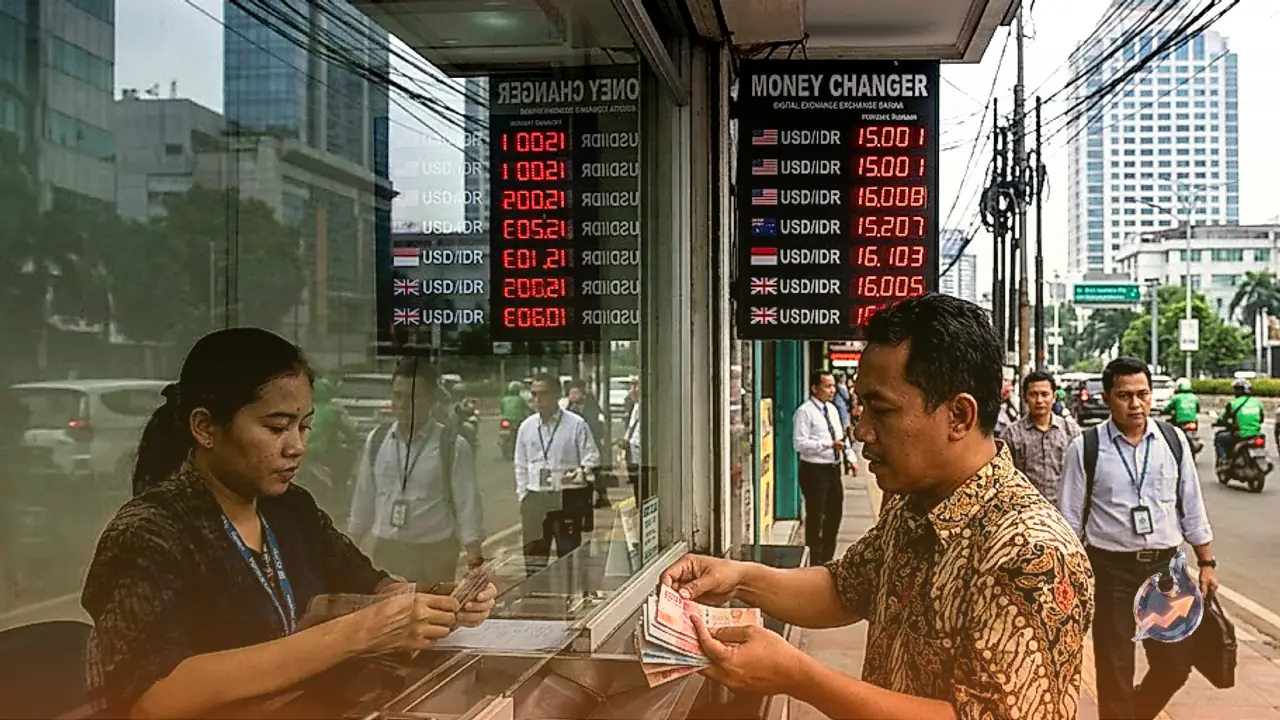






















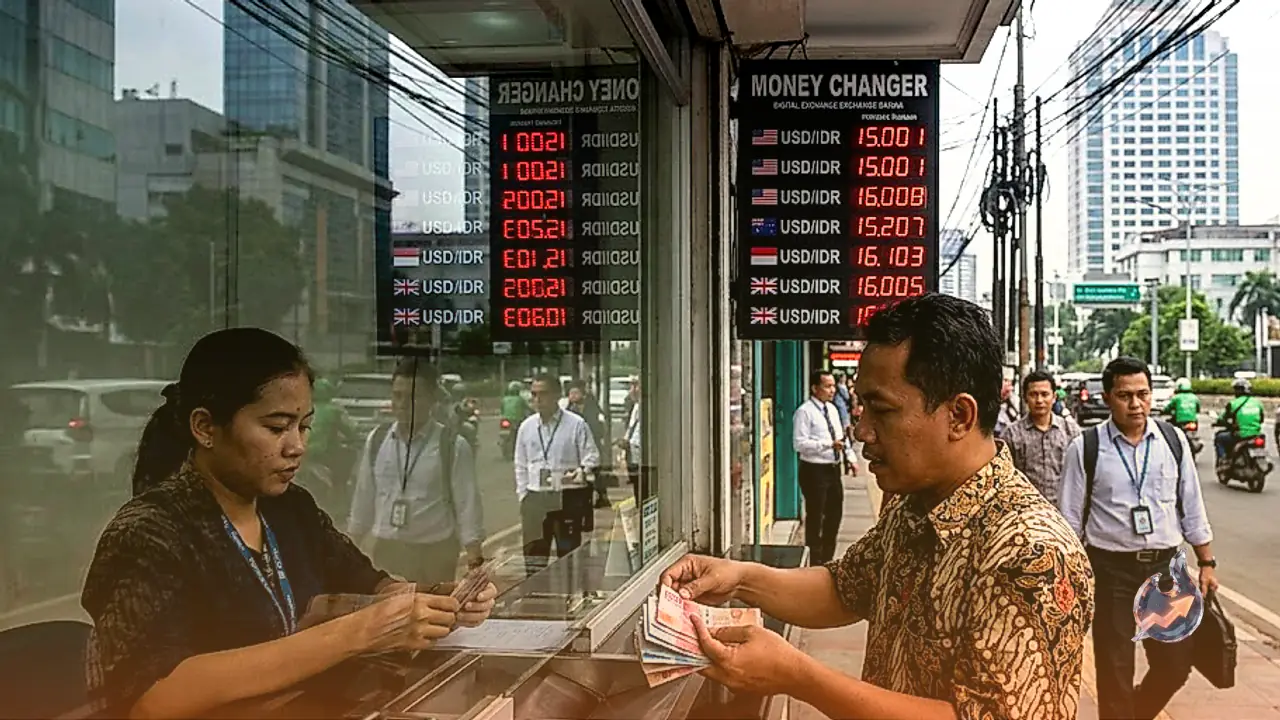

The Indonesian Rupiah remained on the back foot against the US Dollar during European trading hours on Wednesday, weighed down by a modest contraction in Indonesia's foreign exchange reserves. The USD/IDR currency pair recovered from its prior-day losses to trade around the 17,900 mark following the release of reserve assets data. Bank Indonesia reported that foreign reserve assets slipped slightly to USD 146.3 billion in September 2026, pulling back from the five-month peak of USD 146.5 billion registered in August. While the decline represents a relatively small shift, ongoing energy price spikes and broad macroeconomic uncertainty have limited any meaningful recovery for the Southeast Asian currency.
Foreign Reserves Breakdown and Bank Indonesia Adequacy Metrics
Despite the slight drop of $200 million month-over-month, the reserve position at the close of September remains robust when measured against international standards. Bank Indonesia confirmed that the USD 146.3 billion in reserve assets is sufficient to finance 5.3 months of imports. When calculated alongside the servicing of government external debt, the reserves cover 5.2 months of obligations. Both figures comfortably exceed the accepted global adequacy benchmark, which typically requires a cushion of approximately three months of imports.
Bank Indonesia reiterated that the current holdings provide ample room to safeguard the external sector's resilience against capital flow reversals while supporting ongoing macroeconomic and financial stability. Nonetheless, foreign exchange participants treated the minor decline as a sign of persistent intervention costs and external account pressures, especially as commodity and energy import bills face potential expansion.
Crude Oil Spikes, Middle East Risks, and the Greenback Dynamic
Beyond domestic data, external macro drivers continue to propel the USD/IDR pair. A steady advance in crude oil prices, spurred by persistent supply risks across the Middle East, has reignited headline inflation fears across major economies. Higher energy costs naturally revive speculation regarding tighter monetary policies, which tends to support the US Dollar at the expense of emerging market currencies.
At the same time, the Greenback's broader upward momentum faces certain constraints. Recent cooling in the United States labor market has tempered expectations that the Federal Reserve will embark on extended policy tightening. Data from the CME FedWatch tool shows that interest-rate swap pricing currently reflects approximately a 20% probability of an additional interest rate increase at the Federal Reserve's upcoming October meeting. This tug-of-war between oil-driven inflation concerns and a softening employment backdrop has kept currency pairs locked in sensitive technical trading zones.
USD/IDR Technical Setup and Key Trading Hurdles
From a daily chart perspective, USD/IDR changing hands at 17,900 places the spot price right above its 50-day Exponential Moving Average (EMA). However, short-term upside remains capped by the descending nine-day EMA. This alignment suggests that the market is attempting to establish a durable medium-term support base, though it still lacks the momentum required for a clean upside breakout. The 14-day Relative Strength Index (RSI) stands at 52.81, lingering slightly above the neutral 50 threshold to reflect modest but unhurried buying interest. Additionally, the FXS Fed Sentiment Index registered at 137.91, signaling a calmer policy narrative relative to recent highs and restraining runaway directional bets.
Looking at chart levels, immediate technical resistance is positioned at the nine-day EMA near 17,912.81, where a daily close above could unlock further upward momentum toward fresh multi-week highs. On the downside, initial support appears around the recent close of 17,903.20. Stronger structural demand is anchored at the 50-day EMA at 17,851.51. A sustained breach below this moving average would invalidate the developing bullish bias and potentially trigger a deeper short-term retracement toward lower chart shelves.
Live Market Data and Indicator Confirmation
According to live market pricing captured during the close-bell session, USD/IDR is trading at 17,875, reflecting a mild daily change of -0.07% from its previous close of 17,888. Over the past 52 weeks, the exchange rate has moved within an expansive span between 15,636 and 18,222, with trading volume pacing exactly at 1.00x its 20-day average. Momentum indicators provide a clear picture of underlying conditions: the 14-day RSI is positioned at 54, while the MACD reads 41.31 against a signal line of 24.80, producing an expanding bullish histogram reading of 16.52.
Trend-following moving averages reinforce the long-term upward trajectory. The 20-day EMA sits at 17,814, the 50-day EMA at 17,794, and the 200-day EMA at 17,399, mirrored by the 50-day SMA at 17,788 and 200-day SMA at 17,419. With the 50-day EMA running comfortably above the 200-day EMA, a confirmed golden cross remains in play. Bollinger Bands (20,2) span from 17,502 to 18,048 with a midpoint of 17,775, keeping current spot prices well within standard deviation boundaries. Trend strength remains modest, as evidenced by a 14-day ADX reading of 24, indicating range-bound tendencies. The Stochastic oscillator shows a fast line at 55 and a signal line at 60. Daily volatility measured by the 14-day ATR is 160.40, offering a logical parameter for risk buffers. For intraday traders, the central pivot is calculated at 17,884, with overhead resistances at R1 17,896 and R2 17,917, and downside supports located at S1 17,863 and S2 17,851. On a rolling 20-day basis, key support rests near 17,493 against overhead resistance near 18,053.
Hawkish Remarks from Federal Reserve Leadership
Policy commentary from Federal Reserve officials has provided an additional layer of dollar resilience. Fed official Schmid struck a decidedly hawkish tone, generating an 8/10 FXS Speechtracker score that exceeds the long-term benchmark average of 7.5/10. This assessment highlights an uncompromising commitment to bringing down consumer price growth.
Schmid characterized current inflation levels as frustrating and warned that institutional credibility remains on the line. Notably, Schmid pointed to AI as emerging into one of the largest structural drivers of inflation, warning that price pressures could endure even as the domestic workforce sits in a relatively healthy position. The explicit assertion that monetary policymakers still have unfinished business on short-term policy rates, despite higher yields across long-dated government debt, reaffirms a prolonged restrictive posture that broadly underpins the US Dollar.
Understanding Market Mechanics: Risk-On versus Risk-Off Regimes
In global financial markets, the concepts of risk-on and risk-off define how much uncertainty and potential loss institutional investors are prepared to tolerate during a given cycle. A risk-on environment reflects widespread optimism about economic growth, prompting market participants to rotate capital into growth-sensitive and higher-volatility assets. Conversely, a risk-off phase causes capital allocators to prioritize wealth preservation, shifting into defensive securities that guarantee principal return even if yield payouts are modest.
Under risk-on conditions, equity benchmarks rally, and industrial commodities typically rise alongside broader economic expansion, with gold often lagging. Currencies of resource-exporting countries appreciate as trade flows accelerate, and cryptocurrencies frequently witness speculative inflows. In sharp contrast, a risk-off flight leads to heavy buying of sovereign government bonds, boosts gold as a reliable store of value, and drives appreciation across traditional safe-haven foreign exchange instruments like the US Dollar, Japanese Yen, and Swiss Franc.
Currency Divergence Across Commodity and Safe-Haven Assets
During risk-on rallies, commodity-linked currencies such as the Australian Dollar (AUD), Canadian Dollar (CAD), and New Zealand Dollar (NZD), along with emerging currencies like the Russian Ruble (RUB) and South African Rand (ZAR), tend to outperform. These export-heavy economies rely heavily on sustained demand for agricultural, mineral, and energy shipments, making their exchange rates highly responsive to international growth expectations.
During risk-off contractions, defensive currencies take center stage. The US Dollar benefits from its undisputed role as the primary global reserve asset and the unparalleled liquidity of US Treasuries, where default risk is viewed as near zero. The Japanese Yen draws support from strong domestic ownership of government debt, meaning Japanese investors rarely liquidate domestic assets in a panic. The Swiss Franc commands sustained demand due to Switzerland's stringent banking regulations, political stability, and rigorous capital safeguards.
Wider FX Action: AUD, JPY, Gold, and Emerging Central Banks
The broader currency landscape reflected similar macro tensions on Wednesday. The AUD/USD pair struggled to sustain its recent recovery, drifting under the 0.7000 threshold during Asian trading hours as higher US Treasury yields revived greenback demand, overcoming hawkish policy rhetoric from the Reserve Bank of Australia while investors waited for the release of the FOMC minutes. Similarly, USD/JPY held near a one-and-a-half-week peak close to 158.50, where traders paused ahead of the 200-day Simple Moving Average resistance amid dovish remarks from the Bank of Japan.
In commodities, Spot Gold saw its previous Asian bounce evaporate, faltering near $4,150 per ounce as rising oil prices and Treasury yields boosted the greenback, leaving the precious metal vulnerable to sell-on-rally trading strategies. Meanwhile, the Indian Rupee showed muted movement following a rate hike from the Reserve Bank of India, which lifted its benchmark repo rate by 25 basis points to 5.5% while shifting its stance from neutral to calibrated tightening. Across the Atlantic, the European Central Bank faces a complex dilemma: while inflation runs near double its target, tightening financial conditions across the bond market are already doing part of the policy work, limiting the central bank's scope for straightforward interest rate adjustments.