














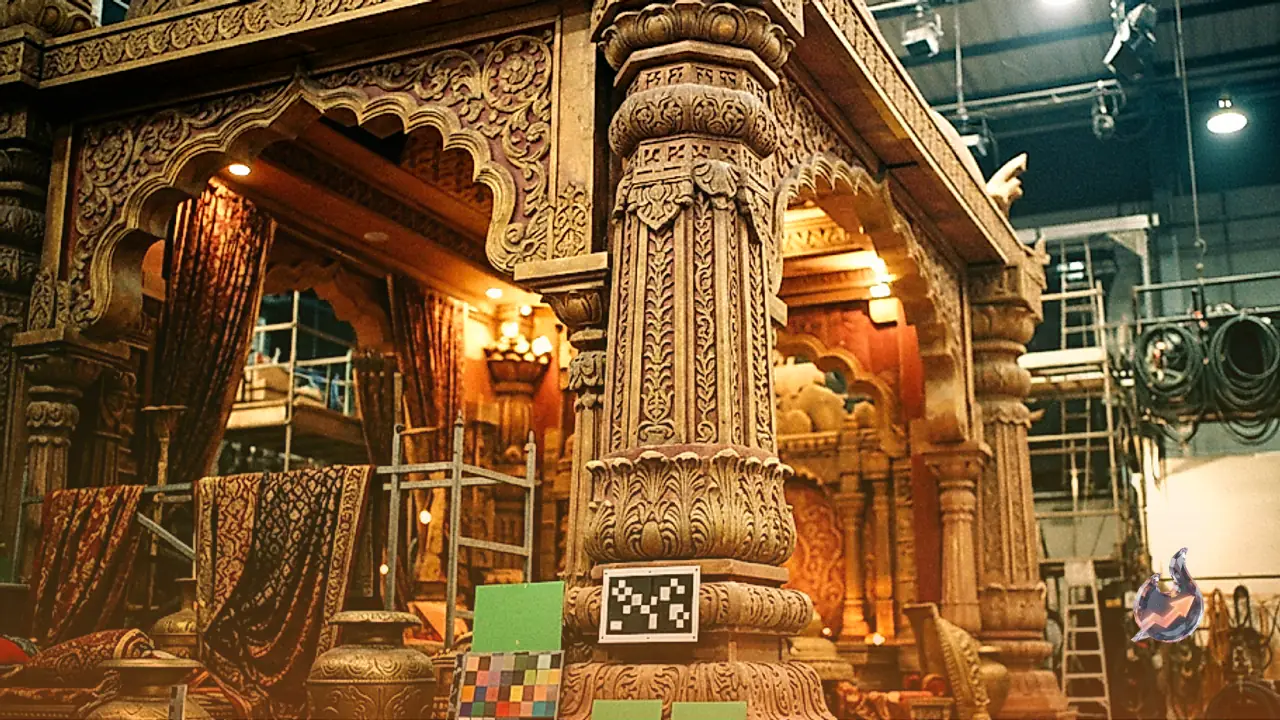

Behind the immense scale of the upcoming cinematic retelling of the ancient epic, spearheaded by director Nitesh Tiwari and producer Namit Malhotra, lies an intricate architectural balancing act that spanned more than three years. Bringing the vast worlds of Ayodhya and Lanka to life for the 4000-crore production starring Ranbir Kapoor as Lord Ram and Yash as Ravana required far more than erecting sprawling stages. Production designer Subrata Chakraborty and his creative collaborator Amit Ray had to navigate a complex fusion of historical research, classical Indian architecture, and high-end modern digital pipelines.
Reorienting Western Concept Art Toward Authentic Indian Heritage
By the time Chakraborty and Ray entered the production, development had already been underway for more than five years. An international pre-visualization unit led by Academy Award-winning production designer Ramsey Avery had laid down the initial blueprints. However, those preliminary drafts leaned heavily toward Western visual tropes and European grandiosity. Recognizing that the narrative required roots deeply embedded in native soil, the Indian designers began a systematic process of reimagining the spaces.
The international collaborators embraced the shift once the research demonstrated how Indian temple architecture, ancient monuments, and traditional building philosophies could elevate the material. The design crew systematically explored temple layouts across India, while also studying historical structures in Sri Lanka, Cambodia, and other pockets of Southeast Asia to understand regional interpretations of the legend's vast geography.
Contrasting Visual Dialects: Serene Ayodhya and Imposing Lanka
Establishing an immediate visual contrast between the two primary kingdoms was central to Tiwari's directorial vision. For Ayodhya, the mandate was to evoke an overwhelming sense of tranquility, moral balance, and cool spiritual clarity. The creative team executed this by utilizing muted, cool palettes and subtle architectural contours, allowing the scale to feel regal without overwhelming the peaceful aura of the righteous realm.
In stark contrast, Lanka was envisioned as an unyielding manifestation of raw power, conquest, and monarchical pride. To avoid visual cliches, the designers deliberately looked beyond modern Sri Lankan architectural motifs. They drew substantial inspiration from the massive, ornate stone architecture of ancient Cambodia and neighboring Southeast Asian civilisations, crafting a kingdom whose visual vocabulary radiates unbridled ambition and intimidating majesty.
Echoes of Konark and the Engineering of King Dasharatha's Chariot
Traces of prominent Indian historical monuments, such as the architectural language of the Konark Sun Temple, were woven into specific set pieces. The legendary Pushpaka Vimana retained much of its foundational aesthetic from early drafts, but the local team introduced crucial geometric modifications to tie it closer to indigenous craftsmanship.
Crafting functional physical props presented its own structural engineering hurdles. Dasharatha's royal battle chariot required an extensive six-week development window solely dedicated to its chassis, suspension, and mechanical stability. While Chakraborty had drafted period vehicles for prior assignments, operating at this massive scale with rigorous safety tolerances demanded an unprecedented engineering standard.
The Logistics Behind Lord Shiva's Bow in Mithila
The iconic sequence in Mithila featuring the divine bow of Lord Shiva presented another logistical challenge. The sculpted prop was intentionally rendered on such a monumental scale that manual lifting by actors or crew was physically impossible. Associate production designer Pallavi Petkar and her dedicated technical squad tackled the problem through extensive mechanical experimentation.
The solution was a hidden reinforced structural frame and a specialized modular transport platform. This bespoke system permitted the massive artifact to be safely maneuvered across the soundstage and positioned seamlessly during the ceremonial sequence, maintaining absolute visual conviction without exposing mechanical support on camera.
Calibrating Physical Sets Against Digital Extensions
The core visual philosophy of the production hinged on achieving absolute visual imperceptibility between practical craftsmanship and digital visual effects. The ratio of physical sets to digital extensions was calibrated scene by scene. In the grand throne chamber of Ayodhya, approximately 70 percent of the environment was physically constructed on stages, with the remaining 30 percent completed through digital visual effects. Similarly, the courtyard environment built for Dasharatha's tragic premonition sequence relied on a 70 to 80 percent practical build.
Conversely, high-intensity battle sequences set in Lanka inverted this formula entirely. Practical set construction provided around 30 percent of the immediate staging, while 70 percent was generated virtually to accommodate explosive action and impossible scale. For sequences depicting the netherworld of Rasatala, the allocation balanced evenly at roughly 50 percent practical builds and 50 percent digital enhancements. The Pushpaka Vimana stood as the most digitally dominant asset, constructed with roughly 90 percent virtual assets and only a 10 percent tactile physical cockpit structure for actor interaction.
The Mathematical Rigor of Virtual Integration
Chakraborty characterized the entire production design workflow as an exercise in precise spatial mathematics. Aligning green screens, virtual camera perspectives, and practical set pieces required zero-tolerance accuracy, because any minor misalignment in scale, perspective, or physical placement would instantly shatter the realism of the digital composite. Creating expansive wilderness backdrops required sophisticated 3D modeling, material texturing, and Blender workflows to place every tree, stone, and elevation accurately, uniting Indian historical art with modern global cinematic technology.