






















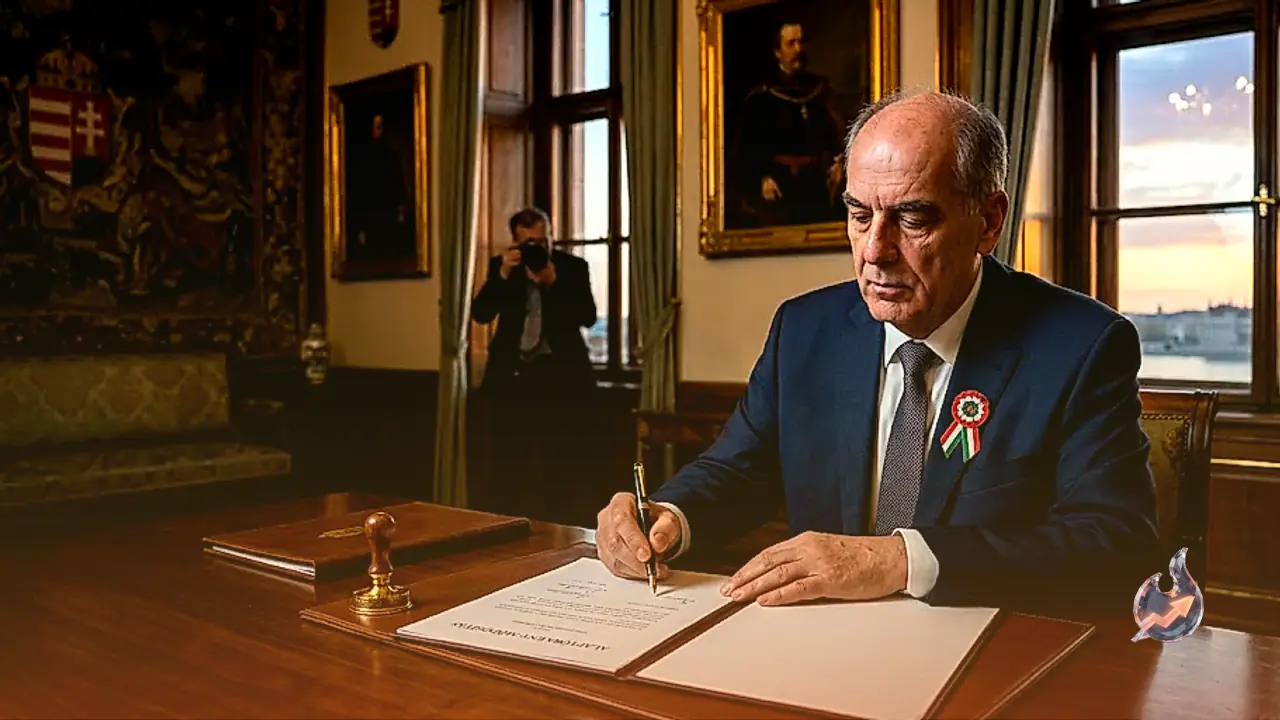

Hungary's presidency changes hands at the stroke of midnight this Sunday, after Tamás Sulyok put his own signature on the constitutional amendment that ends his term in office. The move comes only days after Prime Minister Péter Magyar's Tisza party forced the change through parliament, the most dramatic step yet in a months-long campaign to push Sulyok out.
Why Tisza wanted him gone
Sulyok has long been viewed as close to former prime minister Viktor Orbán, whose party lost power in April after governing Hungary for sixteen years. Once Tisza swept to victory in that election, Magyar and his colleagues repeatedly called on Sulyok to resign, arguing that a president installed under the old government no longer belonged at the head of the state. The Tisza government has treated Sulyok's presidency as a leftover of the administration voters rejected, describing him as a puppet of the outgoing regime rather than an impartial head of state. When he declined to step down on his own, the party's 141 deputies used their numbers in parliament to pass a constitutional amendment specifically designed to remove him from office.
A five-day deadline
Once the amendment cleared parliament, Sulyok had just five days either to sign it himself or risk being dragged into a long constitutional crisis followed by impeachment proceedings. He waited almost the entire window before responding, confirming only on Saturday evening, right as the deadline was about to lapse, that he would accept the change. His signature formally brings his presidency to a close at midnight on Sunday.
Had Sulyok refused to sign, Hungary would have been pushed into unfamiliar territory: a sitting president resisting a parliamentary majority's attempt to remove him, with impeachment proceedings then playing out in public even as the new government tried to consolidate its own authority. That scenario could have kept Sulyok in office for weeks or months longer, giving Fidesz and Orbán a rallying point around what they call government overreach. By signing instead, Sulyok avoided that showdown, even as he used his final act in office to condemn the process that ended his term.
Sulyok's parting accusation
Even while agreeing to leave office, Sulyok used his statement to turn on the government that removed him, accusing Magyar's administration of breaching the rule of law. He called the amendment a "breaking point in Hungarian constitutional democracy" and said the "core values of a free society... have been trampled underfoot for the sake of political power." It was a pointed farewell from a man who, until this vote, had held one of the country's most senior constitutional offices.
Tisza's boldest move since taking power
Tisza has pushed through a string of major constitutional changes since its landslide election win in April, but ousting a sitting president stands out as its most forceful step so far. When the vote to pass the amendment was announced in parliament on Monday, Tisza's 141 deputies rose for a standing ovation, underlining how significant the party considers Sulyok's removal to be.
Orbán's muted response
Orbán condemned the amendment as an act of tyranny and called on supporters to take to the streets in protest. Yet his reaction has come against the backdrop of a party in visible decline: since the April defeat, Orbán's party has been in free fall, and Orbán himself has barely appeared in public. He has also refused to take up his own seat in parliament, a striking absence for a politician who dominated Hungarian politics for well over a decade.
Sixteen years of Fidesz control
Orbán's Fidesz party governed Hungary from 2010 until this year, a run long enough to give it a two-thirds parliamentary majority. That supermajority let Fidesz reshape the Hungarian state according to its own priorities, including filling positions that were meant to be politically independent with people loyal to the party. Sulyok's presidency was widely seen as one product of that system, which is precisely why Tisza treated his removal as unfinished business rather than routine politics.
A former judge weighs in
After the vote, András Baka, who previously served as head of Hungary's Supreme Court, said: "I quite agree with the removal of the president." Baka argued that Hungary had genuinely been governed under the rule of law between 1989 and 2010, and that it was only after that period that Fidesz began capturing state institutions and building what he called an authoritarian state. He went further, warning that dismantling a well-established authoritarian system is now extremely difficult precisely because it "was designed to survive even after electoral defeat."
With Sulyok's exit locked in, the immediate questions facing Hungary are who Tisza will install in his place and whether Orbán's calls for street protests gather any real momentum among a party base still coming to terms with life outside government.