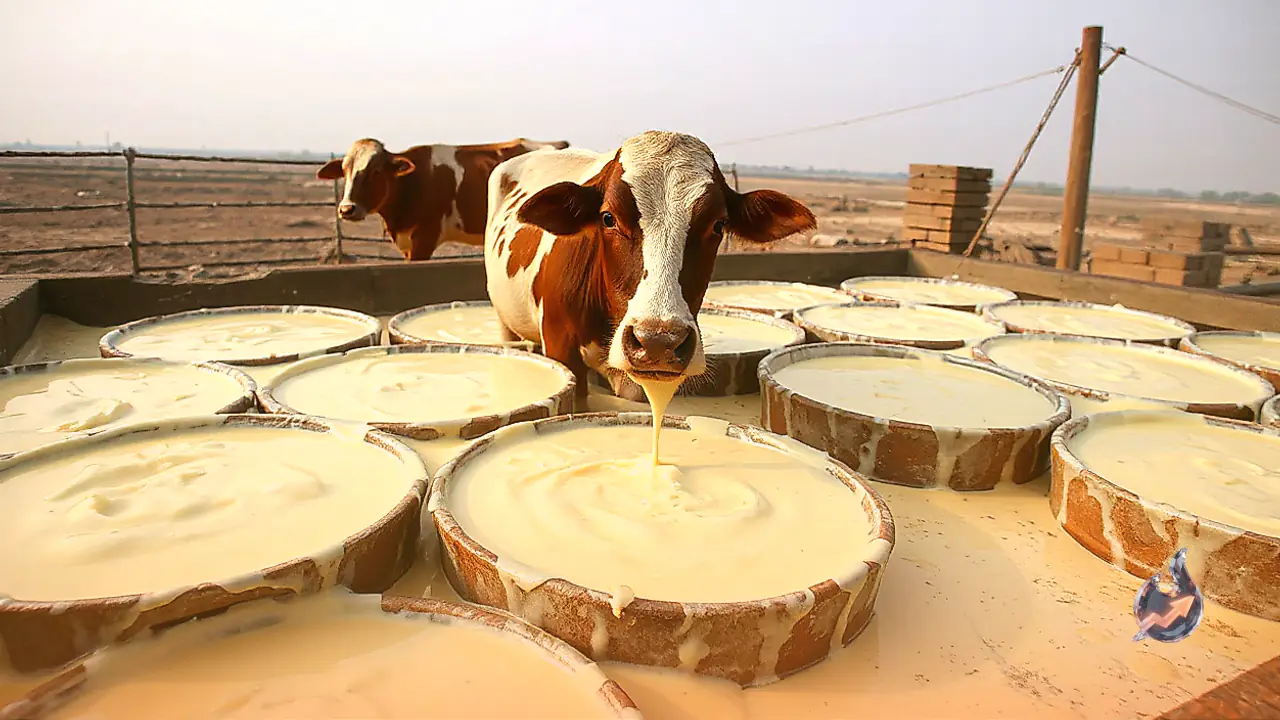

Rural Indian culinary culture holds countless regional delicacies whose distinct flavors and textures stand completely apart from modern confectionery. In the Ballia district of eastern Uttar Pradesh, milk collected during the first few days after a cow gives birth is used to prepare an extraordinary traditional sweet. Locally, this specialty is known as Pheenus, while across various regions it is also recognized as khees, innari, or bovine colostrum. The defining characteristic of this thick, yellowish milk is that it curdles naturally into soft curds the moment heat is applied, requiring no acidic curdling agent such as lemon juice or vinegar.
Early Colostrum and the Changing Village Tradition
This nutrient-rich milk is available strictly for roughly three to five days following the birth of a calf. In earlier decades, whenever a cow calved in a village household, neighbors and relatives would visit to request a small portion of the colostrum specifically to cook Pheenus. The milk was shared freely as a gesture of goodwill and community bonding. In recent years, however, with the commercialization of dairy production extending into rural areas, this informal sharing culture has significantly declined.
Nutritional Value and Vital Nourishment for the Newborn Calf
According to 58-year-old Kaptan Lal, a resident of Anand Nagar in Ballia, the milk retains the unique property suitable for making Pheenus only during these initial few days. After this brief period, the cow's milk normalizes and will no longer curdle spontaneously upon heating. Lal noted that the Pheenus prepared from this colostrum, available traditionally for about three days, yields a rich, grainy, and delightfully thick dessert. He had sourced the milk from his neighbor Vijendra Verma to prepare a batch of the traditional sweet.
Biologically, colostrum serves as an indispensable first nourishment for the newborn calf. Packed with exceptionally high concentrations of proteins and vital minerals, it imparts immediate strength and vigor to the young animal. Crucially, the secretion is loaded with essential maternal antibodies that shield the newborn against infections and illnesses, establishing early immune defense. For this reason, ensuring the calf receives its share remains paramount before any remaining milk is utilized in the kitchen.
Step-by-Step Preparation of Traditional Pheenus
Making this authentic rural dessert is straightforward and relies on minimal culinary intervention.
- Heating the Colostrum: Pour the fresh, clean colostrum into a heavy-bottomed pan and place it over a gas stove or a traditional wood-fired hearth on moderate heat.
- Spontaneous Curdling: As heat penetrates the liquid, the milk rapidly splits into distinct, soft, grainy curds without any additives. If desired, this curdled mass can also be gathered to produce fresh paneer.
- Sweetening and Stirring: Once the curdling occurs, add either jaggery or sugar according to personal preference. It is essential to continuously stir the mixture throughout the simmering process to prevent it from scorching or sticking to the bottom of the utensil.
- Reducing the Moisture: Gradually, the separated whey evaporates, leaving behind a thick, succulent, and crumbly sweet mixture. Incorporating jaggery instead of refined sugar imparts a distinct earthy depth and caramel-like warmth that elevates the overall profile.
Enhancing Texture and Flavor With Dry Fruits
While plain Pheenus possesses a wholesome and naturally satisfying taste on its own, it can be enriched further with a selection of dry fruits. Folding in chopped dried dates, almonds, cashews, raisins, and grated dry coconut during the later stages of cooking adds delightful texture and nutty complexity.
Even though modern dairy practices continue to shift, the practice of preparing Pheenus while safeguarding the calf's nutritional needs persists across many traditional families. More than a simple dessert, it reflects rural culinary memories, generational heritage, and a deep connection to indigenous farming roots. Its transient availability for less than a week makes Pheenus an exceptional and fleeting celebration of Indian rural flavors.