























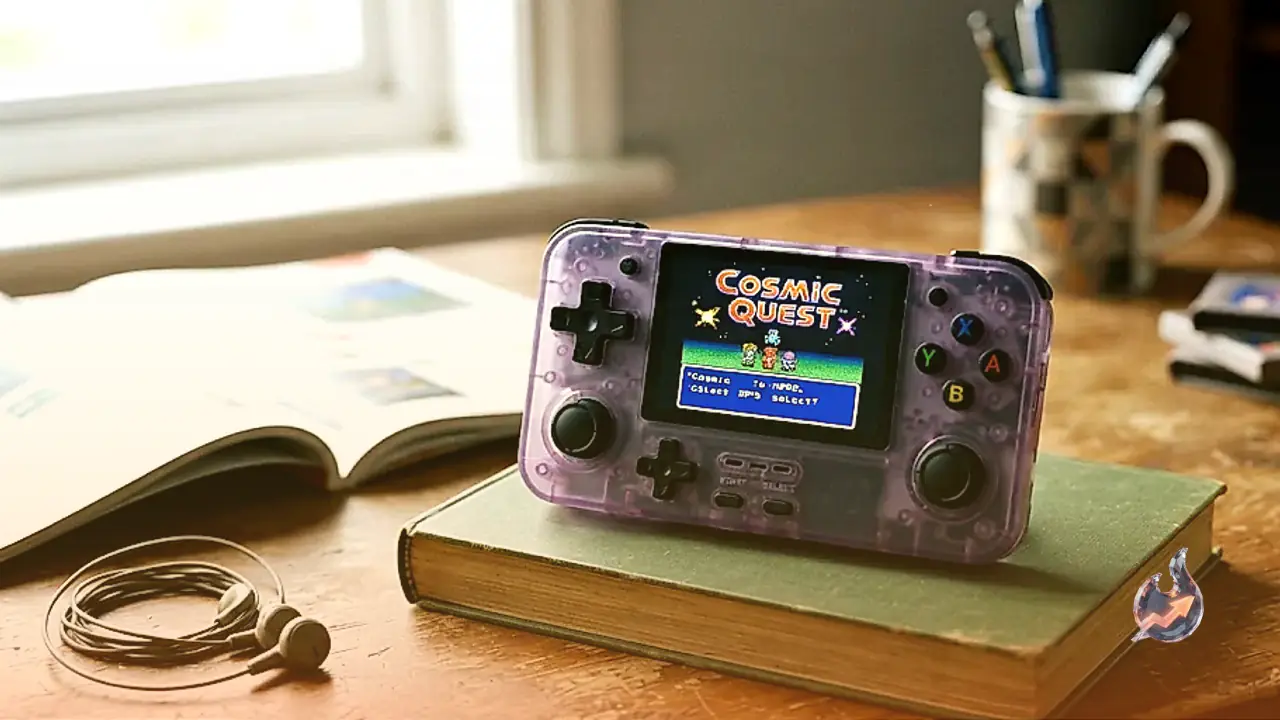

The Evercade Nexus is much more than just a routine hardware update in the console lineup. While it maintains full backwards compatibility with every previously released cartridge in the ecosystem, it represents the most significant generational leap the platform has taken so far in both physical design and future gaming potential. This is a genuine level-up for retro gaming enthusiasts that delivers a brilliant overall experience.
Dual Thumbsticks and Improved Tate Mode
The most notable hardware change is the inclusion of twin symmetrical thumbsticks. This addition carries major implications for the future of the platform, but it immediately enhances Tate Mode, which is a returning feature from the Evercade EXP. Pronounced tah-tay, meaning vertical in Japanese, tapping the dedicated mode-shift button rotates the screen by 90 degrees. This allows players to experience vertically scrolling arcade titles in their intended orientation rather than viewing them crammed into a tiny pillar-boxed window on a standard widescreen display.
On the older EXP hardware, users had to hold the console on the left side to utilize the directional pad for movement, which necessitated duplicate action buttons on that same side and resulted in a cluttered layout. On the Nexus, Tate Mode rotates in the opposite direction, enabling players to comfortably use the right-hand thumbstick alongside the default ABXY button configuration. This arrangement feels significantly better to use, aided by the larger overall physical dimensions of the device, and keeps the aesthetic much cleaner.
Regardless of which screen orientation you choose to play in, the display panel itself is substantially larger. It features a 5.89-inch IPS panel running at an 840 by 512-pixel resolution, yielding a pixel density of 167 pixels per inch compared to the original 4.3-inch liquid crystal display. Furthermore, the screen is considerably brighter now, boasting upwards of 500 nits of luminance. The resulting image is crisp, vibrant, and makes games look fantastic.
Under the hood, the Nexus does not see any actual upgrades in processor power or system memory. It continues to rely on the same 1.5-GHz quad-core chip found in the EXP, paired with 512 megabytes of random-access memory. While those specifications might sound modest in 2026, the hardware is still significantly more powerful than the vintage machines it emulates, and this consistency guarantees universal cross-device compatibility across every single game cartridge.
The primary drawback of this hardware consistency is that the Nexus still feels sluggish at the system software level. Powering on the device requires roughly 35 to 40 seconds on average, and loading an individual cartridge can take a similar duration. Actual gameplay runs without any performance hiccups, but navigating the menus to reach that point can be frustratingly slow. Disappointingly, there is also no quick-suspend functionality available, which forces users to completely power down the device and boot it back up between gaming sessions.
The underlying operating system has also received a visual and functional refresh. Navigating into the settings menu reveals several new customization tools that allow users to adjust the color palette for the background and the glowing LED logo, select custom onscreen borders for non-widescreen titles, and fine-tune aspect ratios along with virtual scan lines to personalize the device.
Perhaps more exciting than the hardware refinements is the direction in which the software library is heading. Nearly every game released on the platform to date has originated from the 8-bit or 16-bit eras, which consisted almost universally of two-dimensional titles. The introduction of physical thumbsticks opens up possibilities for an entirely new generation of three-dimensional software. The manufacturer states that the Nexus is fully compatible with 32-bit and 64-bit games, dramatically expanding the horizon for upcoming releases.
Even more impressively, the first two collections to leverage this generational leap also see the platform move beyond traditional emulation for the very first time. Both the Banjo-Kazooie and Banjo-Tooie double-pack along with the DOOM and DOOM II compilation are natively ported games. This technical shift delivers improved performance, intentional widescreen aspect ratios tailored to the display, higher resolutions running at up to 60 frames per second, and direct on-cartridge save slots rather than reliance on virtual quick saves.
For the time being, the Nexus stands indisputably as the ultimate way to experience both the vast historical library and this emerging pseudo-generation of native software releases. With its upgraded screen, larger physical form factor, and newly added controls suited for three-dimensional titles, it is an absolute delight to use.