






















The flagship television market in 2026 sees the arrival of a major technological leap from Samsung in the form of the Samsung R95H. Built around an innovative Micro RGB panel architecture, which is also referred to across the display industry as RGB Mini LED, this television aims to push the boundaries of color reproduction and contrast far beyond standard Mini LED configurations. Positioning itself right at the top of Samsung’s 2026 television lineup alongside the Samsung S95H OLED, the R95H serves as the manufacturer's flagship LED offering. Driven by the custom-engineered Micro RGB AI Engine Pro processor and running the latest 2026 edition of Tizen OS, the display comes packed with advanced gaming and image processing features. Designed for high-end living rooms and dedicated home theaters, the television is offered in 65-inch, 75-inch, and 85-inch screen sizes, delivering a comprehensive feature set alongside a few notable performance trade-offs.
Micro RGB Panel Architecture and Processing Hardware
Under the hood, the Samsung R95H relies on a Micro RGB backlighting structure that fundamentally changes how LED backlights emit light. Unlike conventional Mini LED screens that rely on blue LEDs with quantum dot layers, Micro RGB utilizes dedicated red, green, and blue micro-scale illumination elements. This design enables a significantly wider native color gamut and deeper contrast control. To manage this complex light array, Samsung integrated the Micro RGB AI Engine Pro chip, a specialized neural processing unit explicitly tuned to analyze frame-by-frame color mapping, local dimming control, and upscaling routines. The software side is powered by the 2026 iteration of Tizen OS, which offers a refreshed interface, smooth navigation, and deep smart home hub integration.
Connectivity on the Samsung R95H is fully modern. All four HDMI ports built into the panel support the full bandwidth of the HDMI 2.1 specification. The television can handle video signals up to 4K resolution at a 165Hz refresh rate or 1080p signals at a blistering 240Hz. Game console and PC users also benefit from complete Variable Refresh Rate (VRR) support, including all three primary standards: HDMI Forum VRR, AMD FreeSync Premium Pro, and NVIDIA G-SYNC compatibility. The panel itself utilizes VA (Vertical Alignment) LCD technology with an anti-glare matte screen finish, designed to optimize contrast while scattering incoming ambient light reflections.
Bright Room Visibility and Anti-Reflection Performance
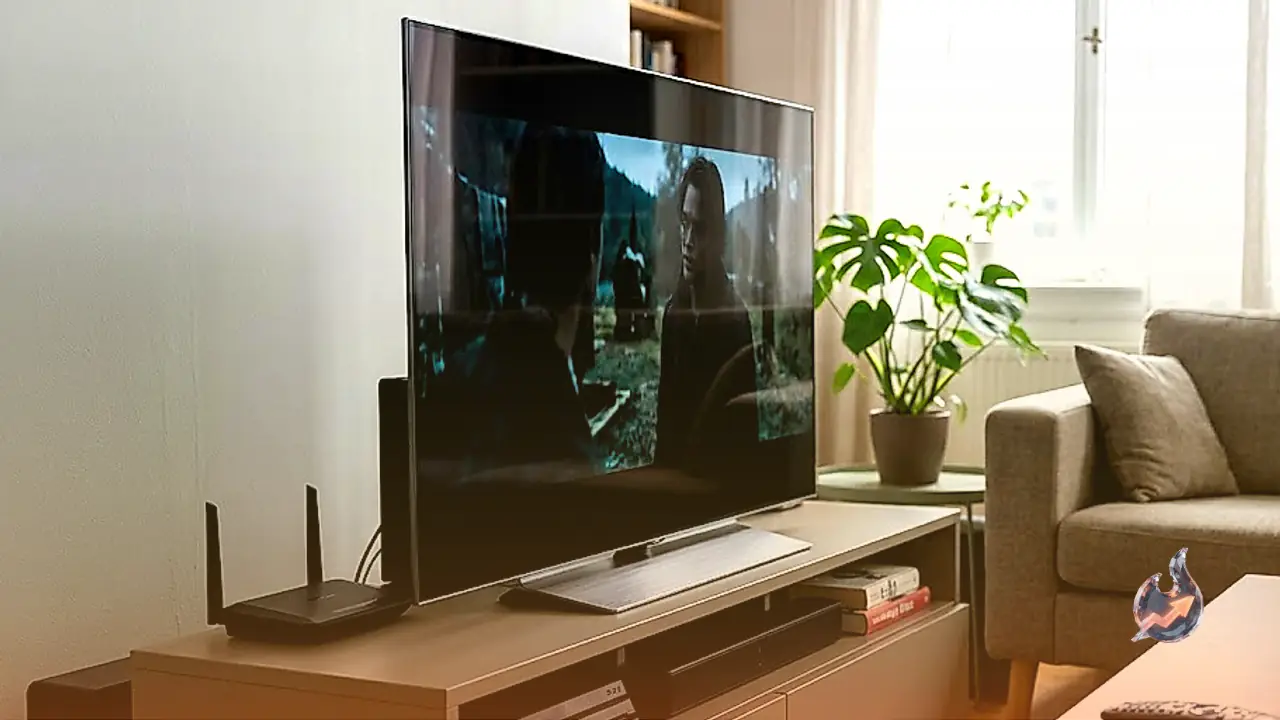
When placed in brightly illuminated environments, the Samsung R95H demonstrates unmatched competence. The display delivers outstanding peak brightness levels in Standard Dynamic Range (SDR), allowing it to punch through heavy ambient light without looking washed out or muted. Whether positioned in a room with floor-to-ceiling windows or under direct artificial lighting, the panel easily overcomes severe glare.
A major contributor to this bright-room dominance is the display's top-tier matte finish and reflection handling system. Incoming light sources facing directly toward the screen are diffused evenly across the surface rather than forming sharp, distracting reflections. Even in rooms with intense ambient light, color saturation remains remarkably rich and vivid. While black levels in bright conditions do lose a small fraction of their pitch-black depth compared to dark-room viewing, they stay sufficiently dark to prevent the overall image from appearing flat or faded. For daytime sports watching, such as Sunday afternoon football games, glare is virtually non-existent, ensuring clear visibility for everyone in the room.
Home Theater Picture Quality and Dark Room Contrast
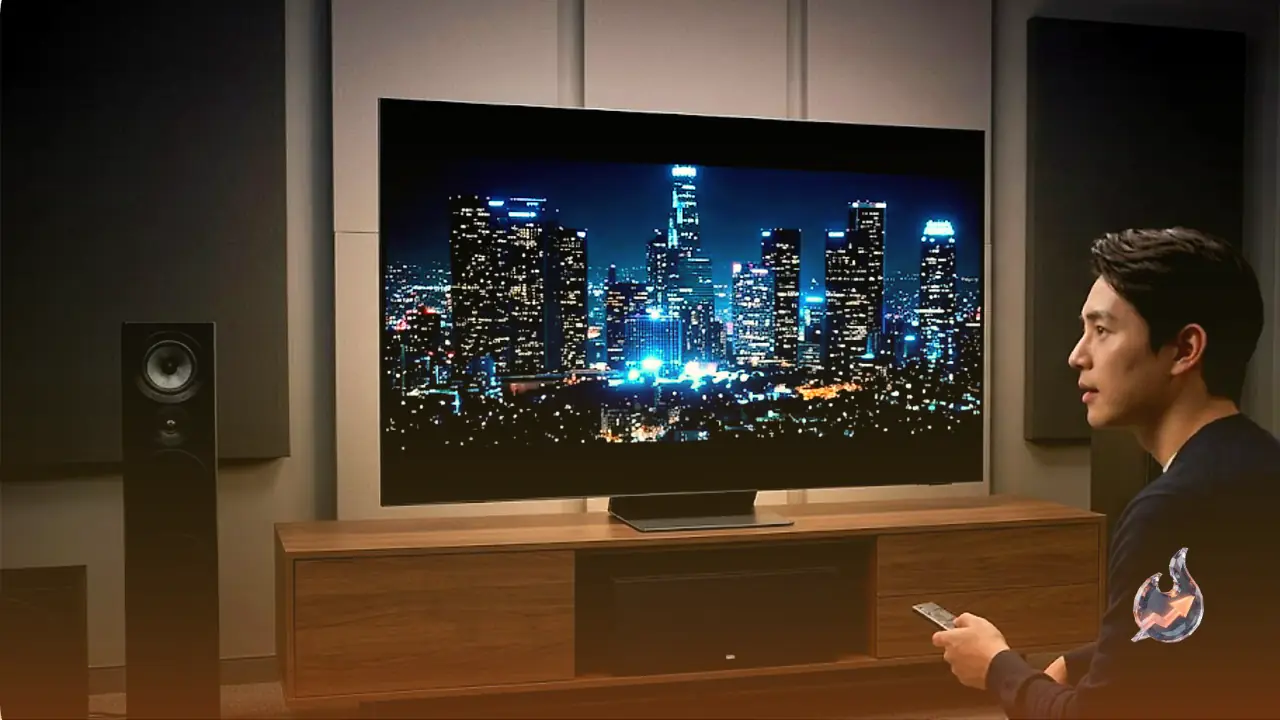
In dark-room home theater setups, the Samsung R95H produces a striking visual presentation powered by its sophisticated local dimming system. Although the VA panel's native contrast is inherently respectable, enabling the local dimming algorithm elevates the black levels to extraordinary depths. Dark scenes appear bold and uniform across the entire screen expanse. Furthermore, the local dimming precision is so high that there is almost zero haloing or blooming around bright specular objects, high-contrast highlights, or white subtitles against pure black backgrounds.
High Dynamic Range (HDR) performance is equally impactful. The display achieves incredible HDR peak brightness, enabling specular highlights—such as explosions, sunlight reflections, and laser effects—to stand out with intense impact. Color volume in both SDR and HDR is exceptional, providing a vast palette of saturated, punchy hues. However, dark-room evaluation reveals two distinct picture flaws. First, colors can occasionally bleed into adjacent white areas of the image, causing whites to take on a subtle tint. For instance, white boundary lines on a green sports pitch or football field can take on a visible greenish hue due to the surrounding field color. Second, the out-of-the-box color accuracy is poor, presenting a noticeable blue tint across all picture modes in both SDR and HDR unless a professional color calibration is performed.
Image Processing, Upscaling, and Motion Handling
Video processing is a strong suit of the Micro RGB AI Engine Pro chip. The Samsung R95H excels at processing low-resolution feeds and compressed streaming content, doing a fantastic job of eliminating digital compression artifacts and noise. Low-resolution cable or broadcast signals are upscaled cleanly without introducing unnatural edge sharpness or ringing artifacts. The television also demonstrates excellent PQ EOTF (Perceptual Quantizer Electro-Optical Transfer Function) tracking, meaning HDR content is mapped accurately to its intended brightness curve across different light levels. In addition, gradient handling is very smooth, keeping color banding in skies or gradient fills to an absolute minimum.
When it comes to motion handling for movies and general television viewing, results are mixed. The panel completely eliminates motion judder across almost all content sources. Whether watching standard 24p film signals, 60i broadcast feeds, or 25p European content over a 60p signal, the cadence remains smooth and consistent. Micro-judder is non-existent, and there is very little stutter during slow-panning camera movements. However, the physical LCD panel exhibits slow pixel transition response times. This slower response time generates noticeable motion blur during fast-moving sequences. Fast-running athletes, swift football passes, and quick action scenes suffer from softened edges and subtle motion trailing. Additionally, the four physical corners of the screen appear noticeably dimmer than the central region, presenting slight vignetting.
Gaming Performance and VRR Compatibility
For modern gaming enthusiasts, the Samsung R95H presents a highly capable feature set paired with one major operational limitation. With four full-bandwidth HDMI 2.1 ports capable of 4K @ 165Hz and 1080p @ 240Hz, the TV interfaces seamlessly with current-generation game consoles and high-end gaming PCs. Input lag in the dedicated Game Mode, while slightly higher than some top competing OLED displays, remains sufficiently low to deliver a snappy, responsive feel during gameplay.
The visual quality in HDR games is impressive, offering punchy specular highlights, vivid game environments, and deep shadow detail. Full VRR support ensures that screen tearing and frame pacing stutters are effectively mitigated. However, the panel's slow pixel transitions become particularly distracting in fast-paced video games. First-person shooters, competitive racing titles, and fast-action games display substantial motion blur during quick camera pans, which can soften fine textures and reduce clarity during intense combat.
Audio Format Support and HDR Format Ecosystem
Audio format handling on the Samsung R95H covers all standard Dolby protocols, including Dolby Atmos, providing seamless passthrough to external soundbars and AV receivers via eARC. However, Samsung continues its long-standing policy of omitting support for DTS audio codecs, meaning physical media collectors relying on DTS-HD Master Audio or DTS:X tracks will require external decoding source devices.
In terms of high dynamic range formats, the TV supports standard HDR10, HLG, and Samsung’s preferred HDR10+ dynamic format. However, it lacks native support for Dolby Vision HDR. While HDR10+ content looks stellar thanks to the panel's extreme peak brightness and Micro RGB color volume, the absence of Dolby Vision means the TV will fall back to static HDR10 metadata when playing Dolby Vision mastered titles from major streaming platforms.
Final Verdict and Target Audience
The Samsung R95H stands as a formidable LED display that showcases the impressive potential of Micro RGB backlighting technology. Its combination of incredible SDR peak brightness, industry-leading reflection handling, deep black levels, and robust 165Hz gaming capabilities make it a versatile performer for mixed usage. It is particularly well-suited for bright living rooms with direct sunlight exposure and dark home theater spaces where haloing-free contrast is required.
However, prospective buyers must consider its limitations. Achieving color accuracy requires professional calibration due to the native blue tint, fast-motion content suffers from pixel transition blur, and the lack of Dolby Vision and DTS audio limits format flexibility. For consumers who prioritize extreme brightness, reflection control, and high refresh rate gaming over super-fast motion clarity, the Samsung R95H represents one of the most powerful LED televisions available in 2026.