




















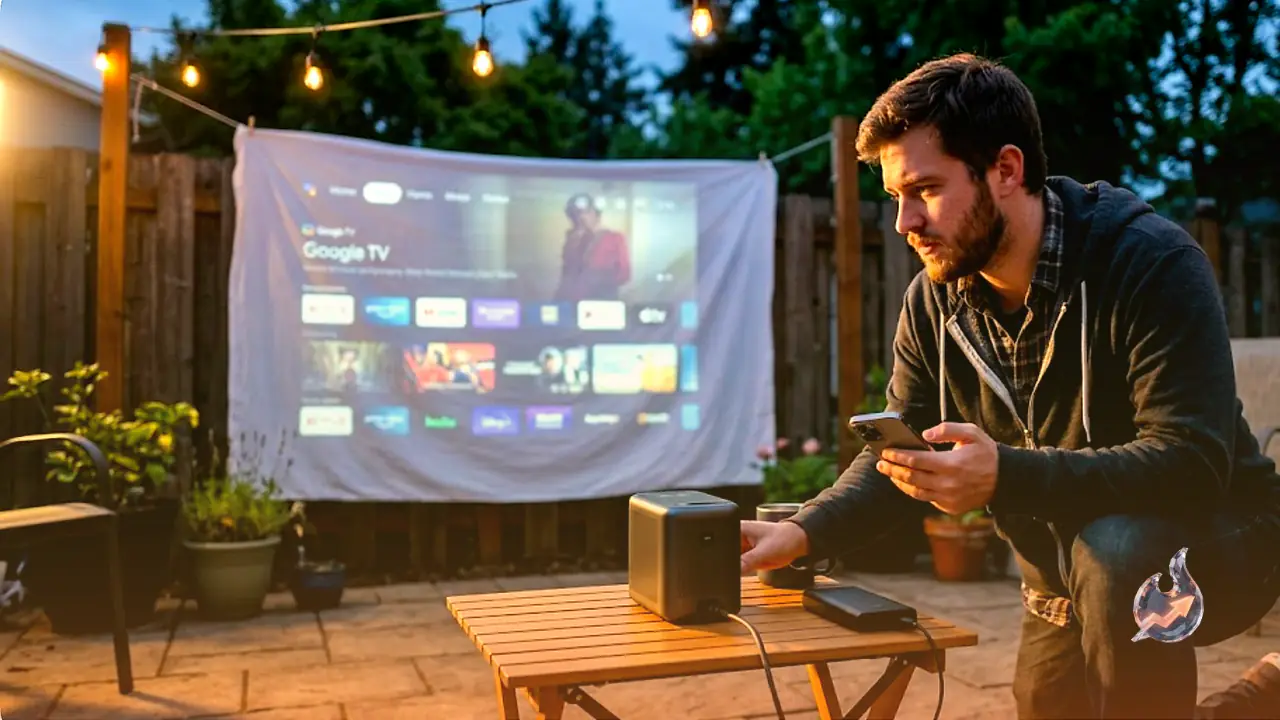

Part flashlight, part home theatre, the Anker Nebula Mars 3 Air markets itself as a projector you can carry from the living room to the backyard without much fuss. It packs a 1080p DLP panel driven by an LED light source, a built-in battery, an integrated carry handle, Google TV, casting support and dual 8W speakers, all wrapped into a unit meant for casual, room-to-room viewing rather than a dedicated home theatre setup. But once the picture actually lights up a wall, the review found the experience is a mixed bag, strong on convenience and colour, weak on the brightness and contrast that make a picture feel cinematic.
Built To Move, Not Built For The Dark Basement
Setup is where the Mars 3 Air tries hardest to impress. It comes with autofocus, automatic keystone correction, obstacle avoidance, auto screen fit and post-movement auto-correction, so shifting the projector from one room to another does not mean manually squaring up the image every single time. Connectivity is kept simple, there is one HDMI port, Wi-Fi, Bluetooth and a USB-A port, but there is no Ethernet jack and no optical audio output, so anyone wanting a wired network connection or a soundbar hookup through optical cable will have to look elsewhere.
Movie Nights Demand A Dark Room
For movie watching, the review rated the Mars 3 Air as sub-par, largely because of brightness and contrast. The picture needs a dark room and a smaller screen size to stay watchable, and dark scenes come across as gray and flat rather than deep or cinematic. Judder handling was also disappointing, meaning camera pans during films can look uneven or choppy to anyone sensitive to motion artifacts. On the upside, its colour gamut is wide for a portable projector, so colourful movies and animated content still look fairly vibrant, and out-of-the-box accuracy is decent enough for most casual viewers, though the review noted it cannot really be improved through calibration.
Gaming Sessions Work, But Not For Fast Titles
Gaming fares no better than movie playback, with the Mars 3 Air again rated sub-par overall. The projector is capped at 1080p @ 60Hz, and input lag is only passable, responsive enough for slower-paced games but not built for competitive or fast-action titles. Image quality does not help its case here either, since the unit's dimness and disappointing contrast carry over into gaming content. Still, the built-in battery and the automatic setup tools make it genuinely easy to set the projector down for a quick session, and because it runs Google TV, it also gives direct access to cloud streaming gaming services, meaning players do not need to carry a separate console along with it.
Brightness Is The Biggest Weak Spot
Brightness is where the Mars 3 Air struggles the most. It is usable in a dark room, especially at smaller screen sizes, but the image loses impact quickly the moment any ambient light enters the space. That rules it out for daytime viewing or any lights-on use. The one bright spot, literally, is its brightness uniformity, which the review called fantastic, keeping the image looking clean and even across the entire screen rather than dimmer at the edges.
Contrast Still Falls Short In Dark Scenes
Contrast performance was also flagged as disappointing. Very dark scenes look washed out, with raised black levels and limited shadow depth, so the projector does not deliver a genuinely cinematic image even in a properly dark room. This is less of a problem with brighter material such as animation, sports or casual television, but taken overall, contrast is not one of the Mars 3 Air's strengths.
Where It Wins And Where It Loses
Putting it all together, the Mars 3 Air's strengths are colour, portability and convenience. It stays colourful across most content, is highly portable thanks to its carry handle and battery, comes packed with a full suite of screen adaptation features, and delivers fantastic brightness uniformity. Its weaknesses are just as clear, it is not really bright enough for anything but dark rooms, input lag is not good enough for faster games, it is limited to 1080p @ 60Hz, contrast struggles badly in very dark scenes, its out-of-the-box accuracy is only somewhat good and resists improvement through calibration, and camera pans can look choppy for anyone sensitive to judder.