























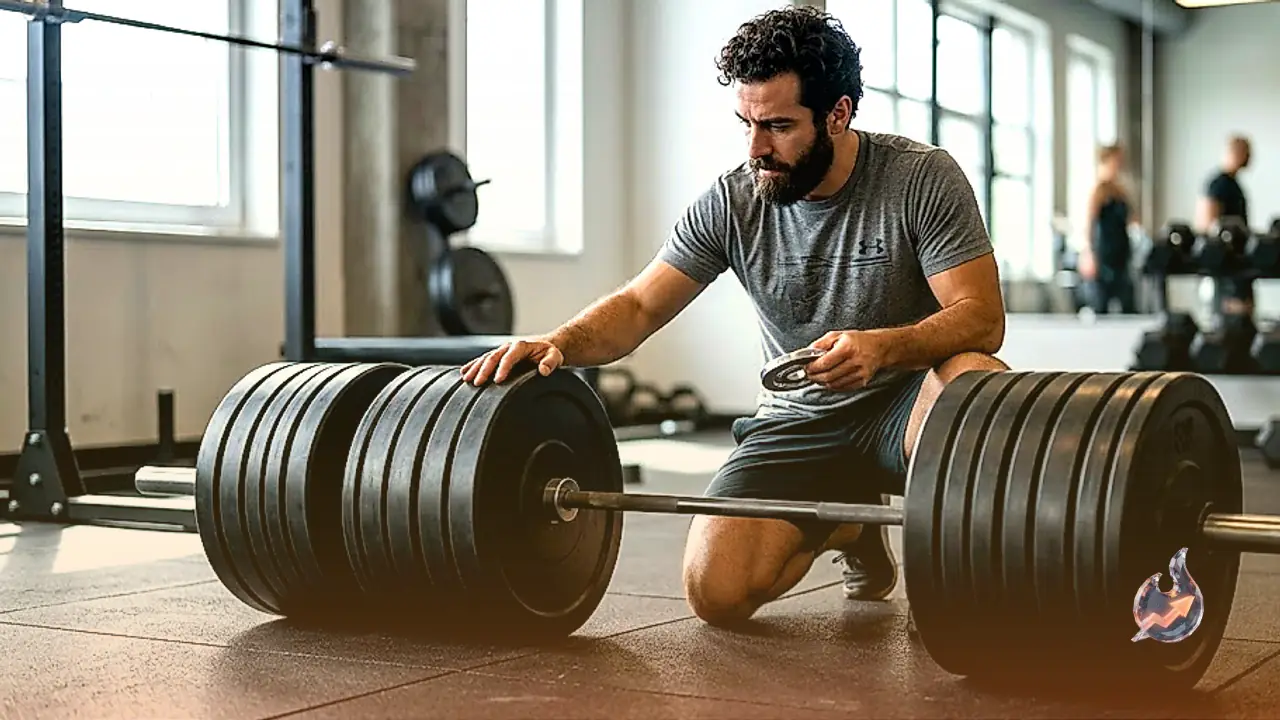

Here is a quick test for anyone who lifts: you want a barbell loaded to 185 pounds, so how many plates go on each side, and which sizes? If the answer 'a 45 and a 25' did not pop into your head instantly, a short lesson in plate math will make your time at the rack far smoother. Once this arithmetic becomes second nature, you will keep loading plates correctly without ever pausing to think about it.
Yes, the bar counts too
Start with the single most important rule. When you tell somebody how much weight you lifted, that figure is the entire load in your hands, and that means the bar itself, not just the plates hanging off each end.
Across most gyms in the United States, a standard full-size barbell weighs either 45 pounds or 20 kilograms, and 20 kilograms happens to work out to 44 pounds. If every other plate in your gym is marked in pounds, just treat the bar as 45. Nobody walks around announcing 'I benched 224 pounds' simply because the bar was technically a 20-kilo model.
You can recognize one of these standard bars easily. It runs seven feet long, and the loadable sleeves on each end are two inches across. In almost every gym, the bars sitting on squat racks and bench press stations are exactly this kind.
Some gyms stock several different bars. If yours does, look at the end of the bar for a stamped weight, or ask a staff member. In gyms that use kilo plates, and in any CrossFit box, Olympic-style weightlifting uses a 20 kilogram bar for men, close enough to 45 pounds, and a shorter, thinner 15 kilogram bar for women. CrossFitters usually round that women's bar to 35 pounds, though in truth it sits closer to 33.
Lighter bars, machines, and collars
Your gym may also keep lighter training bars, which can weigh 25 pounds or even as little as 10. A lot of home equipment uses a thinner 1-inch bar without the wider collars found on Olympic or powerlifting bars, and those are lighter still, so weigh yours or check the packaging to learn its exact weight.
When you train on a Smith machine or any other plate-loaded or cabled machine, do not waste effort trying to work out what the machine or its bar weighs. Every model is built differently, they are almost never labeled, and the resistance will not necessarily feel the same as free weight on a barbell anyway. Simply record the total you loaded onto it, and that is plenty for tracking your progress.
What about the clips or collars that lock the plates in place? Usually they are too light to be worth counting. But if they are the big, heavy type and you know their weight, you are welcome to add them in. In sanctioned weightlifting and powerlifting meets, the collars weigh 2.5 kilos each and do get counted toward the total lifted.
Apps that do the math for you
If you are brand new to lifting, or you just want to check your arithmetic, an app can handle the whole calculation. A free option called Bar Is Loaded is available on both iOS and Android, and an online equivalent is the weight plate calculator from ExRx. Any of these tools needs three pieces of information from you: how heavy your bar is, which plate sizes you have on hand, and how many of each you own. An app will usually load some sensible defaults, but it is worth double-checking them. A commercial gym may have effectively unlimited plates, but in a home gym some totals are simply impossible to hit if you do not own the right combination, which is exactly why these apps ask you to enter your plate inventory.
The one formula worth memorizing
This may seem obvious, but it is worth stating plainly so it is easy to find: to work out the total on the bar, add up the plates on one end, double that figure, then add the weight of the bar. Say you have a 45 and a 25 on each side. Add 25 and 45 to get 70, double it to reach 140, then add the 45-pound bar, which brings you to 185.
More often, though, you will begin with a target number you want to lift and then have to load the bar to match. Practice this enough and before long you will be sliding plates on correctly without giving it much thought. A few strategies make that second nature.
Common pound totals worth committing to memory
Assume you are working with a 45-pound bar. You will reach for the same handful of combinations again and again, and these totals will quickly start to feel familiar
- 55 pounds: a 5-pound plate on each side
- 65 pounds: a 10-pound plate on each side
- 95 pounds: a 25-pound plate on each side
Once you are strong enough to hang full 45-pound plates on both ends, it pays to get comfortable with multiples of 45. Lifters usually describe these loads by the number of plates per side, so when someone says they can bench 'two plates,' they mean two on each end, which is 225 pounds. The common totals in that system are
- 135 pounds: one 45-pound plate on each side
- 225 pounds: two 45s on each side
- 315 pounds: three 45s on each side
- 405 pounds: four 45s on each side
- 495 pounds: five 45s on each side
You can also run the numbers as you warm up, adding plates set by set. Picture this: you do a set with just the empty bar, then add a 10 on each side to reach 65, then a second pair of 10s to hit 85. Next you swap both pairs out for a single 25 on each side, which puts you at 95, and now you want your next set at 100. You are only five pounds short, so you grab a pair of 2.5-pound plates, and you are there.
The same trick in kilograms
Some gyms rack their plates in kilos rather than pounds, and a few carry both, so stay alert. The logic does not change: count the bar and memorize the go-to combinations. Bumper plates and competition-style steel plates are frequently color-coded, so the colors are noted below.
On a 15kg women's bar
- A pair of 10 kilo plates (green) = 35kg
- A pair of 15s (yellow) = 45kg
- A pair of 20s (blue) = 55kg
- A pair of 25s (red) = 65kg
- Two pairs of 25s = 115kg
- Three pairs of 25s = 165kg
On a 20kg men's bar
- A pair of 10 kilo plates (green) = 40kg
- A pair of 15s (yellow) = 50kg
- A pair of 20s (blue) = 60kg
- A pair of 25s (red) = 70kg
- Two pairs of 25s = 120kg
- Three pairs of 25s = 170kg
Converting between pounds and kilos
If you bounce between pounds and kilos, being able to convert in your head helps a lot. Multiply kilos by 2.2 to get pounds, or divide pounds by 2.2 to get kilos. Because a kilo is 'bigger' than a pound, the same object always shows a smaller number in kilos and a larger one in pounds. Handily, several of the conversions come out pleasingly symmetrical
- 5kg = 11 pounds
- 10kg = 22 pounds
- 20kg = 44 pounds
- 30kg = 66 pounds
- 40kg = 88 pounds
- 50kg = 110 pounds
- 100kg = 220 pounds
- 150kg = 330 pounds
If you split your training between one gym that works entirely in kilos and another that works entirely in pounds, the cleanest approach is to keep your notes in whatever unit each gym uses rather than converting on every single lift. Keeping Olympic lifting logs in kilos and powerlifting logs in pounds, for instance, saves a lot of mental math.
And if kilos still feel foreign, start by memorizing just one figure: your own bodyweight in kilograms. That single number lets you make fast judgment calls like 'this is heavier than me' or 'this is about half my weight' without ever reaching for a calculator.