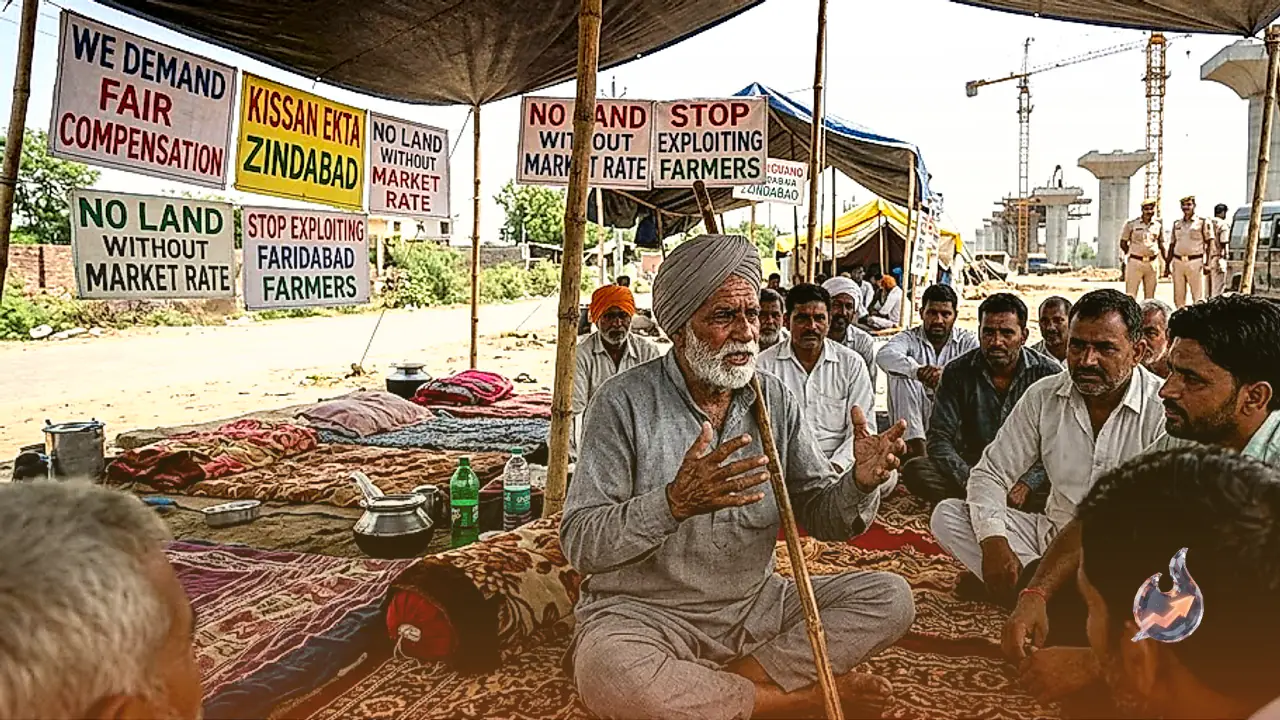
























Farmers toil day and night to cultivate vegetables, yet they often fail to receive a fair return for their hard work in the very fields where they sweat. The story of Rajesh, a 62-year-old woman farmer from Deeg village in Faridabad, reflects this exact agricultural crisis. Rajesh leased one acre of land to cultivate okra, ridge gourd, bottle gourd, and chili peppers. She had anticipated that the demand for green vegetables would rise during the monsoon season, leading to profitable returns, but the reality turned out to be completely different.
While green vegetable prices in retail markets are putting a heavy burden on consumers' pockets, the exact same produce is being sold at exceptionally low rates directly from the farmers' fields. Okra is retailing in markets for fifty to sixty rupees per kilogram, yet Rajesh is forced to part with her produce for a mere one rupee per kilogram. Similarly, bottle gourd sells in the market for twenty to thirty rupees per kilogram, whereas the farmer receives only one to two rupees per kilogram for it.
Sharing her plight, Rajesh explained that she lives in Deeg village and undertook vegetable cultivation on a single acre of land, growing okra, ridge gourd, bottle gourd, and chili peppers. She had expected that her hard work would yield a good harvest and bring financial profit to her family. However, for about the past month, vegetable prices have plummeted to such a low level that she is unable to even recover her production costs.
Rajesh noted that at 62 years of age, she still works tirelessly in the fields from dawn until dusk, personally caring for the crops. Hiring laborers to harvest the okra incurs a daily expense of about six00 rupees. Despite this, when the price fetched for the okra is only one rupee per kilo, making a profit is out of the question, and she incurs direct losses instead. Rajesh pointed out that while her okra leaves the farm for roughly one rupee a kilo, everyday consumers visiting the local market have to shell out forty rupees or even more. In many places, okra is retailing between fifty and sixty rupees per kilogram, leaving her baffled as to why produce fetching such high prices in the market is bought so cheaply from the farmer.
Struggling to recover even the cost of cultivation
Rajesh explained that she also grows bottle gourd, which leaves her farm priced at around one to two rupees per kilogram, while the same vegetable retails in the market for twenty to thirty rupees per kilogram. For chili peppers, she receives a meager rate of only ten to twelve rupees per kilogram. Cultivating crops involves substantial expenses on fertilizers, chemical treatments, labor, and intensive physical work, but these costs cannot be recovered upon selling the harvest.
Transporting the vegetables to the wholesale market requires hiring a tempo at a cost of roughly 250 rupees, Rajesh stated. When the farmgate price of the vegetable is so dismally low, covering even the transportation fare to the market becomes a difficult challenge. On numerous occasions, it feels preferable to abandon the vegetables in the fields or plough them under rather than transport them to the market. Rajesh mentions that she is farming on leased land, for which she has to pay an annual rent of about 37,000 rupees. Under current conditions, earning enough from farming to cover even the land lease amount has become nearly impossible, let alone the separate expenses for fertilizers, pesticides, labor, and transportation, while fair prices remain elusive.
Why is there such a massive gap between farmers and consumers?
Rajesh stated that her family depends entirely on agriculture for their livelihood and sustenance, making farming their primary source of income. However, when crops fail to fetch fair prices, the entire household plunges into distress. She works hard in the fields all day, hoping that selling the harvest will pay for household expenses, but the crashing vegetable rates have completely dashed her expectations.
She expressed deep sorrow that on one hand, ordinary citizens are compelled to buy expensive vegetables, while on the other hand, farmers are forced to sell their harvest at throwaway prices. She questions why there is such an immense gap between the price paid by the consumer and the earnings of the farmer. If okra sells for fifty to sixty rupees per kilogram in the market, she wonders why the farmer receives only one rupee per kilogram for it, leaving her with an agonizing dilemma.
Rajेश emphasized that farmers deserve fair prices commensurate with their relentless labor and production expenses. Farming is far from easy, requiring workers to endure scorching sun, heavy rain, and harsh weather conditions to raise a crop. If proper remuneration is absent after all that effort, agriculture transforms into a loss-making enterprise, with the massive price gap between farm and market directly penalizing the farmer's pocket.