




















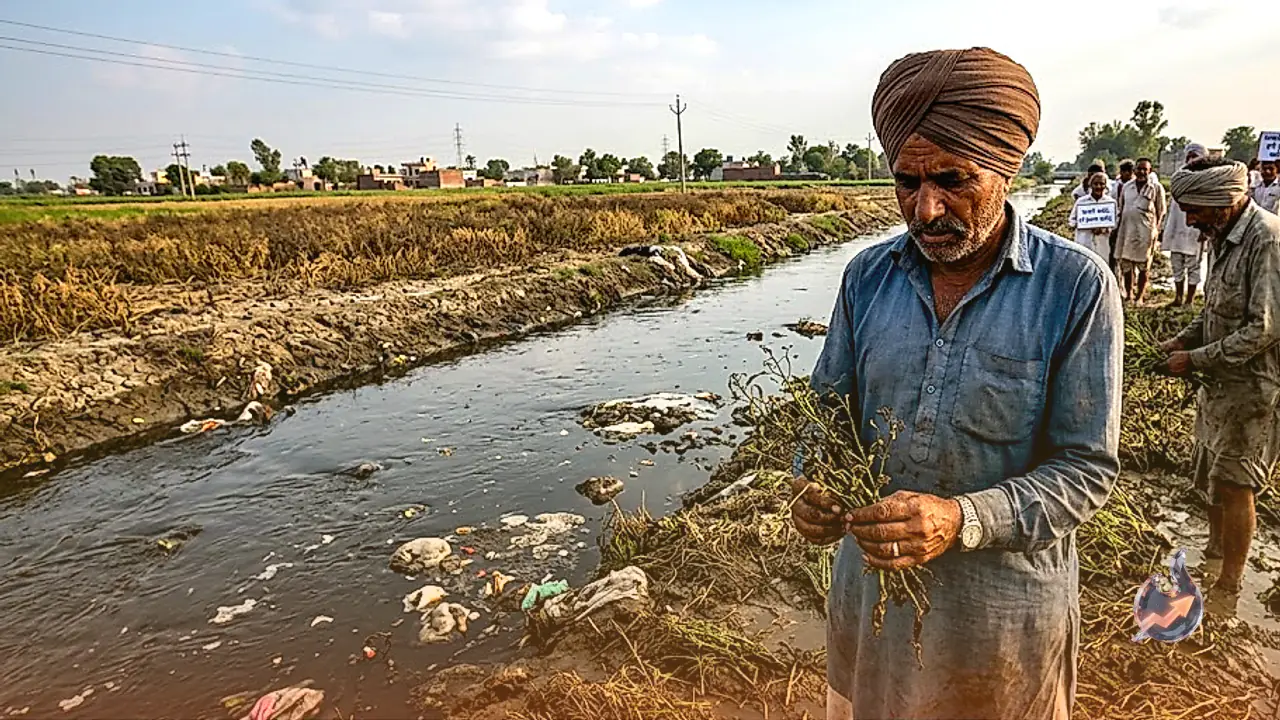

Farmers across several agricultural villages in Faridabad district of Haryana are confronting a severe irrigation crisis as the Agra Canal has become heavily contaminated with industrial effluents and urban sewage. Once a reliable lifeline for local agriculture, the canal now carries pitch-black, chemical-laden water that threatens to destroy standing crops and permanently damage soil fertility. Due to a lack of alternative water sources, local cultivators are forced to irrigate their fields with this toxic mixture, raising urgent concerns over agricultural sustainability and community health.
Toxic Industrial Effluents and Sewage Waste Pollute the Canal
Flowing from Delhi through various rural pockets of Faridabad, the Agra Canal has seen contamination levels surge to dangerous limits. Devi Singh Lamba, a farmer residing in Jawa village near Ballabhgarh, explains that surrounding chemical manufacturing units routinely discharge untreated industrial waste directly into the canal bed. When this chemical-infused water reaches agricultural fields, it scorches crops and impairs soil health. Furthermore, residents living in villages adjoining the canal are reporting an increase in serious health conditions caused by persistent exposure to toxic fumes and contaminated groundwater. According to Devi Singh Lamba, industrial establishments and local municipal departments must set up proper water treatment infrastructure so that effluents are thoroughly treated before release.
Severe Impact on Sotai Village and Regional Farming
Narayan, a farmer cultivating roughly 6 acres of land in Sotai village, describes the complete helplessness of the farming community. He points out that municipal drains and overflowing sewer lines are being diverted straight into the Agra Canal alongside toxic factory waste. With no secondary canal systems or adequate tube well infrastructure available, farmers have no choice but to pump this foul, hazardous water into their fields. Cultivators are increasingly anxious about the long-term food safety risks and health hazards posed by harvesting crops irrigated with chemical waste.
Sandeep Kumar, another farmer from Sotai village, highlights the magnitude of the agricultural sector at risk. Sotai village alone encompasses between 700 and 800 acres of fertile farmland that depend entirely on the Agra Canal for irrigation. Sandeep Kumar notes that the canal water currently resembles thick, black sewage. A decade ago, the canal supplied clean water, and agricultural operations ran smoothly without contamination issues. However, over the past 10 years, rapid and unmonitored industrial expansion across the region has progressively worsened the water quality. Because local agriculture relies so heavily on this canal, degraded water quality impacts the livelihood of hundreds of farming families.
Crop Damage, Soil Degradation, and Escalating Health Risks
The damage inflicted by polluted canal water extends far beyond immediate crop failure; it threatens long-term agricultural productivity by altering soil composition and acidity. Toxic chemical residues accumulate in the topsoil, destroying beneficial micro-organisms and reducing crop yields season after season. Simultaneously, nearby villagers face heightened health risks, including skin diseases and respiratory issues linked to proximity to open chemical drains. Farmer Devi Singh Lamba notes that these irrigation challenges compound existing economic burdens, such as chronic fertilizer shortages. Farmers often fail to secure subsidized fertilizers on time and are forced to buy expensive supplies from the open market. Suffering crop losses from poisoned water while paying premium prices for farming inputs is pushing smallholders into severe financial distress.
Farmers Demand Water Testing and Mandatory Treatment
Faced with deteriorating conditions, the regional farming community is demanding swift regulatory and administrative intervention. Devi Singh Lamba and fellow farmers urge authorities to conduct rigorous laboratory testing of Agra Canal water to identify toxic chemical compounds and pinpoint polluting units. They demand that strict enforcement actions be taken against factories violating environmental standards. The primary demand of the farmers is that all industrial waste and municipal sewage must undergo mandatory multi-stage filtration and treatment before being discharged into the canal, ensuring that both agriculture and public health are protected.