


















From being standard-bearer of Indian literature on the global stage with a Booker Prize to courting fierce national controversies over her political positions on Kashmir, author Arundhati Roy remains one of the most polarizing figures in contemporary public discourse. While her prose commands a dedicated global readership, her ideological stances have drawn sustained criticism across the political spectrum in India. This dual identity has once again surfaced following the release of the Hindi translation of her memoir, titled Meri Maa Meri Gangster (originally published in English as Mother Mary Comes to Me). The literary work has already been translated into 45 languages, underscoring her broad international reach.
Book Events in Patna and Delhi Spark Renewed Interest
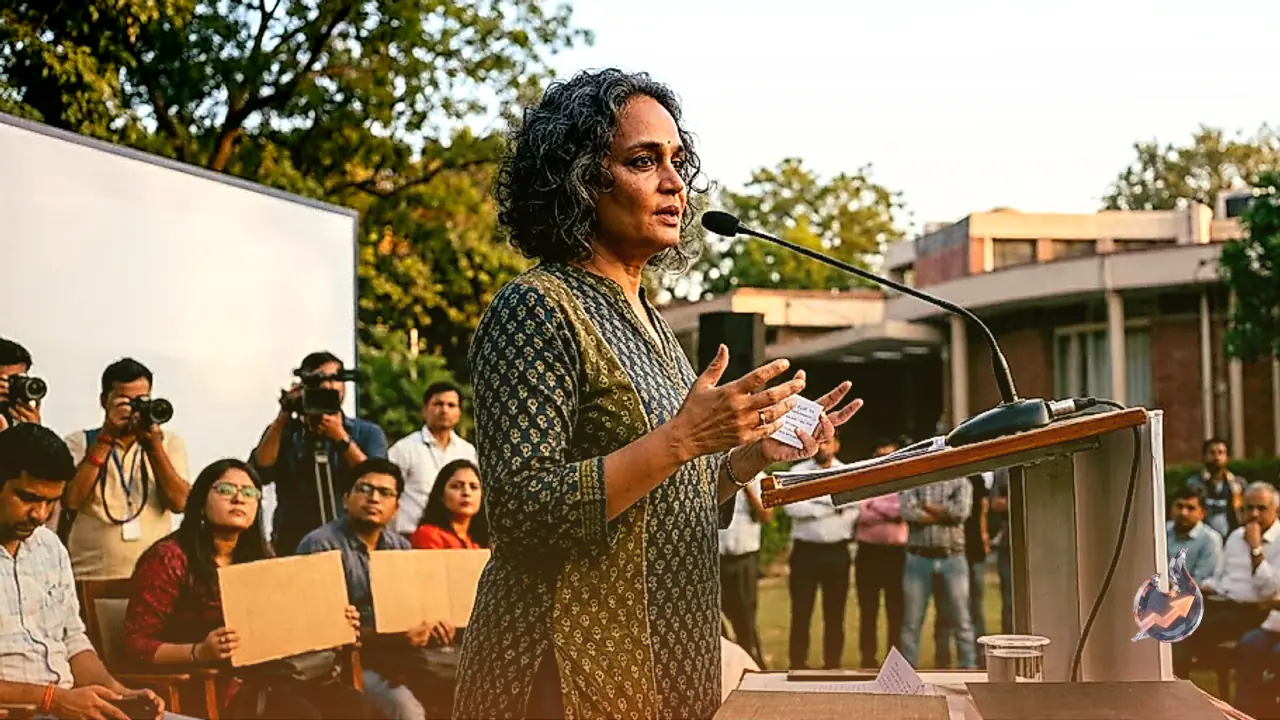
The official launch of the Hindi edition took place on 18 July 2026 at Arthshila in Patna, Bihar, with the author present to interact with attendees. Subsequently, on 3 August, a discussion and book-signing event was held at the India International Centre in New Delhi. The event witnessed an overwhelming turnout, leaving standing room only inside the packed auditorium. However, as praise poured in during these literary gatherings, a parallel wave of criticism re-emerged on social media platforms, where past speeches and photographs were circulated to challenge her political record.
Memoir Explores Complex Dynamics of Family and Authority
The book itself is a deeply personal memoir focusing on her intricate relationship with her late mother, Mary Roy. Across its pages, the narrative weaves together themes of maternal bond, personal friction, female identity, and the nature of social and political authority. Arundhati Roy recounts vivid memories spanning from her arrival in Delhi as a 16-year-old to the final moments of her mother's life. Readers and critics alike have noted the emotional depth and raw honesty with which these personal milestones are depicted.
Literary Acclaim and the Rise of a Bold Voice
The first dimension of Arundhati Roy's public identity was established in 1997, when her debut novel The God of Small Things won the prestigious Booker Prize. The achievement marked a significant moment for Indian writing in English, garnering widespread international critical acclaim. She later authored her second novel, The Ministry of Utmost Happiness, along with several non-fiction essay collections focusing on environmental destruction, the Narmada Dam project, tribal rights, and caste politics. Her sharp, uncompromising prose style earned her a reputation among admirers as a fearless and independent intellectual.
The Kashmir Controversy and Public Backlash
In contrast to her literary accolades, her second public persona stems from her explicit commentary on the Kashmir dispute. Roy has repeatedly asserted that Kashmir is not an integral part of India. Speaking at a public seminar titled Azadi - The Only Way in Delhi on 21 October 2010, she stated that Kashmir had never been an integral part of India, calling it a historical fact and claiming that the Indian government had acknowledged this at the United Nations. She further remarked that India needed liberation from Kashmir just as much as Kashmir needed liberation from India.
Legal Scrutiny and Criticism of Separatist Alignments
Roy reiterated these remarks a few days later, on 24 October 2010, during an event in Srinagar. A prominent national newspaper featured her statement on its front page on 25 October 2010. The comments prompted widespread outrage across the nation, leading to calls for legal prosecution. Opponents argued that freedom of speech does not extend to questioning national sovereignty or encouraging secessionist sentiments. Her public association with separatist figures such as Syed Ali Shah Geelani and her perceived sympathy toward anti-establishment movements in Kashmir sparked deep discomfort among a large segment of Indian society.
Freedom of Expression Versus Civic Responsibility
This duality is reflected within her literary output as well. For instance, her novel The Ministry of Utmost Happiness incorporates Kashmiri characters and storylines, while her essay collections regularly critique state policy and military presence in conflict zones. While Roy views herself as an active citizen duty-bound to question power, critics argue that sharing platforms with separatist leaders goes beyond constructive civic activism. Detractors emphasize that public figures holding international stature bear a responsibility toward the nation, as their statements can influence public perception and young minds.
A Consistent Anti-Establishment Record Across Regimes
An examination of her public record indicates that Roy's confrontational stance is not directed at any single political party, but rather at the Indian state machinery regardless of who holds power. During the Congress-led administration, her critiques regarding the Narmada Dam, nuclear policy, tribal displacements, and Kashmir were as stern as her current opposition to the BJP government. In fact, her controversial remarks on Kashmir in 2008 and 2010 drew strong condemnation from both the Congress and the BJP, demonstrating a long-standing pattern of anti-establishment commentary.
Conclusion
Ultimately, Arundhati Roy's literary accomplishments and global standing remain undeniable, as evidenced by the widespread translation of her work across 45 languages. Yet, her political positions on Kashmir remain unacceptable to a vast majority of Indians. Balancing the bounds of artistic expression with national integrity remains a complex debate, leaving Arundhati Roy as one of the most polarizing figures in modern Indian public life.