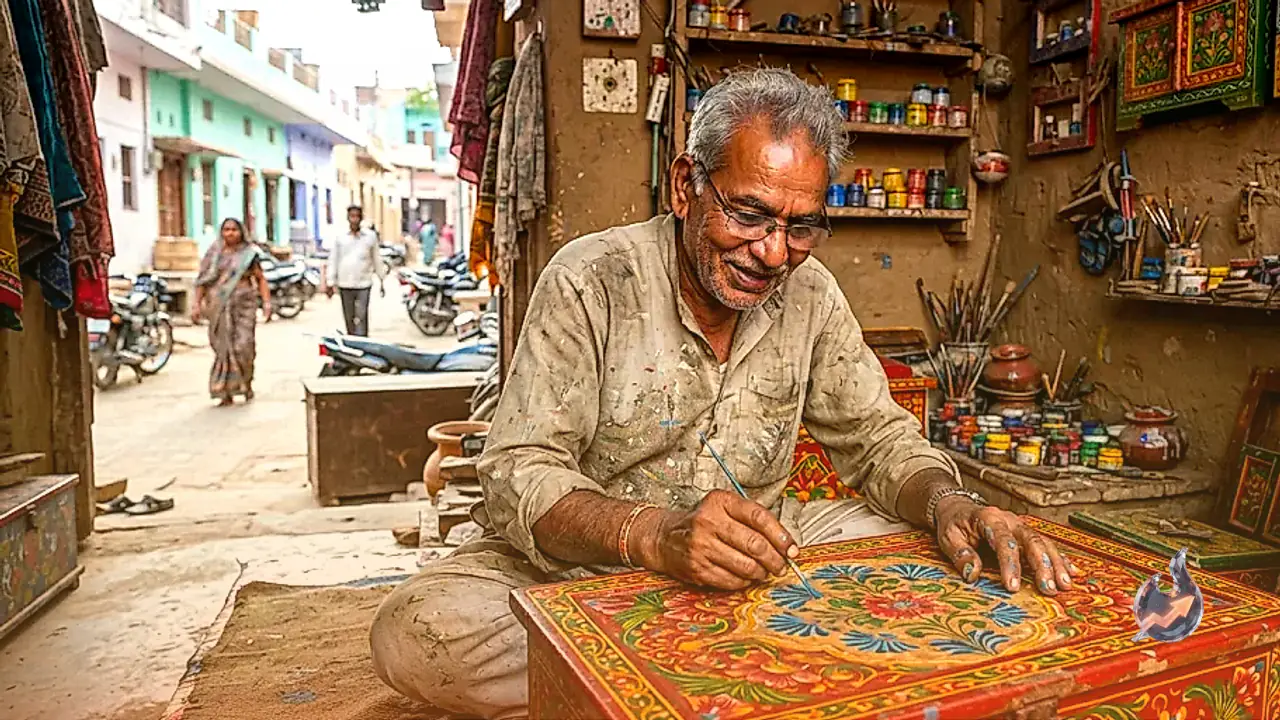

At a time when conventional wisdom pushes young individuals toward formal degrees and civil service employment, an artisan in Jharkhand demonstrates the enduring value of practical talent and self-reliance. In Rohini village, located within Deoghar district, 42-year-old Abhay Rana chose a path centered entirely around craftsmanship rather than corporate positions or government jobs. For the past 30 years, he has relied solely on paintbrushes and pigments to secure a livelihood and provide for his family.
Mastering the Craft Without Formal Training
Rana discovered his passion for colors and sketching during his early childhood years. Due to financial constraints, pursuing higher education or enrolling in an established art academy was out of reach. Instead of letting circumstances deter him, he took the initiative to practice on available surfaces, teaching himself how to letter walls, balance tones, and sketch distinct motifs.
Through relentless trial and regular practice, his precision improved significantly over time. Local residents began noticing the finesse in his lettering and drawings, which gradually transformed an informal passion into a dependable profession. Rana held firmly to the conviction that genuine skill and continuous dedication would eventually establish his identity and financial independence, an approach that ultimately shaped his entire career.
Versatility Across Walls, Portraits, and Nature
Rather than confining his work to a single style, Rana developed an adaptable skill set suited to varied client demands. His day-to-day assignments range from commercial lettering and informational wall messages to intricate home painting projects. He also accepts commissions for realistic human portraits as well as depictions of wildlife, birds, and scenic landscapes.
Whenever a project arrives, he approaches the surface with complete dedication, ensuring that the final outcome meets the client expectations while preserving artistic quality. For Rana, handling brushes is far more than a routine trade; it forms the core of his personal identity and self-expression.
Facing the Shift Toward Computerized Printing
Reflecting on past decades, Rana recalls an era when digital graphics and automated printing were not commonplace. During that period, traditional painters experienced steady demand for manual banners, pamphlets, public wall ads, and customized imagery. The compensation matched the rigorous physical effort, allowing skilled craftsmen to maintain stable earnings.
The rapid expansion of computerized flex banners and quick digital print solutions has significantly transformed local market dynamics. Many commercial clients now favor automated outputs for their speed and lower upfront turnaround. This technological evolution has reduced the overall volume of hand-painted commissions and created downward pressure on earnings. Nevertheless, Rana continues his trade with resolve, refusing to abandon the brush.
Steadfast Dedication to Traditional Artistry
Even in an age dominated by screen-based layouts, Rana believes that hand-rendered brushwork carries an authenticity and warmth that digital reproductions cannot replicate. Over three decades of consistent craftsmanship have enabled him to sustain his household with dignity. He maintains that choosing traditional art over standard employment was the right decision, finding lasting contentment in his creative independence and hard-earned livelihood.