























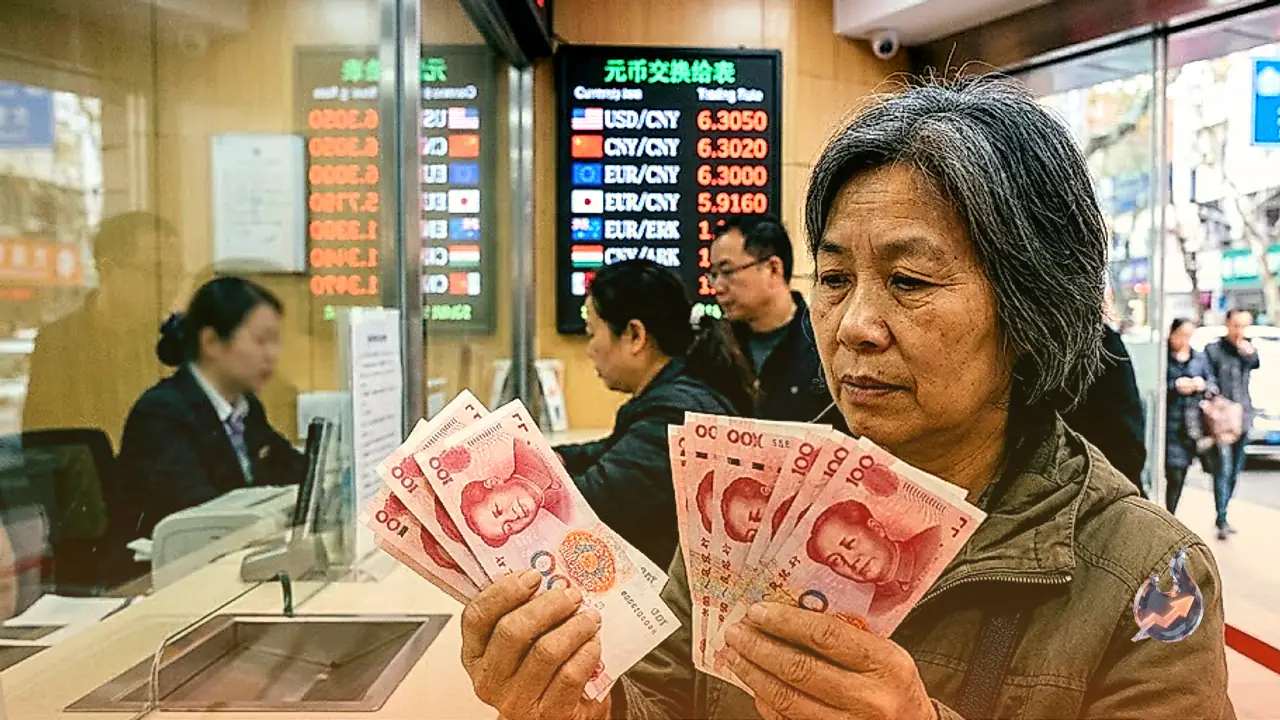

The Chinese yuan recently settled near multi-year highs in global foreign exchange markets, though official fixing levels continue to indicate that monetary authorities are putting up some resistance against an overly rapid pace of appreciation. Market analysts and observers note that a cautious regulatory stance is being maintained to prevent one-way and excessively sharp shifts in the exchange rate.
Central Bank Policy Stance and Market Metrics
The USDCNY midpoint on Friday was nudged slightly higher to 6.7817, remaining approximately 550 pips above market expectations. This positioning demonstrates that the People's Bank of China remains comfortable with gradual renminbi strength but is actively leaning against any overly rapid or one-way upward trajectory. According to live market data, USD/CNY currently trades at 6.71, down 0.16 percent from its previous close of 6.72. The pair's 52-week range spans from 6.71 to 7.19, with trading volume running at 1.00x of the 20-day average.
Technical Indicators and Momentum
On the technical front, USD/CNH last closed near the 6.7210 mark. Daily momentum remains mildly bearish, while the Relative Strength Index has dipped into oversold territory. Live technical calculations show RSI(14) resting at 17, confirming deeply oversold conditions. Additionally, the MACD prints at -0.01 versus a signal line of -0.01, with a histogram reading of -0.00, reflecting persistent downside pressure. Regarding moving averages, the 20-day exponential moving average (EMA20) stands at 6.74, the EMA50 at 6.76, and the EMA200 at 6.89, alongside an SMA50 of 6.77 and SMA200 of 6.88, indicating a long-term downtrend characterized by a death cross. Bollinger Bands (20,2) range from 6.72 to 6.77 with a midpoint of 6.75, showing the price trading below the lower band. The ADX(14) registers at 34, indicating an established trend, while the Stochastic oscillator displays a fast line of 5 and a signal line of 2, with ATR(14) at 0.00. The broader bias remains skewed toward the downside, though the risk of a sharp snapback cannot be completely ruled out.
Key Support and Resistance Levels
Foreign exchange specialists have identified critical technical boundaries for the currency pair. Immediate resistance overhead is situated at 6.7480, which marks the 21-day moving average, followed by 6.7540. Live pivot data places the nearest resistance levels at R1 6.72 and R2 6.73. On the downside, foundational support rests at 6.72, 6.7140 corresponding to the 61.8 percent Fibonacci retracement of the move from the 2022 low to the triple-top, and the psychological 6.70 level. Live metrics pinpoint S1 at 6.71 and S2 at 6.70, with 20-day support around 6.71 and resistance near 6.77.
Broader Foreign Exchange Market Overview
Across the wider currency landscape, other major currency pairs are attracting close scrutiny from market participants. The British pound (GBP/USD) has surrendered a portion of its recent recovery, revisiting the lower 1.3600 region at the start of the week. Cable trades with a mild downward bias amid respectable gains in the Greenback as investors remain cautious ahead of upcoming US economic data releases and the Jackson Hole symposium. Similarly, the euro (EUR/USD) remains slightly offered, sliding toward the 1.1660 zone to print daily troughs on Monday. The pair's pullback follows a decent advance in the US dollar while market participants continue tracking developments within the US money market.
Commodities and US Treasury Operations
In precious metals, gold has surrendered part of its initial advance, though it preserves its solid bullish structure above the $4,600 per troy ounce threshold on Monday. The yellow metal's resilience persists despite slight gains registered by the US dollar and a modest pullback in US Treasury yields across the curve. Meanwhile, the US Treasury department announced an adjustment to its calendar, stating it would at least double the size of liquidity support buyback operations across the 10-year to 20-year and 20-year to 30-year sectors. The maximum amount per operation has been lifted from $2 billion to at least $4 billion, effective from September 9 through November 4.