






















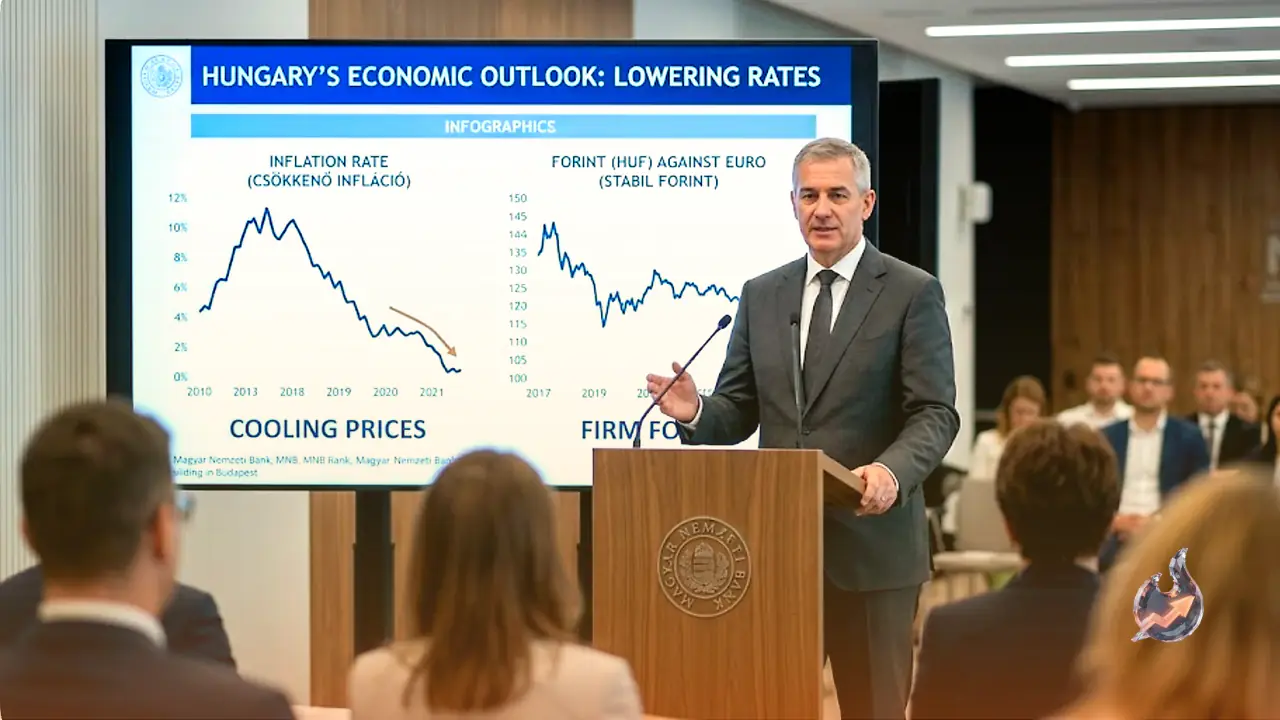

Inflation in Hungary is staying remarkably calm, and the biggest reasons are a strong Hungarian forint and a set of government measures. According to Standard Chartered's Saabir Salad, this subdued price pressure has opened the door for the National Bank of Hungary (NBH) to ease policy and adopt a noticeably more dovish stance.
Why inflation is staying tame
Despite a shock to energy prices, Hungary has managed to keep a lid on inflation. The forint's strength and government action, including caps on fuel prices, are seen as the key forces behind that resilience.
"Inflation has remained subdued despite the energy price shock, supported by a strong HUF and government measures, including fuel price caps."
The data tells the same story. Headline CPI rose 1.8% year on year in May, coming in below Standard Chartered's own 2.2% forecast and even below the lower bound of the NBH's 3% target range.
"Headline CPI came in at 1.8% y/y in May, below both our 2.2% forecast and the lower bound of the NBH's 3% +/-1ppt target range."
Forecasts trimmed lower
In response to those numbers, Salad has cut his inflation projections for the coming years. The 2026 forecast has been lowered to 2.2% from 3.9%, though it still sits above the central bank's own estimate, while the 2027 forecast has been reduced to 2.5% from 3.4%.
"In light of this, we lower our 2026 inflation forecast to 2.2% (from 3.9%, still above the central bank's forecast), and our 2027 forecast to 2.5% (3.4%)."
Risks have not gone away
Even with the encouraging picture, Salad cautions that the danger is not fully behind. He believes the risks lean toward higher inflation because of Hungary's exposure to geopolitical instability, even though the central bank itself views those risks as balanced.
"While the central bank assesses inflation risks as balanced, we continue to see risks as skewed to the upside given Hungary's vulnerability to geopolitical instability."
If inflation turns out hotter than expected, it could directly affect how quickly rate cuts proceed.
"The pace of easing could be slower if inflation proves higher than we expect."