























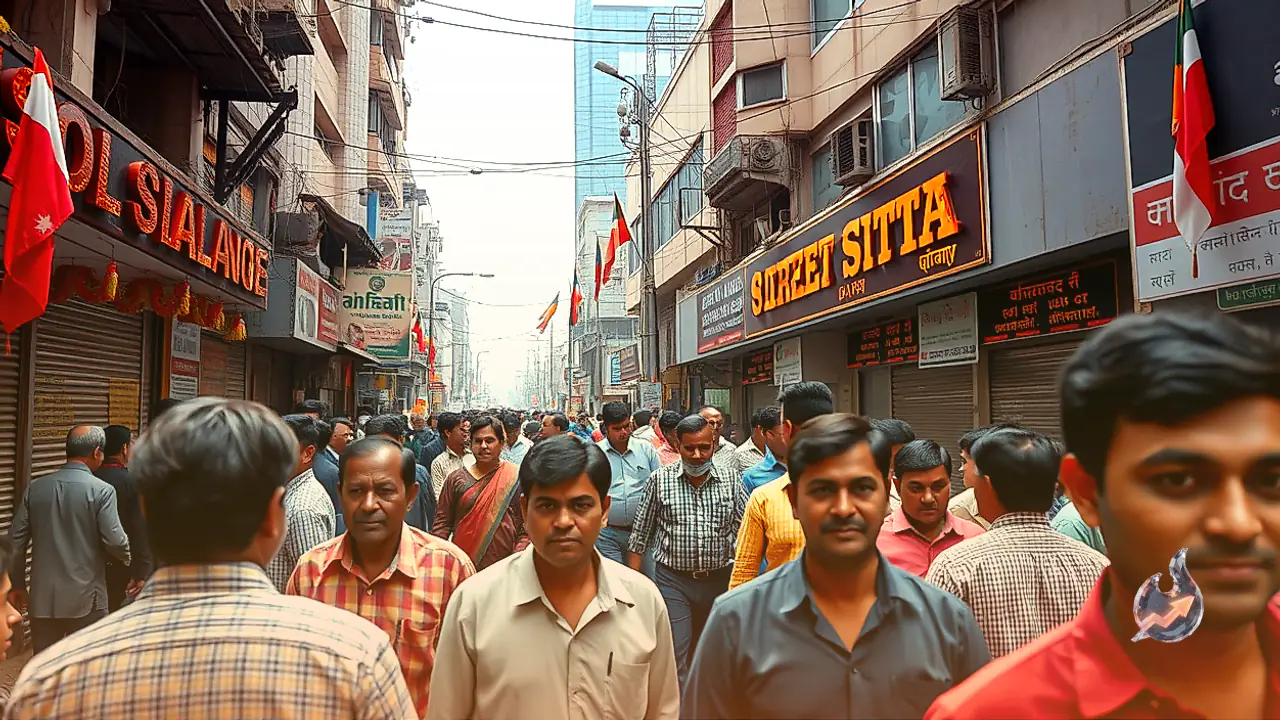

Indian financial bourses will suspend all regular business activities on October 2, 2026, to commemorate the national holiday of Gandhi Jayanti. Trading operations will remain closed across both key national exchanges, the Bombay Stock Exchange (BSE) and the National Stock Exchange (NSE). Because the national holiday falls on a Friday, the shutdown directly connects to the regular Saturday and Sunday weekend closures on October 3 and October 4. As a result, market participants and institutional desks will experience an uninterrupted three-day trading break before counters resume activity the following week.
Full Suspension Across Multiple Market Segments
The operational shutdown applies to a wide spectrum of market verticals as outlined in the official 2026 exchange holiday schedule. In addition to the cash equity segment, dealings across the equity derivatives and currency derivatives markets will be unavailable throughout the day. Fixed-income and institutional funding segments will also observe the holiday, halting transactions in the Negotiated Dealing System-Order Matching (NDS-RST), the Tri Party repo clearing window, and the Securities Lending and Borrowing (SLB) mechanism. The suspension equally applies to sovereign and corporate bonds, electronic gold receipts, and commodity derivative contracts.
The Multi Commodity Exchange (MCX) operates across two daily trading windows under normal conditions: a morning session from 9:00 am to 5:00 pm, followed by an evening session running from 5:00 pm until 11:30 pm or 11:55 pm. These dual windows allow domestic market participants to trade energy, base metals, and precious metals contracts such as gold, silver, crude oil, natural gas, lead, copper, and zinc. While MCX typically keeps its evening window active on standard commercial holidays, both morning and evening sessions will remain entirely shut on October 2 due to the national holiday designation.
Honoring Mahatma Gandhi on His Birth Anniversary
October 2 marks the national celebration honoring Mahatma Gandhi, who spearheaded the historical non-violent freedom movement that liberated India from colonial rule. Globally recognized for his steadfast philosophy of peace, communal harmony, and passive resistance, Gandhi remains an enduring national figure whose image adorns official Indian legal tender. To observe this national occasion, government offices, banking networks, and premier commercial exchanges shut down nationwide every year.
Steep Declines Preceding the Trading Break
The market pause comes directly on the heels of intense selling pressure that gripped frontline indices during the prior session. The benchmark Sensex sank by 571 points, or 0.8 percent, concluding the day at 71,909.70. Simultaneously, the broader Nifty 50 retreated 199 points, or 0.9 percent, to end at 22,421.95. The slump extended a challenging streak across the street, pushing five-day cumulative losses to 1,690.3 points on the Sensex and 694 points on the Nifty 50.
Vinod Nair, Head of Research at Geojit Investments, noted that domestic equities faced a turbulent holiday-shortened trading frame. Growing global turbulence gradually eroded domestic resilience, dragging the headline indices under key psychological support levels. Escalating crude oil prices pushed up macroeconomic concerns, while US Treasury yields approached two-decade highs under expectations that the US Federal Reserve will maintain monetary tightening. This narrowed the yield gap between India and the United States, intensifying depreciation pressures on the Indian rupee.
Institutional Outflows and Sector-Wide Fractures
Institutional trading patterns also revealed acute divergence throughout the trading week, as explained by Nair. Foreign institutional investors (FIIs) expanded their net sales, whereas domestic institutional investors (DIIs) sustained continuous buying that absorbed a major portion of the foreign pullout. While domestic absorption prevented a catastrophic plunge, it proved insufficient to halt the downward slide. Wider market segments fell in tandem with blue-chip benchmarks, while massive capital requirements from primary market IPO offerings diverted liquid cash away from the secondary equity floor.
Sector performance saw intense downside concentration in rate-sensitive and raw-material-linked baskets. Real estate, public sector undertaking (PSU) banks, consumer durables, and metal counters bore the brunt of portfolio liquidation. Automakers faced deeper declines after releasing disappointing wholesale monthly sales figures. In contrast, information technology emerged as the lone gainer, drawing defensive interest as the weakening rupee boosted projected revenue realizations for software exporters.
Forward Outlook: Central Bank Decisions and Global Signals
Addressing the path ahead, Nair highlighted the impending monetary policy decision from the Reserve Bank of India (RBI) as the foremost domestic driver. The urgent necessity to anchor the rupee and curb imported price spikes has elevated market expectations regarding a potential benchmark rate hike. Simultaneously, India's upcoming PMI numbers will reveal whether underlying economic health remains insulated from foreign macroeconomic drags.
On the international front, global yields and Fed projections will be driven by US non-farm payroll figures, PMI updates, and the publication of recent FOMC meeting minutes. Given expectations that second-quarter corporate profit growth could decelerate compared to the first quarter, overall market sentiment is projected to stay brittle. Nevertheless, any visible military de-escalation in West Asia could spark an abrupt risk relief rally. Until substantial improvements surface, market participants are encouraged to focus on balance sheet durability and visible earnings pipelines, with long-term investors utilizing price weakness to accumulate top-tier holdings gradually.
Technical Support and Resistance Parameters
From a chartist perspective, Amol Athawale, Vice President of Technical Research at Kotak Securities, indicated that the near-term market structure is technically weak but deeply oversold. Consequently, the possibility of a short-term rebound from prevailing levels remains on the table. Athawale identified 22,200 on the Nifty and 71,300 on the Sensex as a pivotal support floor, while 22,500/72,200 forms an immediate overhead resistance barrier.
A sustained breakout above 22,500/72,200 could allow the recovery move to stretch toward 22,700-22,800 on the Nifty and 73,000-73,200 on the Sensex. Conversely, breaching below the 22,200/71,300 support cushion could accelerate underlying momentum, dragging benchmarks down to 22,000-21,950 and 71,000-70,700 respectively. In the banking index, Athawale noted that 54,000 represents a make-or-break foundation for the Bank Nifty. Preserving this threshold might induce a short-covering bounce toward 55,000-55,500, but a slip below 54,000 risks intensifying downside slides toward 53,500-53,200.