























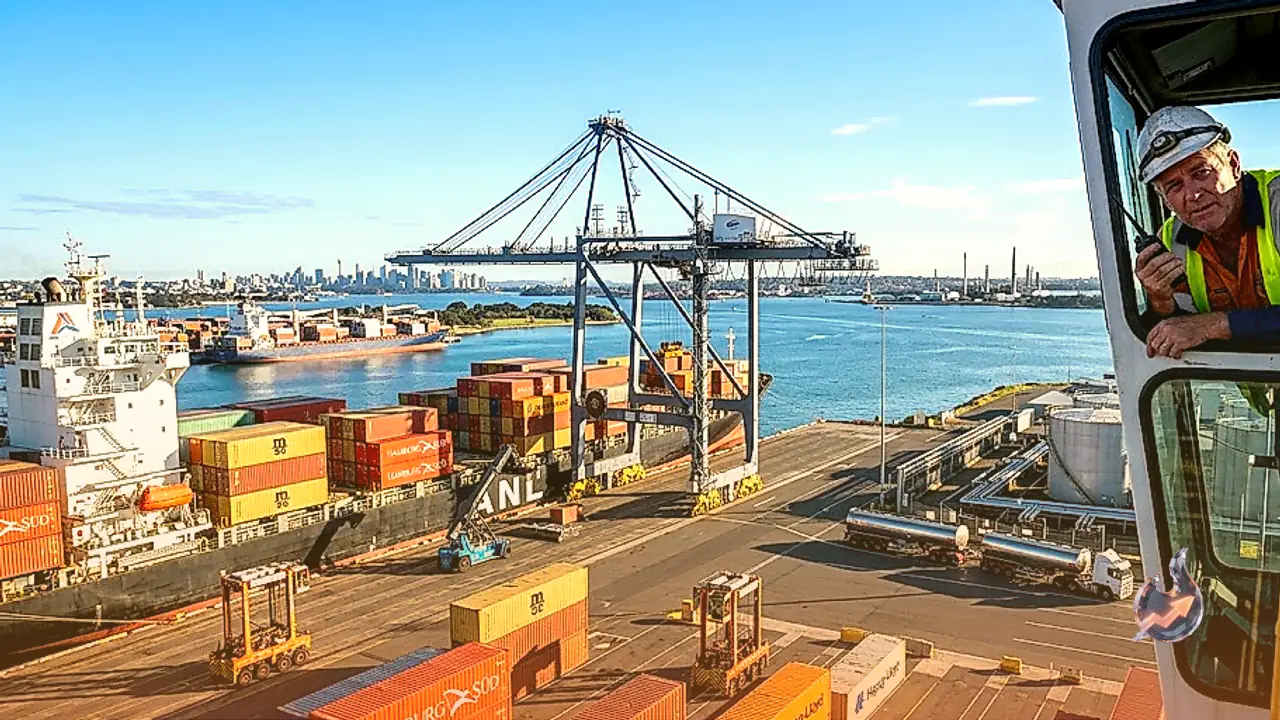

Australia's trade surplus narrowed slightly to A$1,923 million month-on-month in July, coming off a revised surplus of A$1,929 million recorded in June, according to the latest international trade figures released by the Australian Bureau of Statistics on Thursday. The reading comfortably surpassed market consensus expectations, which had projected a trade surplus of A$1,390 million for the month. Following the publication of the official trade balance report, the Australian Dollar (AUD) showed limited immediate volatility, with the AUD/USD currency pair trading around 0.7168, dipping just 0.01% on the day.
Detailed Trade Volume Analysis: July Export and Import Performance
A deeper breakdown of the trade report highlights that Australian exports contracted by 3.3% month-on-month in July. This sharp pullback follows a robust 9.6% surge in export volumes recorded in the preceding month of June. Concurrently, Australian imports declined by 2.5% month-on-month in July, accelerating from the minor 0.2% drop observed in June. Despite contractions on both sides of the trade ledger, the total value of outbound shipments continued to outpace inbound goods and services, ensuring that the country maintained a net positive trade position.
Trade balance statistics provide crucial insight into the underlying structural demand for a nation's currency. When a country consistently exports more than it imports, foreign purchasers must acquire the domestic currency to settle commercial transactions, generating natural upward pressure on exchange rates. Australia's ability to maintain a surplus of A$1,923 million despite broader global economic headwinds underscores the resilient international demand for its primary commodities and agricultural output.
Monetary Policy Dynamics: Reserve Bank of Australia Interest Rate Framework
Interest rate decisions established by the Reserve Bank of Australia (RBA) represent one of the primary macro determinants of the Australian Dollar's exchange rate. By setting the target cash rate for interbank lending, the RBA directly influences borrowing costs, consumer spending, and business investment across the domestic economy. The central bank operates under a mandate to maintain consumer price inflation within a target band of 2% to 3% over the medium term.
Relatively higher interest rates in Australia compared to other major advanced economies tend to support the AUD by attracting foreign capital seeking higher yields. Conversely, lower relative interest rates diminish currency appeal. Furthermore, the RBA can deploy unconventional policy tools, such as quantitative easing (QE) and quantitative tightening (QT). Quantitative easing expands money supply and exerts downward pressure on AUD, whereas quantitative tightening reduces liquidity and bolsters currency valuation.
Commodity Linkages: Iron Ore Exports and Chinese Demand
Australia is a resource-heavy economy whose economic performance is intimately connected with global commodity demand. Iron ore represents Australia's largest single export commodity, generating approximately $118 billion annually based on 2021 data, with the vast majority of shipments bound for industrial processing in China. Consequently, international iron ore price fluctuations serve as a direct catalyst for AUD price action.
As Australia's largest trading partner, the health of the Chinese economy plays a pivotal role in determining overall trade volumes. Robust Chinese industrial activity drives demand for Australian raw materials, spurring foreign currency inflows and boosting aggregate demand for the Australian Dollar. Surprises in Chinese macroeconomic data, whether positive or negative, frequently spill over into immediate sentiment shifts across AUD foreign exchange pairs.
Foreign Exchange Overview: GBP/USD and EUR/USD Trends
In broader foreign exchange markets, GBP/USD (Cable) extended its multi-day negative trajectory, although the pair managed a temporary bounce off four-week lows around the 1.3470 level on Wednesday. This corrective phase occurred despite a subdued performance in the US Dollar Index and persistent geopolitical friction, as market participants reassessed monetary policy paths for the Bank of England and the Federal Reserve.
Similarly, EUR/USD (Fiber) experienced sustained selling pressure, revisiting the 1.1580 region as the North American trading session drew to a close on Wednesday. The single currency built upon its Tuesday bearish momentum, while the Greenback gradually gathered traction, recovering from earlier intra-session troughs as traders evaluated upcoming macroeconomic data releases.
Precious Metals and Energy Stress: Gold Consolidation and Record Diesel Spreads
Gold prices consolidated below the $4,400 per ounce threshold during Thursday's Asian session, halting the prior session's recovery from a four-week low. Safe-haven demand stemming from heightened US-Iran geopolitical tensions and expectations surrounding potential September Federal Reserve rate cuts countered recent US economic data. Sluggish US Treasury yields provided an underlying tailwind for non-yielding bullion, maintaining a tight trading range.
Within energy markets, underlying refined product spreads indicate substantial physical supply tightness despite relatively range-bound crude benchmarks. The US diesel crack spread, measuring the premium of ultra-low sulphur diesel futures over WTI crude, broke through $100 per barrel for the first time on record, setting an intraday record high above $102.00 per barrel. This extraordinary spread highlights capacity constraints and heightened industrial demand for distillate fuels globally.
Central Bank Communication Reset and Geopolitical Shifts
The global macroeconomic environment is currently adjusting to major policy announcements. At the Jackson Hole symposium held August 27-29, Federal Reserve Chairman Kevin Warsh delivered a structural reset in central bank communication by declaring an end to forward guidance. This operational pivot signifies a return to strict data dependency, leaving financial markets to react directly to incoming economic prints without explicit forward policy commitments.
On the geopolitical front, China split the G20 alignment 19-to-1 on key international policy declarations. Simultaneously, Scott Bessent signaled that additional financial sanctions are scheduled to be implemented before the end of the week. These developments reinforce an intricate backdrop for global market participants as they navigate monetary policy shifts and geopolitical risk factors.