





















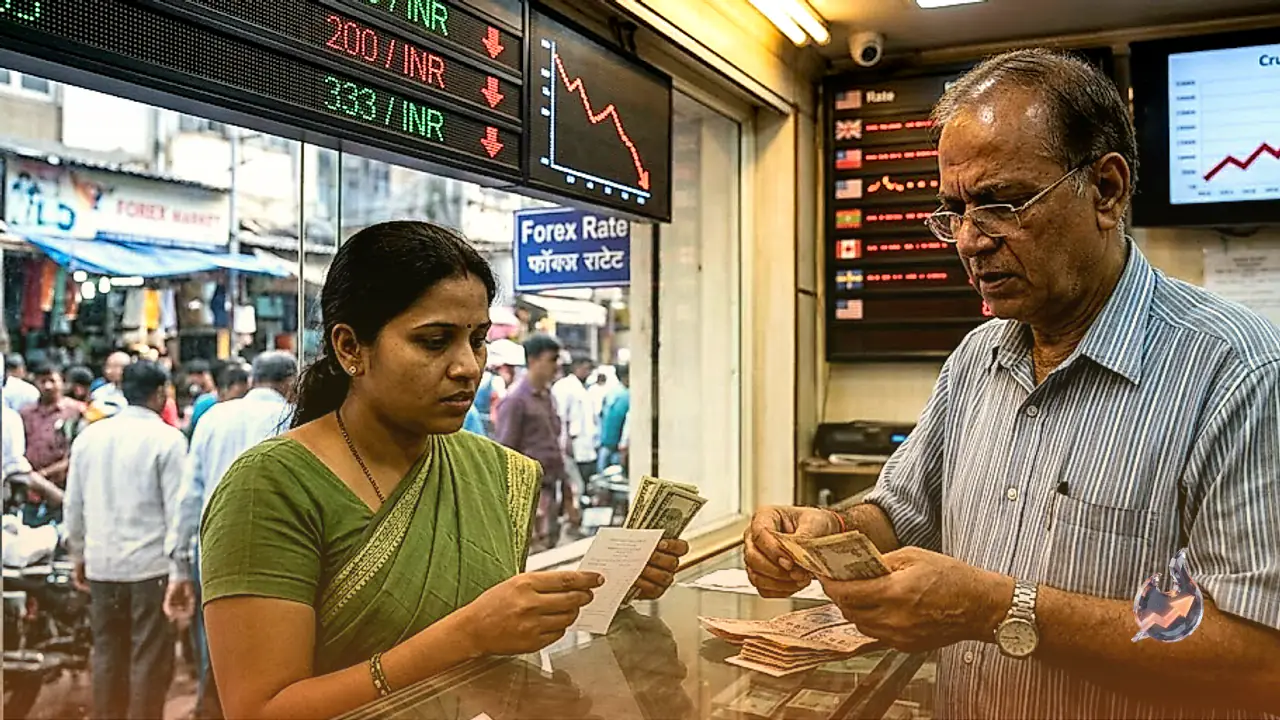

The Indian Rupee (INR) opened the week on a weak note, significantly declining against the US Dollar (USD). The USD/INR pair surged to over a six-week high, trading around the 95.80 mark. This decline is largely attributed to renewed hostilities in the Middle East, which have bolstered the appeal of the US Dollar as a safe-haven asset while simultaneously driving up global oil prices.
Market Sentiment and Oil Prices
During Monday's opening session, the US Dollar Index (DXY), which measures the greenback's performance against six major global currencies, climbed 0.15% to trade near 101.15. Concurrently, energy markets witnessed a sharp spike as the MCX Crude Oil contract expiring on July 20 jumped 4.6% to near Rs. 7,127. Economies like India, which depend heavily on energy imports, often face currency depreciation when oil prices rise sharply due to the increased cost of settling import bills.
Geopolitical Instability
The situation in the Middle East intensified following reports from the US Central Command (CENTCOM), which indicated that forces had struck more than 300 Iranian targets over three nights, with 140 of those strikes occurring on Saturday alone. The escalation has led Iran to announce the closure of the Strait of Hormuz, a critical chokepoint responsible for approximately 20% of the global energy supply. This move has rattled markets and increased the demand for safe-haven investments, further weighing on the Rupee.
Inflation Data and Policy Expectations
Domestically, the focus remains on the upcoming Consumer Price Index (CPI) readings from both India and the United States. India’s retail CPI, set for release at 04:00 PM IST, is anticipated to rise to 4.3% Year-on-Year (YoY), up from 3.93% in May. Any sign of persistent inflationary pressure is expected to increase market expectations for potential interest rate hikes by the Reserve Bank of India (RBI). US core inflation data, scheduled for release on Tuesday, is projected to hold steady at a 2.9% YoY increase.
Foreign Investment and Technical Outlook
Despite the current volatility, foreign investor interest in Indian equities appears to be showing signs of improvement as the first-quarter earnings season for FY2026-27 begins. Foreign investors have remained net buyers in five out of the eight trading sessions recorded in July so far. From a technical perspective, the Relative Strength Index (RSI) stands at 58.05, suggesting a lean toward bullish momentum without indicating overbought conditions. Initial support is expected at the 20-day EMA near 95.18. If the pair manages to break above the July 9 high of 95.96, it may attempt to revisit its all-time high of 97.10.
Macro Factors Influencing the Rupee
The value of the Rupee remains highly sensitive to external inputs including the price of Crude Oil, US Dollar movements, and foreign capital inflows. The Reserve Bank of India (RBI) frequently intervenes in the forex market to ensure stability and uses interest rate adjustments to manage inflation, targeting a 4% goal. Higher real interest rates generally benefit the Rupee by attracting foreign capital seeking higher yields, a practice commonly referred to as the carry trade. Conversely, high inflation, especially when compared to trading partners, can lead to currency devaluation.
Global Market Context
The broader financial landscape remained volatile on Monday. The GBP/USD pair struggled to find momentum below 1.3400, while the Euro held onto losses near 1.1390 against the US Dollar. Gold prices fell sharply, losing the $4,100 mark as the strengthening US Dollar and rising oil prices dampened the appeal of non-yielding assets. In the cryptocurrency space, Cardano (ADA) continued its downward trend, trading below $0.160 following a 14% drop in the previous week.