























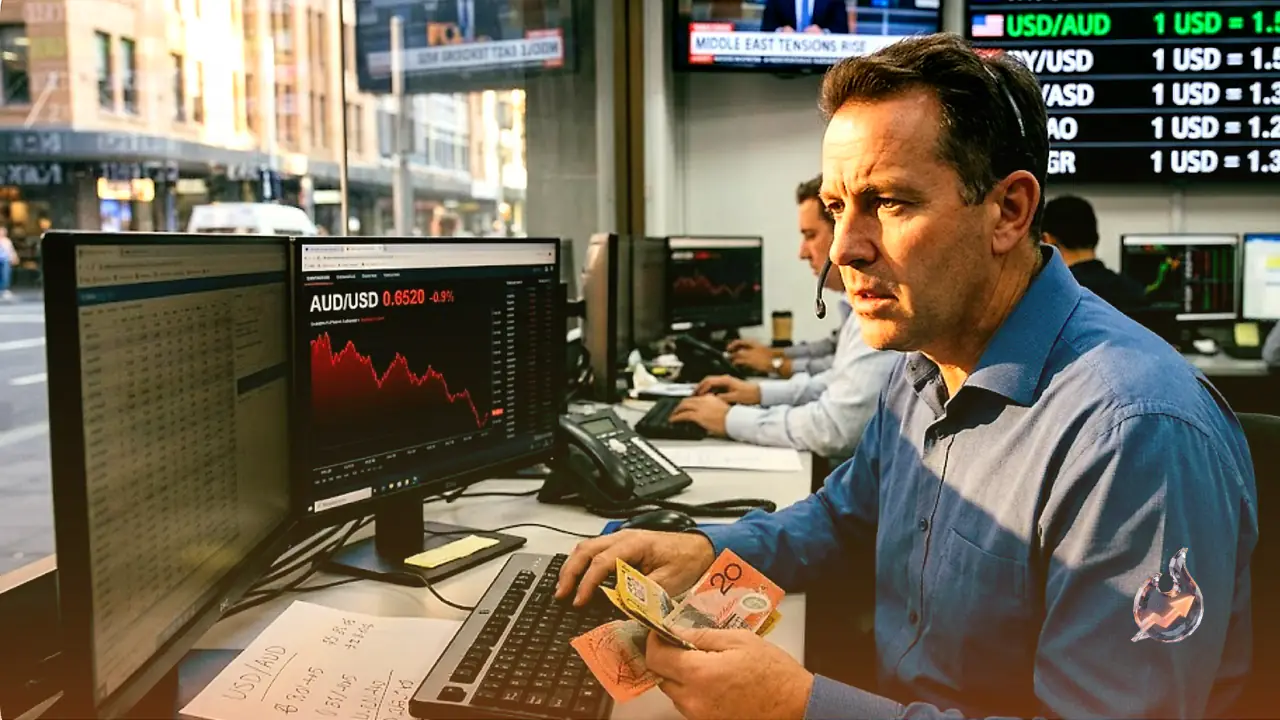

Rising tension in the Middle East has once again flipped the mood across currency markets. With hostilities flaring near the Strait of Hormuz, investors are pulling out of riskier currencies and rushing into the relative safety of the US Dollar, and that pressure has knocked the Australian Dollar down to a two-day low during the week. Intraday, AUD/USD touched 0.6928 after printing a daily high of 0.6961. In the latest live readings, the pair is changing hands near 0.6926, off roughly 0.43% from the previous close of 0.6955.
The Australian Dollar is often treated as a barometer for market appetite. It tends to rise when investors are willing to take on risk and is usually among the first to slip when fear takes over. That is exactly why any burst of geopolitical noise shows up so quickly in its price.
Why the Aussie is sliding
Conditions around the Strait of Hormuz deteriorated on Tuesday as a fragile US-Iran arrangement broke down and slid into a second round of hostilities. During the overlap between the Asian and European sessions, word came through that two vessels had been attacked. Washington hit back by reimposing sanctions on Iran's oil, while US CENTCOM said it was striking Iranian weapon launch sites and air defences, and that further strikes were expected to continue for hours.
The whole sequence turned market sentiment sour. Fear crept in, and money moved to where it feels protected, namely the US Dollar. On the back of that safe-haven demand, the greenback strengthened and moved into a position to challenge its own two-day highs.
The dollar's safe-haven bid
The strength in the US Dollar is clearest in the US Dollar Index (DXY), which measures the buck against a basket of six major currencies. At the time of writing it was up 0.26% at 101.12. Whenever uncertainty spikes somewhere in the world, investors tend to circle back to the dollar, and that familiar pattern repeated itself here.
US data in the background
Currency moves are never driven by geopolitics alone; economic data matters too. May's Goods and Services Trade Balance landed, showing the trade deficit widening by less than estimated but still coming in above April's figure. Alongside that, the NY Fed Survey of Consumer Expectations showed households bracing for higher prices, with one-year inflation expectations climbing from 3.5% to 3.7% in June. Rising inflation expectations feed straight into speculation about interest rates, which is why that reading carries weight.
What the charts are saying
On the technical side, the daily chart shows AUD/USD trading around 0.6928 while keeping a bearish near-term bias. Spot is sitting well below its latest simple triple moving average at 0.7086, and a series of previously rising trend lines now hangs overhead between roughly 0.7002 and 0.7111, forming a lid on the upside.
The 14-period Relative Strength Index (RSI) is hovering near 40, leaning mildly bearish. That signals that downside pressure is still in play, even though the pair has not yet fallen into oversold territory.
With no clear structural support drawn from the available indicators below the current price, traders are likely to keep their eyes on the topside. Initial resistance shows up near 0.7002 from the latest upward trend-line sequence, followed by a dense cap between 0.7086 and 0.7111 built from clustered broken supports and the triple simple moving average. Beyond that, a longer-term downward resistance line anchored near 0.8015 marks a more distant barrier that would need to be cleared to neutralize the broader bearish technical tone.
What actually drives the Australian Dollar
One of the biggest factors for the Australian Dollar is the level of interest rates set by the Reserve Bank of Australia (RBA). Because Australia is a resource-rich country, another key driver is the price of its largest export, Iron Ore. The health of China's economy, its biggest trading partner, matters too, along with Australia's own inflation, its growth rate and its Trade Balance. Market sentiment plays a role as well, meaning whether investors are reaching for riskier assets or hunting for safe havens; a risk-on mood is positive for the Aussie.
The RBA influences the Australian Dollar by setting the rate at which Australian banks lend to one another, which shapes interest rates across the wider economy. Its main goal is to keep inflation stable in a 2 to 3% band by moving rates up or down. Relatively high rates compared with other major central banks support the currency, while relatively low rates do the opposite. The RBA can also lean on quantitative easing and tightening to influence credit conditions, with the former negative for the Aussie and the latter positive.
China, the biggest customer
China is Australia's largest trading partner, so the state of the Chinese economy weighs heavily on the value of the Australian Dollar. When China is doing well, it buys more raw materials, goods and services from Australia, lifting demand for the currency and pushing its value up. The reverse happens when the Chinese economy grows more slowly than expected. That is why positive or negative surprises in Chinese growth data often ripple directly through the Australian Dollar and its pairs.
Iron Ore, Australia's earner
Iron Ore is Australia's largest export, worth $118 billion a year according to 2021 data, with China as its main destination. That makes the price of Iron Ore a driver of the Australian Dollar in its own right. As a rule, when Iron Ore prices rise, the Aussie rises with them because aggregate demand for the currency increases; when prices fall, the opposite plays out. Higher Iron Ore prices also raise the odds of a positive Trade Balance for Australia, which is itself supportive of the currency.
The Trade Balance factor
The Trade Balance, the gap between what a country earns from exports and what it pays for imports, is another force behind the Australian Dollar. If Australia turns out goods that are in strong demand abroad, its currency gains value simply from the surplus demand created by foreign buyers seeking those exports over what the country spends on imports. A positive net Trade Balance therefore strengthens the Aussie, with a negative balance dragging it the other way.
Looking ahead, markets will fix on the Federal Reserve's FOMC minutes and the latest jobless claims, since those will steer expectations for where rates go next. Until then, geopolitical tension looks like the heaviest weight on the Australian Dollar's path.