




















Domestic equity investors and financial market participants will navigate an uninterrupted trading schedule throughout August 2026, as both major national exchanges operate without any mid-week festival breaks. According to the official trading calendar released for the month, trading operations across Indian equity, debt, and derivative markets will remain suspended strictly during routine weekends. With no additional holidays declared by exchange authorities, market activity will proceed across all standard business days, offering active traders five full days of trading in every single week of the month.
Complete Breakdown of Non-Trading Days in August 2026
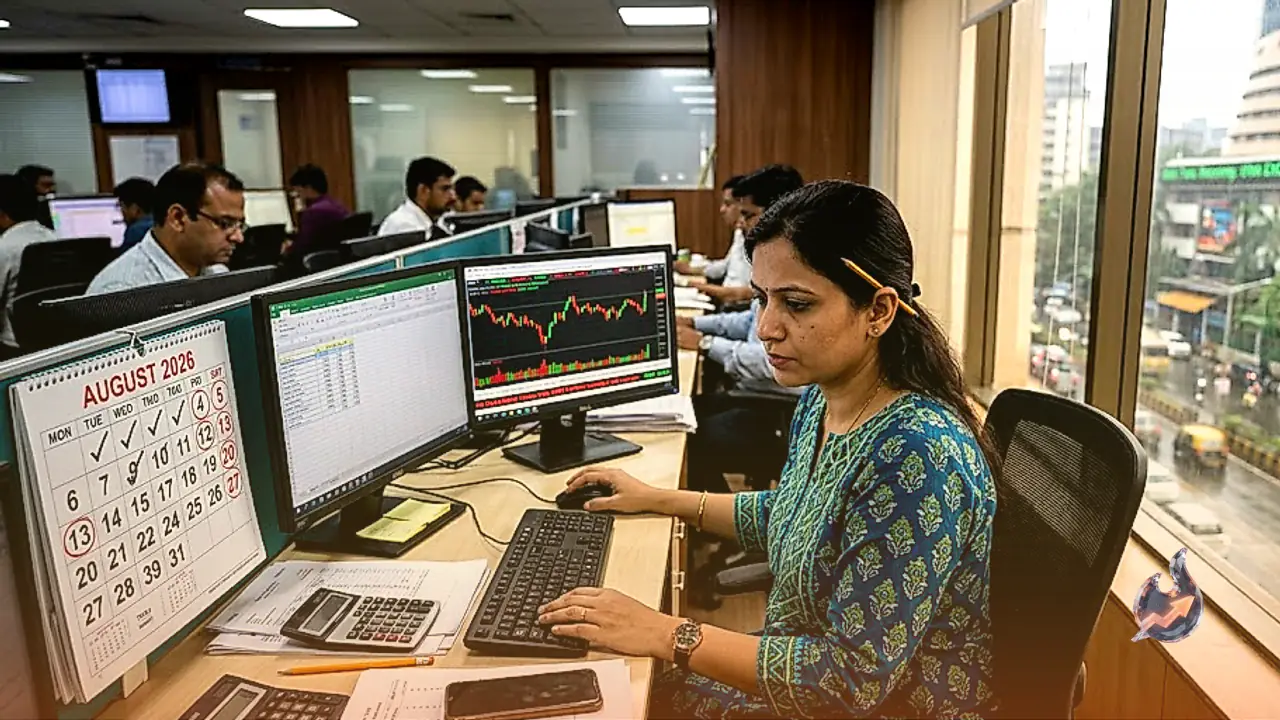
The trading schedule for August 2026 features exactly 10 non-trading days, every single one of which falls on a regular weekend Saturday or Sunday. Market activity on the National Stock Exchange (NSE) and the Bombay Stock Exchange (BSE) will be completely paused on August 1, 2, 8, 9, 15, 16, 22, 23, 29, and 30. During these 10 calendar dates, all operational market segments including cash equities, equity derivatives, currency derivatives, and the Securities Lending and Borrowing (SLB) system will remain closed for regular transactions.
Historically, India's Independence Day on August 15 serves as an official stock market holiday where trading is suspended nationwide. However, in the year 2026, August 15 falls on a Saturday. Because Saturday is already part of the established weekend closure for Indian bourses, exchange management has not designated an additional mid-week holiday for the occasion. Investors will therefore experience standard weekend operational timing without any surprise trading disruptions during the holiday period.
Upcoming Festival Calendar and Special Muhurat Trading Session
With August presenting a completely clean slate devoid of exchange-declared weekday holidays, market participants looking forward to festive trading breaks will have to wait until autumn. The next major batch of market closures is scheduled across September and October, when major national and regional festivals such as Ganesh Chaturthi and Dussehra will prompt trading suspensions on designated weekdays.
Looking further into the official financial calendar, the celebration of Diwali Lakshmi Pujan is set for Sunday, November 8, 2026. Similar to Independence Day, because the festival coincides with a Sunday, it will not disrupt the regular weekly trading hours from Monday through Friday. Nevertheless, honoring long-standing traditions, both the NSE and BSE will organize the customary one-hour Muhurat Trading session on Sunday evening. This symbolic trading window allows investors to place token orders and mark auspicious beginnings for the new Hindu accounting year.
Market Overview: Indices End Week on a Positive Note
Leading up to the start of August, Indian equity benchmark indices ended the previous trading week on a firm note, successfully recovering from a brief phase of market consolidation seen earlier in the month. The benchmark BSE Sensex surged by 166 points, or 0.2 percent, to finish near the psychological 78,000 level. Concurrently, the NSE Nifty 50 advanced by 66 points, also registering a 0.2 percent gain, to settle comfortably above the 24,350 mark. This upward movement marked the third consecutive session of gains for both key benchmark indices.
Daily Trading Trajectory and Sector Performance
The trading week experienced a dynamic sequence of events, starting with a sharp market rebound on July 27 that snapped a grueling five-day losing streak. That recovery was primarily powered by robust corporate quarterly earnings results alongside a welcome pullback in international crude oil prices. Although the market edged slightly lower on July 28 due to minor profit-taking, benchmark indices consolidated effectively on July 29 despite mixed signals from global markets. Prominent large-cap heavyweights including Jio Financial, Hindustan Unilever Limited (HUL), and Infosys provided key support during mid-week trading.
Institutional investment activity witnessed a notable shift during the final sessions of the week. Foreign Institutional Investors (FIIs) turned into net buyers across three consecutive trading sessions, injecting fresh capital into domestic equities and bolstering market confidence. In contrast, Domestic Institutional Investors (DIIs) adopted a cautious stance and recorded net sales over the same timeframe.
From a sectoral perspective, automobile and financial services stocks emerged as the primary growth drivers for the benchmark indices. Shares of major financial powerhouses such as Bajaj Finance and leading automaker Mahindra & Mahindra featured among the top weekly gainers. Conversely, information technology heavyweights, particularly TCS and Infosys, faced selling pressure and acted as the biggest drags on market momentum.