






















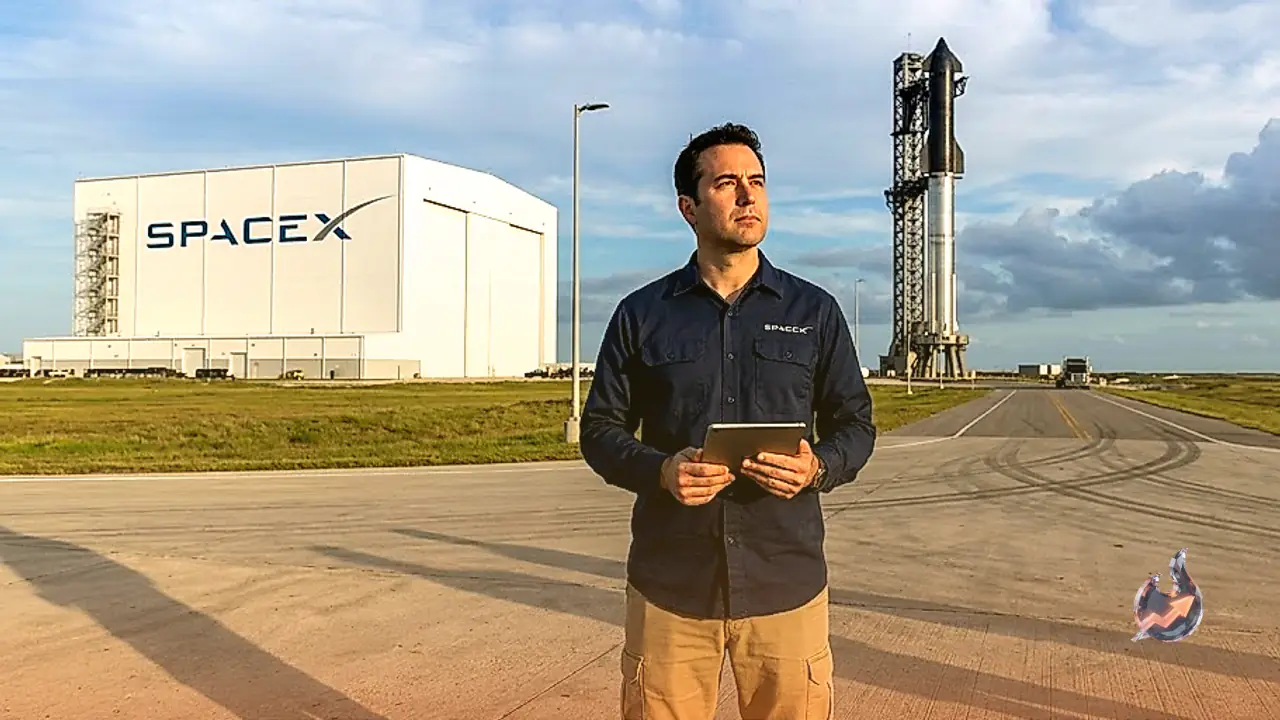

The stock that Wall Street could not stop talking about a month ago hit a sobering marker on Wednesday. For the first time since its blockbuster market debut, SpaceX's share price slipped below its initial public offering (IPO) price, an important moment in the aerospace company's very short life as a publicly traded stock. The move signals that the intense optimism which surrounded the listing has started to cool off.
The slide comes barely a month after SpaceX pulled off what became the largest IPO in history, an event that drew extraordinary investor interest and, for a brief while, pushed the company's market value into the same neighbourhood as some of the world's biggest technology firms.
What happened during Wednesday's session
In Wednesday's trading, SpaceX shares fell to around $134, dropping below their IPO issue price of $135 for the very first time. The stock did recover a little later in the day and closed at roughly $135.27. What stands out is that the shares have now dropped for several straight sessions, extending a correction that began after the spectacular rally that followed the listing.
Why falling below the IPO price matters
The IPO price is the amount at which shares are first offered to investors before they begin changing hands on the stock exchange. As long as a stock trades above that price, the investors who bought in during the public offering are generally sitting on gains. But the moment the market price drops below the IPO price, those same investors move into notional, or paper, losses, unless they had already sold their holdings earlier.
That is why a stock crossing below its IPO level is read as a sign that the market's initial enthusiasm has weakened. It does not, however, necessarily say anything about the company's long-term prospects.
From above $225 back down to $134
SpaceX made a dazzling entry into the public markets. After listing, strong investor demand drove the stock sharply higher, and the shares climbed above $225 during the very first month of trading. That rally briefly lifted the company's market capitalisation beyond $2.6 trillion, placing it among the most valuable listed companies on earth and ahead of several long-established technology giants.
At current levels, though, that valuation has pulled back sharply to around $1.75 trillion. The retreat reflects a reassessment of expectations now that the initial excitement around the IPO has faded.
Not one trigger, but several
The recent decline does not appear to trace back to a single event. Analysts believe a mix of factors is shaping investor sentiment right now.
One is that many investors are taking a fresh look at whether the company's valuation truly matches its current financial performance. SpaceX has hugely ambitious long-term plans spanning reusable rockets, satellite communications and artificial intelligence-related technologies, yet it continues to pour heavy investment into that expansion.
A $25 billion raise and the Nasdaq-100 effect
The company's large capital needs have also stayed in focus. SpaceX recently tapped the bond market to raise $25 billion, a figure that underlines just how much funding it needs to support its future projects and infrastructure. Faced with that, some investors are now taking a more measured stance after the rapid surge that followed the listing.
Another factor at play has been SpaceX's recent inclusion in the Nasdaq-100 Index. When a company enters a benchmark index, it draws buying from exchange-traded funds (ETFs) and other passive investment vehicles, which automatically purchase the shares of index constituents. Such inflows often stir up short-term price movements around the time of index inclusion.
Once those compulsory purchases are done, however, trading usually goes back to being driven by fundamentals and investor expectations, and that shift can add to volatility in the stock.