






















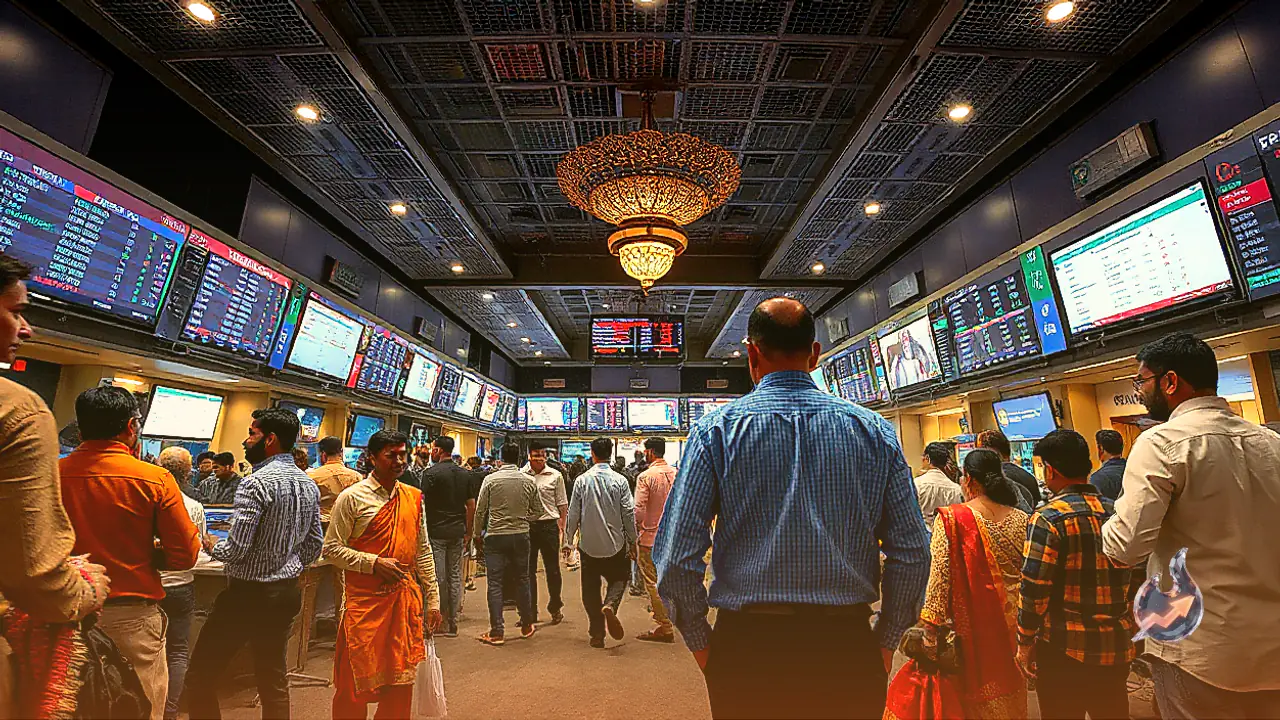

With the festive season underway, clarity has emerged regarding the operating schedule of the Indian capital markets during Dhanteras. Official holiday notifications released by the Bombay Stock Exchange (BSE) and the National Stock Exchange (NSE) confirm that equity markets will conduct normal trading operations on Dhanteras, which falls on Friday, November 6. Trading desks, retail investors, and institutional participants will operate under standard market hours without any festive closure on that day.
Complete Holiday Schedule and the Festive Timeline
The Diwali festive week begins with Dhanteras on Friday, November 6, serving as an ordinary working session for the financial markets. The festivities continue with Choti Diwali on Saturday, November 7, followed by the primary celebration of Badi Diwali on Sunday, November 8, marked as the most auspicious occasion for the traditional worship of Goddess Lakshmi. The concluding ceremonies of the five-day period include Govardhan Puja on Tuesday, November 10, and Bhai Duj on Wednesday, November 11.
According to the official trading calendars maintained by both BSE and NSE, the designated market holiday during this festive week is scheduled on November 10, aligning with the fourth day of Diwali when Govardhan Puja is observed. In the market holiday records of both exchanges, this closure is formally designated under the name of Balipratipada rather than the other associated festive dates.
Cultural and Calendar Context of Balipratipada
Balipratipada generally aligns with the Gregorian months of October or November, marking the initial day or the sixteenth day of the traditional Hindu month of Kartika. It represents the start of the bright lunar fortnight. Across several western and northern Indian states, including Gujarat and Rajasthan, this day is celebrated as the regional New Year under the historical Vikram Samvat calendar, locally known as Bestu Varas or Varsha Pratipada. Traditional scriptures and calendar systems note that this specific date occupies the position of the second half among the three and a half auspicious Muhurtas of the calendar year.
Investment Approach for the Upcoming Samvat 2083
Entering the new year of Samvat 2083 requires disciplined stock selection rather than widespread, broad-based buying across equity indices. Analysis from Religare Broking highlights that persisting global uncertainties, sudden changes in international capital flows, and shifting market valuations will continue to shape equity indices. Under these conditions, sustained portfolio growth will depend less on momentum in benchmark indices and more on pinpointing companies possessing durable competitive advantages, expanding earnings visibility, and a proven track record of outperforming industry peers.
HDFC Bank Backed by Solid Margins and Asset Quality
The investment rationale behind HDFC Bank relies on its healthy asset quality metrics, substantial capital buffers, and an improving balance sheet profile. Currently, deposit accretion is outpacing loan expansion, while core operational efficiencies remain robust across branches.
A critical catalyst for future share price performance is the expected recovery in net interest margins, driven by the steady migration of its liability base toward lower-cost deposits. Because credit provisions remain well-managed and overall loan demand is expanding across diverse sectors, net income expansion should gain momentum as interest spreads revert toward normal historical levels.
Paytm Focuses on Operating Leverage and Profit Expansion
Paytm has altered its strategic direction from chasing top-line expansion to generating recurring, compounded profits. Improvements in merchant monetisation, healthier processing margins, accelerating distribution of third-party financial services, and visible operating leverage are driving profitability improvements.
Key commercial pillars such as merchant subscription devices, digital marketing tools, credit facilitation, and overseas market entry are offering new operational momentum. Projections indicate that the business is positioned to deliver compound annual growth rates of 27.6% in revenue, 86.1% in EBITDA, and 68.6% in net profit through the fiscal year 2029.
Meesho Benefits from Rising Tier-II and Rural Commerce
Meesho is positioned to capitalise on the structural tailwinds of value e-commerce across Tier-II, Tier-III, and rural consumer belts in India. Operating on an asset-light, zero-commission framework, the business model permits rapid operational scaling while demanding limited capital expenditure.
Substantial improvements in regional order density, deployment of proprietary artificial intelligence personalisation engines, efficiency gains from the Valmo logistics network, and revenue extraction through advertising and merchant financial tools are improving margins. Financial estimates project both EBITDA and profit after tax to move into positive territory by the close of fiscal year 2028.
LG Electronics India Expands Footprint via Domestic Manufacturing
The multi-year growth trajectory for LG Electronics India is anchored in rising demand for premium household appliances, deepening supply-chain localisation, export initiatives, and significant capacity investments. Visibility is bolstered by a substantial INR 5,000 crore commitment into manufacturing facilities at Sri City, expanded capacity for compressors and residential air conditioners, expansion across B2B contracts, and rising recurring revenues from annual maintenance contracts (AMCs).
Financial forecasts between fiscal years 2026 and 2029 estimate compound annual growth rates of 13.3% in gross revenues, 22.8% in EBITDA, and 21.5% in net earnings, accompanied by healthy expansion across operational margins.
Ather Energy Positioned in the Two-Wheeler Electric Shift
Ather Energy provides direct operational leverage to India's multi-decade structural migration toward electric two-wheelers, aided by accelerating EV penetration rates, an expanding footprint into mainstream commuter scooters, and extensive manufacturing capacity additions. Proprietary technology stacks, an increasing proportion of domestically sourced components, and rising sales volumes should strengthen gross margins and operating leverage over time.
Nevertheless, because the projected price target indicates a modest upside of 11.2% from prevailing market quotes, the stock maintains a Hold recommendation despite strong underlying industrial opportunities over the long run.
Park Medi World Leads Festive Picks with Aggressive Hospital Additions
Park Medi World presents the highest projected price upside among the curated festive opportunities, propelled by an aggressive hospital bed expansion roadmap spanning northern India. The healthcare network commands a confirmed development pipeline of 2,680 beds spanning strategic acquisitions, greenfield and brownfield builds, operations and management agreements, and public-private partnerships.
Progressive improvements in average revenue per occupied bed (ARPOB), a rising proportion of high-margin super-speciality treatments, and improving unit economics from maturing hospital properties are set to power substantial earnings growth. Between fiscal years 2026 and 2029, the healthcare company is forecasted to record compound annual growth rates of 26.8% in revenues, 28.8% in EBITDA, and 33.7% in net profit.