





















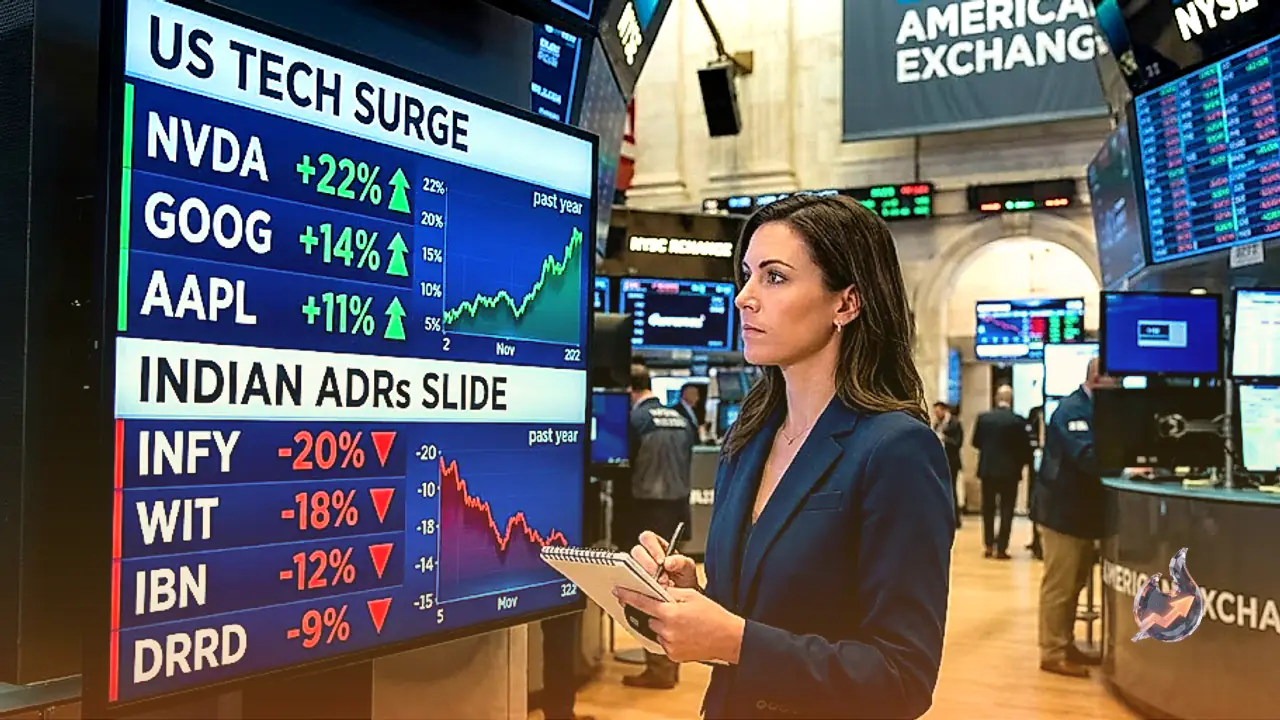

Over the past year, most of the Indian companies whose shares trade in the United States as American Depositary Receipts have drifted lower, and technology names led that slide. Infosys and Wipro both ended the period with double-digit losses as demand for IT services stayed weak. American technology heavyweights told a very different story, with Nvidia, Alphabet and Apple all pushing higher across the same stretch.
IT listings dragged down by weak demand and an IBM shock
The soft patch in global technology spending hit Indian software exporters directly, and a steep fall in IBM shares made matters worse. IBM dropped 25.5% after its second-quarter results came in below expectations, and that weakness spilled over onto Indian IT ADRs, which investors tend to treat as part of the same broad trade. With order books under pressure and clients holding back, the market gave these listings little benefit of the doubt.
Banks failed to pick up the slack
Financials offered no shelter either. HDFC Bank and ICICI Bank, the two most closely watched Indian banking ADRs, both underperformed over the year. Taken together with the IT weakness, the result was thinner investor confidence in several India-linked listings on American exchanges.
Six listings, one uneven scoreboard
There are six Indian ADRs trading in the US, and the broad picture across them over the past year was negative more often than not. Data for Tata Motors, which is listed on the New York Stock Exchange, was not available, leaving a small gap in the overall tally.
Why home-market moves looked milder
One pattern stood out repeatedly: the domestic share moves in India were usually less negative than the swings in the US-listed ADRs. That gap tends to appear when the rupee weakens against the dollar, since currency shifts change how the same company looks to a dollar-based investor. Differences in trading hours, liquidity and overall investor mood from one exchange to another add to the divergence. A few moves were fleeting, such as the brief lift from talk of a US-Iran deal.
Dr. Reddy's under the microscope
Dr. Reddy's drew extra scrutiny after a run of earnings and product updates. The company temporarily halted commercial supplies of its generic semaglutide because of an API issue. On top of that, Torrent Pharmaceuticals recalled select batches of Semalix injection pens that had been manufactured by Dr. Reddy's. Both developments weighed on the company's shares at home as well.
A split picture across two markets
Back in India, Tata Motors was a rare bright spot, standing out as a positive performer even though its ADR visibility was limited. That contrast captures the wider theme. On Wall Street, prices reflected global uncertainty and sector-specific headwinds. On Dalal Street, trading sent mixed signals, cushioned by steady local participation and currency factors. The net effect was a divided outcome for Indian ADRs, depending on which venue you looked at.