





















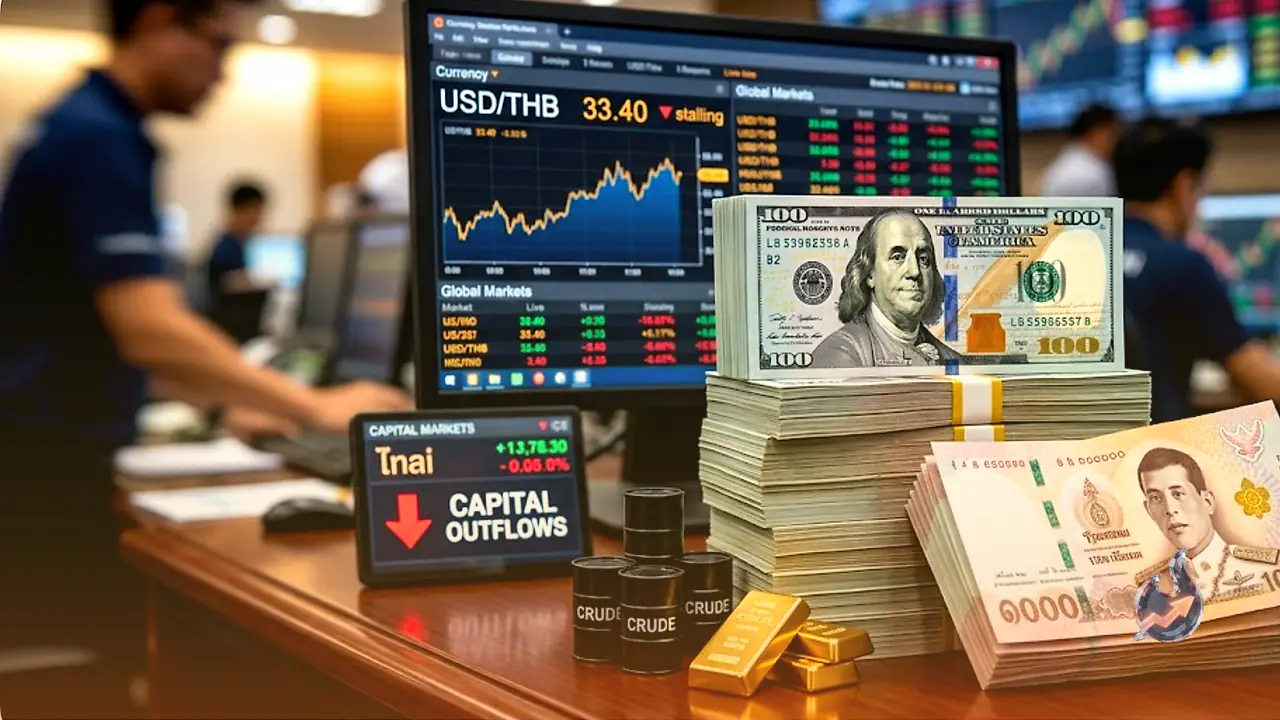

The Thai baht's attempt to claw back ground against the US dollar looks more like a pause than a turnaround, with analysts at OCBC warning that any rebound is likely to stay shallow as long as the greenback keeps its footing. The USD/THB pair has cooled slightly after a sharp climb, but the forces that pushed it higher have not gone away.
Where the pair stands now
After a sudden jump last week, USD/THB has run into interim resistance near the 33.40 area, a sign that buyers are meeting their first real hurdle. The pair was last quoted around 33.28 in the OCBC note. Live data on Tuesday shows it changing hands near 33.22, a touch below the previous close of 33.25, a slip of about 0.09% on the day. The pair has spent the past year inside a 30.82 to 33.47 band, and it is now pressing the upper end of that range.
Why the baht has been under pressure
Bank of Thailand officials have pinned the currency's weakness mainly on two things: broad strength in the US dollar and a steady stream of money leaving Thai equities. At the same time, they have made clear they are ready to step in and smooth out any moves they judge to be excessive, a reminder that the central bank is watching the pace of the slide rather than defending a particular level.
What could cap the dollar's advance
One offset is energy. Softer oil prices tend to ease the upward pressure on USD/THB, since Thailand is a heavy oil importer and cheaper crude lightens its import bill. But that single tailwind may not be enough. For the baht to mount a genuine recovery, several things likely need to line up at once: the dollar's momentum has to fade, oil has to stay contained, the outflows from Thai portfolios have to slow, and gold prices have to settle down. Until that mix falls into place, the bounce is expected to lack staying power.
The levels traders are watching
On the downside, support sits at 33.20 and again at the round 33 mark. On the upside, resistance is pegged at 33.41, which lines up with the 61.8% Fibonacci retracement of the move from the 2025 high to the 2026 low, a level chart watchers treat as an important inflection point. Live market readings echo this map, with near-term support around 33.17 and 33.11 and resistance at 33.27 and 33.31, clustered around a pivot near 33.21.
What the charts are saying
Momentum still leans gently in the dollar's favour. The daily chart keeps a mild bullish tilt, and live indicators back that up: the MACD reads 0.19 against its 0.15 signal line, a modestly positive setup, while the pair trades above its 20, 50 and 200 period moving averages with a golden cross in place, a classic marker of a longer-term uptrend. Still, the picture is not one way. The RSI, now around 62, is cooling off from overbought territory, hinting that the rally is losing intensity. The ADX near 18 points to a weak, range bound trend rather than a powerful one, and a pullback lower cannot be ruled out.
The wider market backdrop
Part of the baht's fate is tied to global risk appetite, and the mood there is cautious. Gold, one of the variables OCBC flagged, has been choppy, and money has been sitting on the sidelines elsewhere. Ethereum exchange-traded funds recently saw about $8 million in outflows even as stablecoin inflows suggested capital parked and waiting, while Bitcoin has been consolidating near $60,000 as large holders buy dips against steady ETF selling. That kind of hesitation in risk assets tends to keep a bid under the dollar, which in turn limits how far the baht can climb.
The bottom line
For now, the message from the charts and the central bank alike is one of patience. The baht is not collapsing, but it is not breaking free either. A durable recovery rests on the dollar easing off, oil staying calm, outflows slowing and gold finding a floor. Strip any one of those away and the currency is likely to keep grinding sideways near the top of its yearly range, with the 33.40 ceiling and the 33.20 floor framing the next move.