























A four-foot-tall humanoid robot strolls down the cobbled streets of Poland, conversing fluently in Polish with passersby, joking with local police officers, and hiking up mountain trails. Across the Atlantic Ocean in Miami, another identical metallic figure sports sports jerseys at World Cup after-parties, commanding between $800 and $1,200 an hour to entertain clubgoers and corporate executives. In 2026, humanoid robots have transcended industrial research laboratories to become the internet's most viral content creators. Behind this global wave of robotic influencers lies a single Chinese hardware platform: the Unitree G1. Manufactured by a Hangzhou-based robotics pioneer, this affordable child-sized humanoid is transforming pop culture, generating billions of views, and driving a commercial revolution that is reshaping the global robotics industry.
From Polish Streets to Global Virality: The Birth of Edward Warchocki
Six months ago, software developer Bartosz Idzik and his business partner Radosław Grzelaczyk decided to order a humanoid robot directly from China. They christened the machine "Edward Warchocki", a playful blend referencing Grzelaczyk’s dog Eddie and "warczeć," which means growling in Polish, while crafting a moniker that reads like an authentic Polish identity. When Edward first took to the streets, the silent 40-kilogram machine evoked unease among onlookers. Recognizing that silence bred fear, Idzik leveraged his programming background to connect Edward directly to a large-scale language model (LLM). The modification allowed the robot to process live spoken Polish and respond dynamically in real-time conversations.
Once Edward gained a voice, public perception flipped instantly. The machine transformed from an intimidating piece of hardware into a beloved local celebrity. Edward began embarking on public adventures: visiting the Polish parliament to chat with politicians, trekking up scenic mountain trails, wading in freshwater lakes, and even undergoing a staged arrest by humorously cooperative police officers. The robot's peak viral moment arrived in April when a video captured Edward carrying a backpack and wearing a Rolex while chasing wild boars through the streets of Warsaw. The clip exploded across social networks worldwide. Today, Edward commands over 1 million followers and has accumulated 4 billion total video views across social platforms.
A Worldwide Sensation: Humanoid Influencers Take Over Global Cities
Edward Warchocki is not an isolated phenomenon; in 2026, robotic influencers have surfaced across major metropolitan cities worldwide. In Austin, Texas, a robot dubbed "Rizzbot" dons a cowboy hat while engaging in humorous flirtatious banter with pedestrians on public sidewalks. In New York City, "Bart Robot" joined ecstatic fans in the streets, breakdancing to celebrate a historic basketball championship victory with Knicks fans. Down in Florida, "Brickell Clanker" became a fixture at post-game celebrations during international soccer tournaments, seamlessly swapping team jerseys to party alongside fans from Argentina, Brazil, and the United States. An anonymous online post on X summed up the spectacle by declaring how lit the metallic performer was.
The Hardware Behind the Trend: Unitree G1 Specifications and Versatility
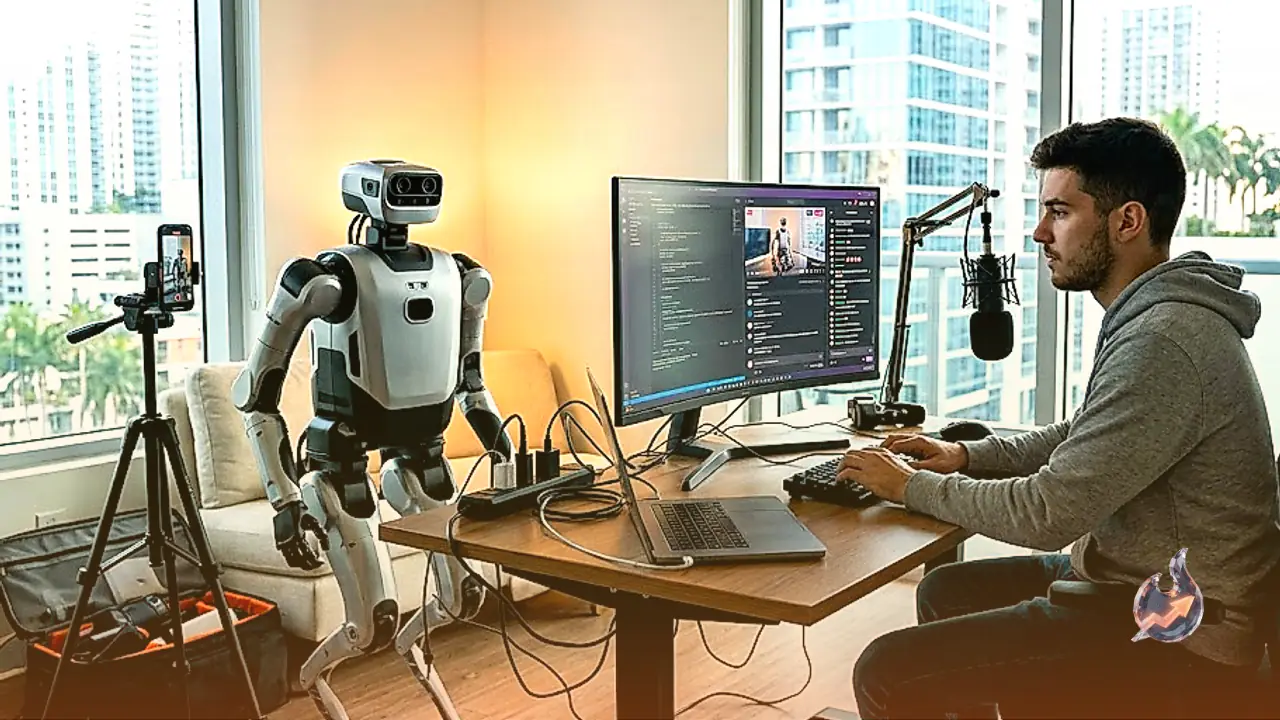
While each robotic persona exhibits a distinct personality, all of these global viral sensations share the exact same foundation: the Unitree G1. Standing roughly at the height of a young child, the G1 features a light-gray aluminum alloy skeleton and a signature hollowed-out face ringed by a vibrant blue light. Built by Unitree, a prominent Chinese robotics manufacturer, the G1 has emerged as one of the most accessible humanoid platforms on the international market.
The robot's mechanical versatility has allowed creators to stage an astounding variety of stunts. Unitree G1 units have performed kung fu demonstrations on America’s Got Talent, engaged in staged boxing matches, navigated complex parkour obstacle courses, and danced on stage at music concerts. They have been filmed running alongside children, attempting (and hilariously failing) to cook meals, co-hosting live broadcasts with prominent streamer Kai Cenat, humorously begging for money, and engaging in self-dating skits. In Asia, G1 units have been formally ordained as monks in Japanese and Korean temples, while in Dubai, a G1 was recorded participating in prayer at a local mosque. Idzik noted that after evaluating multiple humanoid platforms, his team determined the G1 was unmatched for their interactive goals, suggesting that international observers must reframe their view of Chinese innovation in humanoid robotics.
Breaking Lab Boundaries: Unitree’s IPO and Financial Dominance
Unitree is preparing for an initial public offering (IPO) on China's domestic stock exchange in roughly two weeks, revealing financial metrics that distinguish it from competitors. While the vast majority of robotics companies remain bogged down in experimental research labs, Unitree has successfully transitioned into commercial mass delivery. According to its financial disclosures, over 50 percent of the company's 2025 total revenue originated from delivering humanoid robots directly to commercial customers.
During 2025, Unitree shipped 5,511 humanoid units globally at an average price tag under $25,000 per robot. International demand proved exceptionally strong, with 43 percent of total sales coming from markets outside China. Crucially, these delivery volumes enabled Unitree to achieve profitability for the first time in company history last year, setting a milestone for the commercial humanoid sector.
The Miami Creator Ecosystem: Monetizing the $66,000 U5 Model
The success of European creators inspired 24-year-old Jake Cooperstein in Miami to launch his own robotic influencer business. In January, Cooperstein traveled to a NYC robotics warehouse to test the Unitree G1 firsthand. Impressed by its intuitive operational controls, he placed a deposit the following day.
While Unitree advertises the base G1 model at $13,500 on its official website, import tariffs, international shipping, and taxes elevate the price for US buyers, with domestic distributors listing the entry model around $19,000. However, Cooperstein bypassed the base version due to its lack of dextrous hands and strict modification restrictions. Instead, he invested $66,000 in the U5 educational variant, which features advanced multi-articulated hands, enhanced structural components, and expanded software customization capabilities.
Cooperstein named his robot "Brickell Clanker," referencing Miami's financial district, and began taking it out into public spaces. The investment quickly paid off when Brickell Clanker went viral at World Cup fan festivities. Today, Cooperstein monetizes the robot by booking appearances at nightclub parties, influencer gatherings, and corporate events, charging rates between $800 and $1,200 per hour depending on performance requirements. He recently expanded his operations by purchasing a Unitree R1, dubbed "Lil Clanker," a lighter and faster model priced at nearly one-third of the G1's base cost.
Technical Constraints: Teleoperation, Custom Motion, and Safety Protocols
Despite the illusion of autonomous AI, physical navigation remains strictly controlled. Both Idzik and Cooperstein acknowledge that when operating their robots in public environments, they rely heavily on teleoperation. While the Unitree G1 possesses theoretical autonomous navigation capabilities, potential software glitches pose serious safety hazards to crowded public spaces.
Out of the box, the G1 arrives equipped with approximately 20 built-in gestures and 15 pre-programmed dance routines. Creating custom physical movements requires specialized technical engineering. For instance, Cooperstein programmed Brickell Clanker to execute the signature "Viking Row" arm gesture popularized by Norwegian soccer supporters. Reflecting on his first public appearance during fan celebrations, Cooperstein recalled controlling the robot covertly from within the cheering crowd, marveling at how seamlessly spectators accepted the futuristic spectacle.
Regulatory Headwinds and Fleet Expansion: The Road Ahead
The rapid proliferation of Chinese humanoids faces growing geopolitical resistance in North America. Come July, the Federal Communications Commission in the US introduced a regulatory embargo restricting fresh Chinese humanoid imports. While previously approved models such as the Unitree G1 and R1 remain theoretically permitted to operate, future product generations will be blocked from entry into the US market. Unitree did not respond to requests for comment regarding the regulatory shift.
In contrast, European operations continue to expand rapidly. MERA Robotics, co-founded by Idzik and Grzelaczyk, now operates an active fleet comprising 20 humanoid units, mostly Unitree G1 models. While all units in Poland mirror Edward Warchocki's central personality matrix, the company has deployed additional units across the Middle East as well as Southeast Asia under tailored local personas.
Despite their viral success as entertainment icons, broader economic questions linger. Skeptics question whether humanoid robots can transition from crowd-pleasing social media stunts to performing traditional economic tasks on factory assembly lines or in household cleaning. Until humanoids master complex manual labor, creators continue to prove that in the attention economy, entertainment remains the most lucrative job available.