























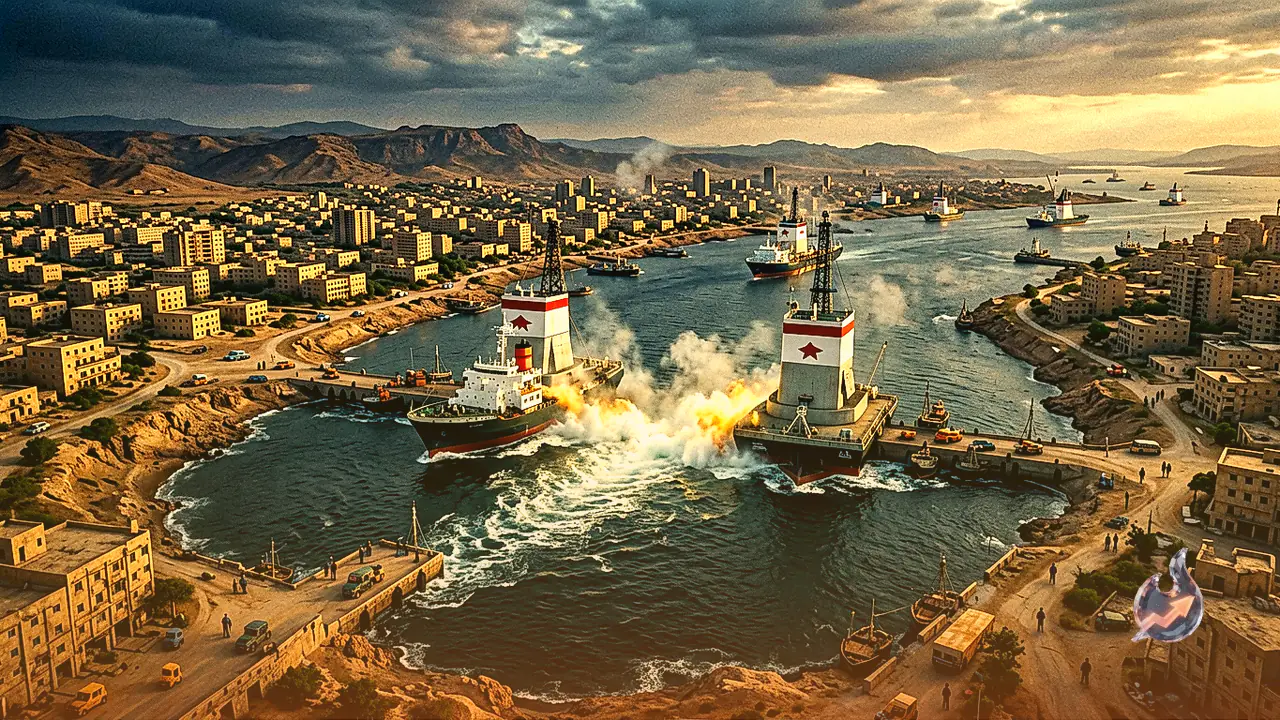

Global energy markets experienced a sharp upward movement after U.S. military forces conducted a strike against Iranian installations near a critical maritime chokepoint, pushing crude benchmarks higher by more than two percent. Brent crude futures advanced by 2.21 dollars, or 2.51 percent, to reach 90.31 dollars a barrel, while U.S. West Texas Intermediate crude gained 1.83 dollars, or 2.19 percent, to settle at 85.23 dollars. The market shift followed a Sunday operation in which American forces destroyed two Iranian missile launchers that officials stated were being prepared for attacks against commercial and military shipping operating within the Strait of Hormuz.
Tehran Retaliation and Regional Escalation
The military action immediately drew a kinetic response from Tehran. Iranian media reported that the Islamic Revolutionary Guard Corps targeted two U.S. air bases located in Jordan using ballistic missiles, though air defense systems successfully intercepted the majority of incoming projectiles. This latest round of exchanges serves to highlight how the ongoing conflict with Iran, initially anticipated by many observers to be a brief engagement, has evolved into a protracted confrontation with economic and geopolitical repercussions extending far beyond the immediate combat zone.
Origins of the Conflict and Diplomatic Strains
The current hostilities commenced on February 28, 2026, when the United States and Israel initiated coordinated airstrikes targeting Iranian infrastructure. Washington stated at the time that the military campaign was designed to degrade the Islamic Republic's nuclear and ballistic missile capabilities while restricting its capacity to project power across the Middle East. Tehran responded by launching retaliatory strikes against Israel, American installations, and various other strategic targets throughout the region. The ensuing months have been characterized by continuous military strikes, failed ceasefire initiatives, and escalating friction centered on the vital shipping lane.
Strategic Importance of the Strait of Hormuz
The waterway quickly emerged as one of the most volatile economic flashpoints of the entire geopolitical crisis. Prior to the outbreak of hostilities, approximately one-fifth of the global supply of oil and gas traversed the Strait of Hormuz, rendering the passage indispensable for major Asian energy importers including India, China, Japan, and South Korea. Larak Island is situated directly within this strategic corridor, in close proximity to some of the busiest commercial shipping lanes on earth. U.S. officials explained that the launchers targeted during the weekend operation were being prepped by the Revolutionary Guards to deploy rockets and naval mines into the commercial route.
Disruption to Maritime Traffic and Logistics
The mere threat of naval mines, missile strikes, or direct assaults on commercial vessels creates severe deterrence, forcing shipping companies to alter routes or suspend transits entirely. Recent maritime tracking data indicated that only around five visible commodity vessels navigated the strait over the weekend. Furthermore, a commercial tanker was reportedly struck by a projectile while traveling inbound through the waterway on Saturday. This dynamic creates a severe operational bottleneck where crude oil remains physically available in international markets, but the logistics of moving it safely from extraction sites to consumer nations have become perilous.
Analyst Projections and Price Outlook
DBS energy research chief Suvro Sarkar noted that the market is currently more inclined toward a contained confrontation rather than an unbounded regional escalation, but cautioned that every successive flare-up threatens to delay the eventual reopening of the Strait of Hormuz. He projects that crude prices will likely trade within a range of 85 to 95 dollars a barrel until definitive clarity emerges regarding the trajectory of the conflict. For retail consumers, particularly within import-dependent nations like India, the stakes remain exceptionally high, as sustained high crude prices drive up the costs of automotive fuels, logistics, imported commodities, and broader inflationary pressures.
Economic Pressures and Diplomatic Stalemate
Complicating matters further is an entrenched diplomatic stalemate. Efforts to broker a peaceful resolution and restore normal commercial navigation through the strait have repeatedly stalled, and the latest military escalation threatens to render future negotiations even more difficult. Concurrently, Washington is ramping up economic penalties. U.S. Treasury Secretary Scott Bessent indicated that the administration anticipates imposing new secondary sanctions on Iran on a weekly basis. Additionally, President Donald Trump announced that petroleum sourced from Venezuela under a recently finalized agreement will be utilized to replenish the U.S. Strategic Petroleum Reserve, which currently sits near its lowest inventory level in 44 years.
A Multifaceted Global Crisis
Six months after the initial wave of U.S. and Israeli airstrikes, the confrontation with Iran has transformed far beyond a traditional military engagement into a comprehensive energy, shipping, and economic crisis, with the Strait of Hormuz firmly positioned at its epicenter.