























A post office insurance scheme being promoted in Shivpuri, Madhya Pradesh, is offering ordinary savers a way to build a fund worth lakhs of rupees through a low, steady monthly contribution. The India Post insurance plan combines life cover with a savings payout, and its premium is far lower than most market alternatives while the bonus is among the highest. Because the risk involved is minimal, the scheme is fast gaining popularity among low and middle income households.
Two Main Insurance Schemes Under India Post
According to India Post Payments Bank executive Priyanka Shakya, the postal department currently runs two insurance schemes aimed at giving ordinary people both savings and protection. The first is Postal Life Insurance, or PLI, meant for government and semi-government employees, army personnel, doctors, engineers, bank staff and graduate youths working in private educational institutions. The second is Rural Postal Life Insurance, or RPLI, designed specifically for people living in rural areas so that every village household can access a secure financial future. In other words, from salaried employees in cities to ordinary families in villages, India Post has a separate insurance option tailored to every group.
Lower Premiums, Higher Bonus Than the Market
Shakya says that compared with other insurance and investment options available in the market, the premium on these two India Post schemes is considerably lower, while the bonus paid out is among the highest. That combination is why the Shivpuri post office's push on these plans has drawn attention among small investors, since even modest, regular savings can eventually add up to a sizeable fund. Such a mix of a low premium and a high bonus is rarely seen in policies offered by private insurance companies.
How an 11-Year Plan Builds a Fund of ₹15.75 Lakh
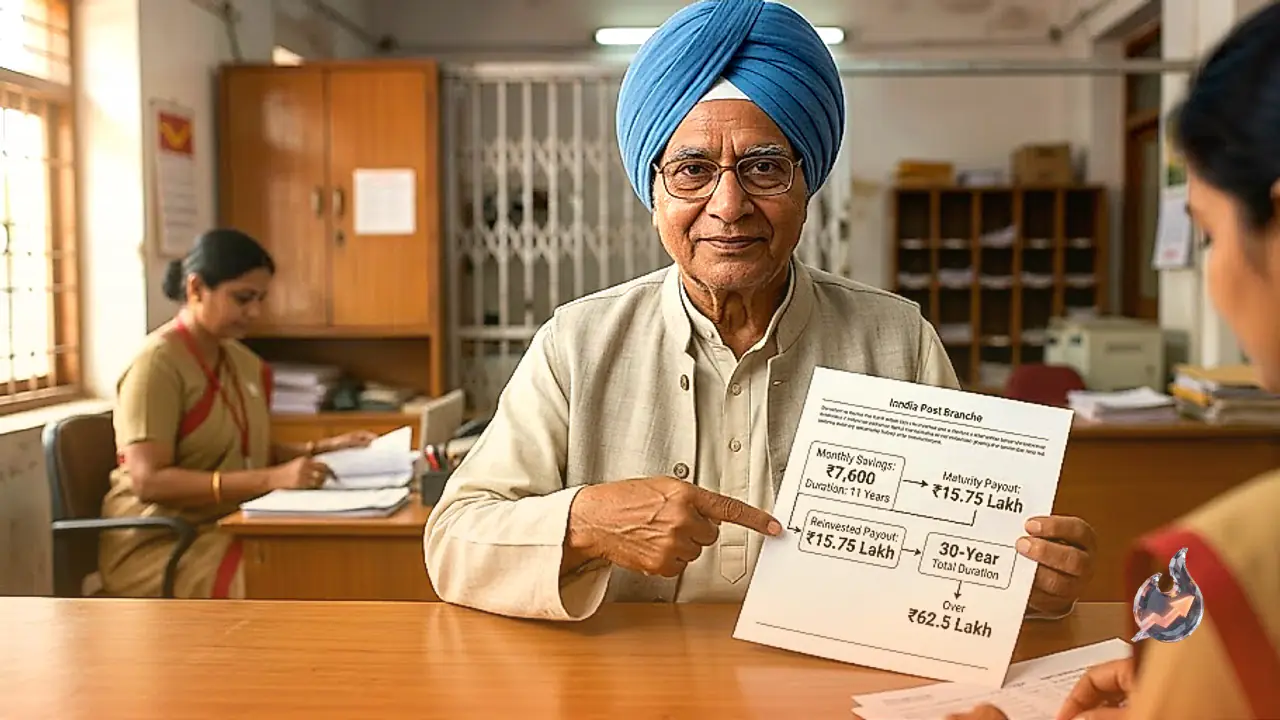
If an investor opts for a plan with a sum assured of ₹10 lakh over 11 years, the monthly premium works out to around ₹7,600, taking the annual premium to roughly ₹91,200. Over the full 11-year term, the investor's total deposit comes to about ₹10.03 lakh. At maturity, after 11 years, the payout is around ₹15.75 lakh. The biggest advantage of this plan is that the investor continues to receive a life insurance cover of the full ₹10 lakh throughout those 11 years, meaning the policyholder gets savings and family protection at the same time.
Reinvesting in Kisan Vikas Patra to Reach ₹62.5 Lakh in 30 Years
Rather than withdrawing the ₹15.75 lakh maturity amount after 11 years, investors are advised to reinvest it in another India Post scheme, Kisan Vikas Patra (KVP). Under current rules, money deposited in Kisan Vikas Patra doubles in 9 years and 7 months. That would take the ₹15.75 lakh to around ₹31.5 lakh. This ₹31.5 lakh is then reinvested in Kisan Vikas Patra for another 10 years, doubling again to more than ₹62.5 lakh. Add up the initial 11-year insurance policy and the two rounds of reinvestment in Kisan Vikas Patra, and the total works out to 30 years, by which point the investor ends up with a fund of more than ₹62.5 lakh. The Shivpuri post office says this approach is particularly beneficial for small investors looking to build a large fund with low risk and a low premium.