























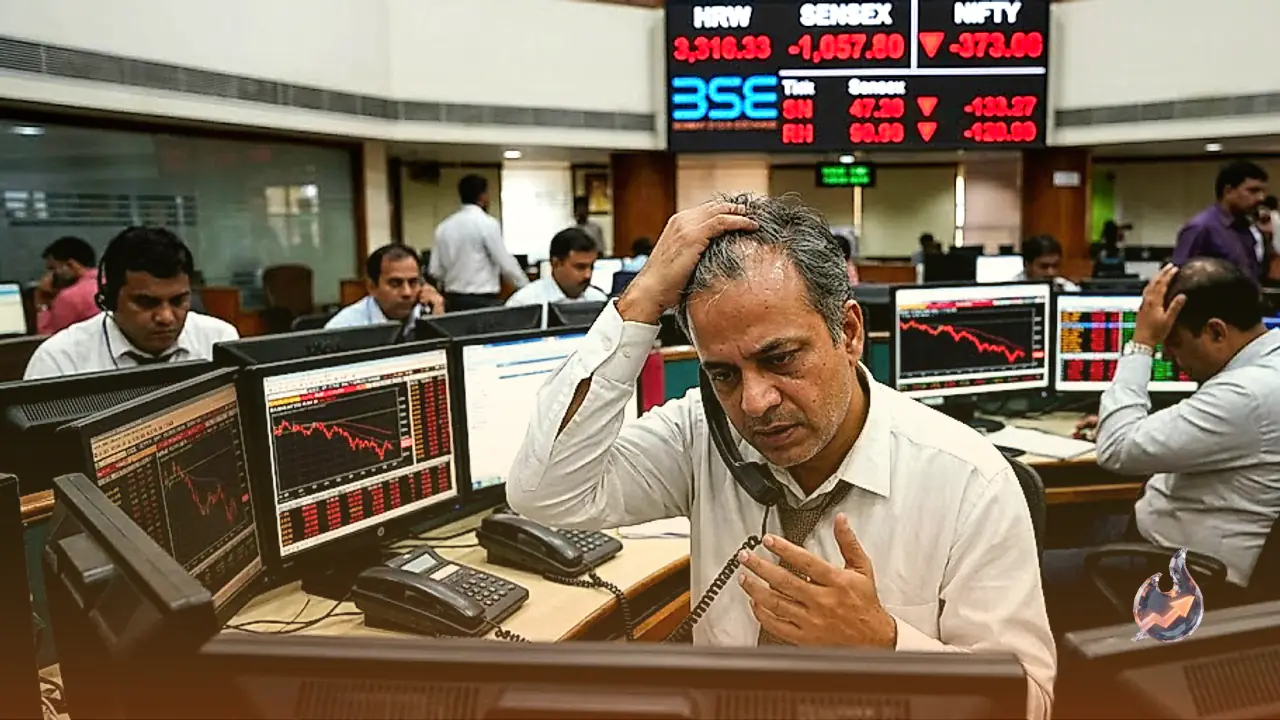

The Indian financial markets have witnessed an unusual divergence between macroeconomic indicators and equity market performance. Even though India recorded a strong Gross Domestic Product (GDP) expansion of 7.8% in the first quarter ending June 2026, benchmark equity indices have failed to rally. Instead of sparking a bullish surge on Dalal Street, investor enthusiasm has been completely muted by escalating geopolitical turmoil occurring roughly 2,830 kilometers away in the Middle East. Over the past eight trading sessions following the official publication of the economic growth metrics, both the BSE Sensex and the NSE Nifty 50 have experienced persistent selling pressure, closing lower in seven of those sessions. The intensified military standoff involving the United States and Iran has driven market participants toward safe-haven assets, prompting bears to execute a swift correction in Indian equities.
Robust Domestic Growth Outshined by Global Macro Uncertainty
India's economic activity demonstrated notable resilience during the June 2026 quarter by posting a real GDP growth rate of 7.8% on a year-on-year (YoY) basis. Although this performance represented a moderation from the revised 8.6% growth recorded in the preceding March 2026 quarter, it matched the growth rate observed in the June quarter of 2025 and aligned fully with broader market expectations. This achievement reconfirmed India's position as the fastest-growing major economy among G20 nations, underlining its ability to withstand ongoing turbulence in the global financial landscape.
Analyzing the quarterly metrics, Tanvee Gupta Jain, Chief India Economist at UBS, highlighted the structural drivers behind the data. According to Jain, real GDP growth remained robust at 7.8% YoY for the June 2026 quarter, supported by a cyclical recovery in underlying economic activity alongside healthy corporate earnings growth. The economist noted that full-year growth projections for FY27 have been revised upward to 6.9% YoY. Jain explained that this economic durability primarily reflects the delayed benefits of indirect tax relief, persistent government welfare transfers, favorable monetary conditions created by the Reserve Bank of India (RBI) through its policy easing steps, and steady credit growth across key commercial sectors. However, despite these solid domestic fundamentals, stock market benchmarks failed to capture any positive momentum.
Deep Correction in Sensex and Nifty Post GDP Announcement
The expectation among market observers was that a 7.8% GDP print would restore buying confidence and re-establish a sustained bullish trend across Indian equities. However, trading realities have turned out to be strikingly negative. On September 9th, market volatility intensified as the BSE Sensex plummeted by 654.5 points, or 0.9%, touching an intraday low of 74,971.27 and dropping below the psychologically important 75,000 threshold. Simultaneously, the NSE Nifty 50 index suffered a steep decline of 168.45 points, or 0.71%, underscoring widespread weakness across heavyweights.
This drop marked the third consecutive session of losses for both major benchmarks. Looking at the overall calendar for September, equities have remained under intense pressure throughout the month, failing to mount a sustained recovery even on the precise day the growth statistics were made public. Official GDP data was released on August 31, 2026, and in the eight trading sessions conducted since then, benchmark indices have declined in seven. The sole session of gains occurred on September 4th, which remains the only bullish trading day registered in September so far.
Prior to the announcement of the GDP figures, the Sensex was trading at 77,264.51 while the Nifty 50 stood at 24,175.65. On the release day of August 31st itself, the Sensex dropped by 308 points and the Nifty fell over 95 points. Cumulative losses from pre-GDP levels to the intraday lows recorded on September 9th reveal a dramatic drop: the Sensex has crashed by 2,349.72 points, while the Nifty 50 has plunged by 709 points. On a year-to-date basis, Indian equity benchmarks have lagged behind several peer emerging markets, primarily due to the geopolitical spillovers originating from the Middle East.
Six Months of Escalating Military Conflict 2,830 Kilometers Away
The primary driver behind the market downturn is the military conflict taking place 2,830 kilometers away from India's borders. The conflict escalated in late February when the United States, in coordination with Israel, initiated military strikes against Iranian targets under Operation Fury. Now entering its sixth month, the war has seen shifts in operational dynamics. While Israeli forces have taken a back seat in recent weeks, military engagements between the US and Iran have intensified through continuous exchanges of long-range missile strikes.
Brief diplomatic efforts between May and June yielded temporary resolutions and sparked brief hopes of a permanent ceasefire. However, those peace initiatives failed to maintain momentum, leaving the geopolitical landscape increasingly ambiguous and unpredictable. Recent operational developments indicate further escalation: Iranian forces targeted and struck two American vessels in regional waters, while the US military destroyed at least five Iranian crude oil tankers in proximity to Kharg Island. Statements issued by both governments confirm an uncompromising commitment to continue military actions.
The geopolitical dispute centers around firm diplomatic and strategic demands. The US has demanded that Iran completely dismantle its nuclear weapons ambitions and cease financial and logistical support for proxy militant organizations such as Hamas and Hezbollah. To enforce compliance, Washington implemented a naval blockade of Iranian ports situated along the Persian Gulf and outlined plans for additional economic sanctions. Conversely, Iran maintains that it is acting in self-defense. Tehran demands legally binding guarantees from both the US and Israel against future aggression, explicit recognition of its sovereign rights, and the immediate cancellation of international sanctions that have crippled its domestic economy. In retaliation against US actions, Iranian strikes have targeted American military and strategic assets stationed in neighboring nations, including Jordan, the United Arab Emirates, Oman, Kuwait, and Saudi Arabia.
Energy Shock, Soaring Crude Prices, and India's Import Risks
With neither side willing to pursue a diplomatic compromise, global energy markets have felt the immediate impact of the war. Crude oil benchmarks have experienced sharp upward surges, pushing Brent crude to the threshold of $100 per barrel. Financial analysts at Goldman Sachs have cautioned that should military hostilities persist over an extended timeline, Brent crude prices could spike to $120 per barrel. A sustained surge in energy costs poses significant risks for global inflation, complicating monetary policy decisions for central banks worldwide.
For India, high oil prices represent a major macroeconomic headwind. The country relies heavily on foreign energy supplies, with its crude oil import dependency reaching nearly 90% this year. A substantial portion of India's foreign exchange outlays and total import bill is dedicated to purchasing crude oil from international suppliers. The current crisis has severely disrupted vital shipping lanes, particularly the Strait of Hormuz, a crucial global transit chokepoint for oil and natural gas shipments. Consequently, the broader economic consequences of the conflict are still unrolling across global supply networks.
Expert Perspectives on Inflation, Currency Pressures, and Market Trajectory
Commenting on the market outlook, Dr. Joseph Thomas, Head of Research at Emkay Wealth Management, emphasized the uncertainty shrouding energy prices. Dr. Thomas noted that oil prices are expected to exhibit high volatility in both directions depending entirely on the duration and intensity of the military conflict. Although periodic diplomatic developments might offer temporary hopes of a settlement, ground realities remain fluid and unpredictable. As a result, financial markets will remain hyper-sensitive to headlines surrounding the conflict and any signs indicating the restoration of conventional supply channels.
Dr. Thomas further explained that the closure or operational restriction of the Strait of Hormuz remains a central determinant of crude price movements due to its critical role in global petroleum transportation. Any prolonged blockage risks tightening global supply balances even further. Moreover, emerging vulnerabilities along other major maritime routes, including the Red Sea and the Bab el-Mandeb Strait, threaten to compound supply chain disruptions across international trade corridors.
For the domestic Indian economy, the risks extend beyond high crude oil prices alone. Dr. Thomas warned that a weakening Indian rupee operating in tandem with elevated global oil prices could severely amplify inflationary pressures. Given that the conflict has endured far past initial timeline projections, assuming that the energy price shock will be merely transitory would be premature. The analyst pointed out two distinct forces influencing the market: in the short term, geopolitical headlines and the pace of supply route restoration will govern crude price trajectories. Over the longer horizon, fundamental supply and demand dynamics will eventually dominate. If global production outpaces demand, crude oil prices are likely to moderate once the geopolitical risk premium dissipates. Emkay Wealth Management concluded that energy markets will closely track developments regarding ceasefire negotiations, maritime security, global petroleum inventory levels, and shifts in export volumes, leaving inflation, currency stability, and equity valuation highly dependent on these geopolitical variables.