























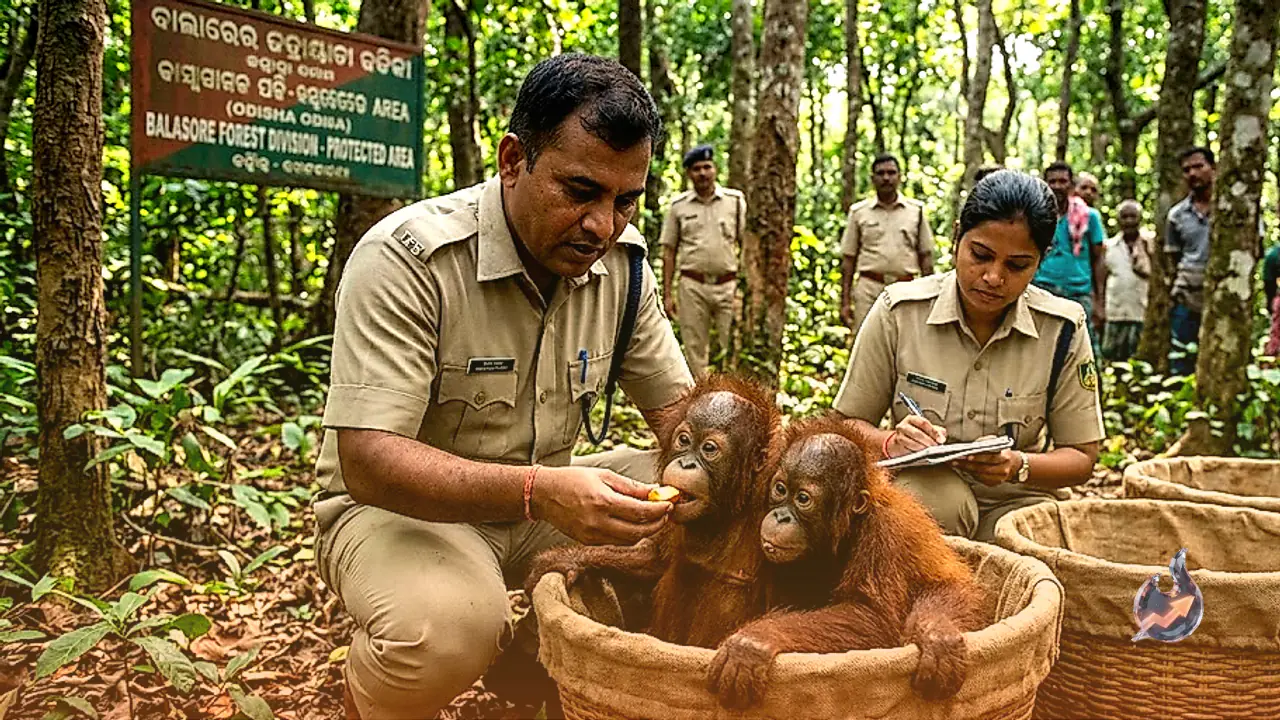

Forest department officials in Odisha's Balasore district have rescued five infant orangutans abandoned inside a casuarina plantation during a routine patrol. The young primates were spotted on Tuesday by forest staff patrolling the Udaipur section within the Udaipur-Talsari forest area, under the Jaleswar range. The rescued group comprises three males and two females, estimated to be between six months and one year old. Because orangutans are not indigenous to Indian wildlife habitats, their sudden presence in a coastal forest has alarmed forest officials and conservation experts alike.
Thousands of Kilometers Away From Natural Habitat
Orangutans are endemic to the tropical rainforests of Southeast Asia, primarily inhabiting the islands of Borneo and Sumatra, which are shared by Indonesia and Malaysia. Wildlife taxonomists recognize three distinct species of orangutans: the Bornean, the Sumatran, and the Tapanuli orangutan. These arboreal mammals spend nearly their entire lives high up in tree canopies, sustaining themselves on fruits, leaves, shoots, and other forest vegetation.
Geographically, Balasore lies approximately 2,700 to 2,900 kilometers away by air from Sumatra, while Borneo is situated nearly 3,700 to 3,800 kilometers away. Given these vast distances and the complete absence of native orangutan populations in India, finding five infants together in an Odisha forest is impossible through natural movement. Authorities strongly suspect that human intervention and illegal wildlife trafficking networks are behind their arrival in the country.
Botched Trafficking Suspected as Forest Staff Act Swiftly
Regional Chief Conservator of Forests Prakash Chand Gogineni confirmed the safe rescue of all five infants. He noted that the situation strongly points toward an aborted illegal smuggling operation. Traffickers carrying the young animals may have encountered unexpected patrolling or logistical hurdles, prompting them to abandon the infants inside the plantation mid-transit. However, officials emphasized that conclusive physical evidence regarding the exact smuggling ring is still being gathered.
Balasore DFO Indalkar Pratik Prakash stated that when the forest team initially discovered the baby orangutans, they were somewhat lethargic but physically responsive. Forest personnel immediately supplied them with suitable food before transporting them safely to the local section office. Preliminary investigations suggest the animals were likely dropped at the location either late Monday night or early Tuesday morning.
Investigation Focuses on Coastal Transit and Specialized Probe
A primary objective of the ongoing investigation is determining the precise entry route used to bring these exotic animals into India. Because Balasore is situated along the coastal belt, enforcement agencies are closely scrutinizing maritime supply routes. Investigators suspect the infants may have been transported aboard boats or cargo vessels before being dumped near the shore.
To expedite the probe, Odisha Forest and Environment Minister Ganesh Ram Singkhuntia has dispatched a dedicated investigation team to the site. The team is conducting intensive searches in the Badapai-Ranakatha locality to gather forensic clues and identify individuals responsible for transporting the animals into the state.
Medical Evaluation at Nandankanan Zoological Park
Following their rescue and preliminary care, all five baby orangutans were transferred to the specialized facilities at Nandankanan Zoological Park. Veterinary specialists conducted comprehensive medical checkups to assess their health status after the ordeal.
Initial medical evaluations revealed no visible external injuries on any of the five animals, and all five are currently reported to be safe and in stable condition. Nevertheless, how these five helpless infants traveled thousands of kilometers from their native rainforests to an Odisha forest remains an active international wildlife crime investigation.