





















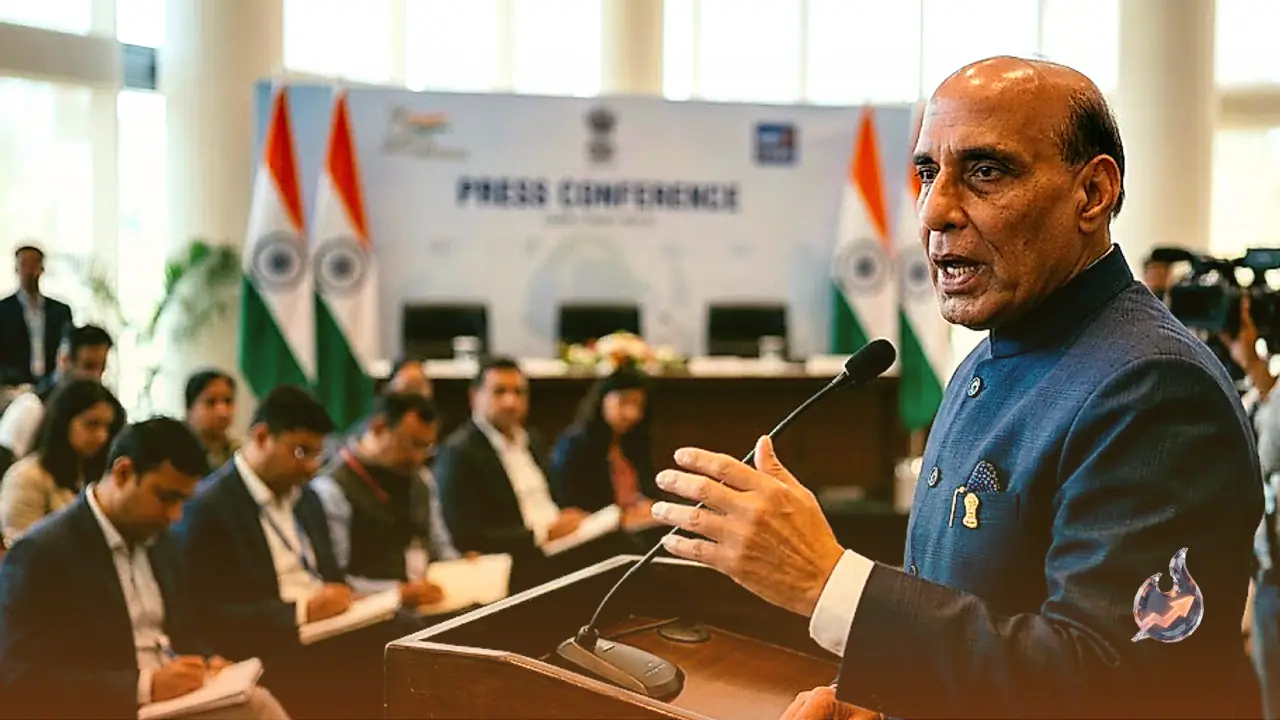

India has undertaken a decisive evolution in its national security doctrine, shifting focus from merely stopping adversarial incursions to actively imposing severe operational and strategic costs on any hostile force that attempts aggression. Addressing an audience on September 24, Defence Minister Rajnath Singh explained that the country's strategic paradigm has moved beyond standard deterrence by denial to embrace deterrence by punishment. Under this doctrine, India is deliberately building capabilities designed to make adversaries pay an unacceptable price for any adventurism, ensuring that crossing national boundaries or threatening vital interests results in swift and proportional consequences.
Strategic Paradigm Shift and Calibrated Diplomacy
Analyzing the evolving security matrix, the Defence Minister emphasized the vital necessity of striking a deliberate equilibrium between assertive diplomatic engagement and robust military readiness. While India remains firmly anchored in democratic norms and continually pursues diplomatic resolution for disputes, it simultaneously retains the full resolve and capability to execute decisive defensive actions. To illustrate this ongoing shift in strategic thinking, he pointed to Operation Sindoor along with earlier surgical strikes carried out across the frontier. These precise military actions demonstrated that the nation's leadership is fully prepared to look past conventional passivity in favor of purposeful tactical countermeasures whenever core security interests face imminent threat.
Evolving Threat Vectors Beyond Fixed Geographic Borders
Detailing the changing nature of modern warfare, the Defence Minister observed that national security risks can no longer be evaluated solely within traditional territorial borders. While sovereign geographic borders remain static and legally fixed, the threat vectors confronting modern states are constantly shifting and expanding across multiple domains. Adversarial entities today are not restricted to physical land encroachments; they increasingly seek to degrade a nation's broader economic architecture, compromise interconnected cyber networks, and sabotage critical technological infrastructure. Consequently, India's overarching defense planning must place domestic technological excellence and network resilience at the very center of its tactical priorities.
Cyber as the Modern Battleground: Terrain, Technology, and Thinking
Framing the parameters of future defense preparedness, the Defence Minister designated terrain, technology, and thinking as three foundational elements of national readiness. He identified cyberspace as a crucial new battleground where modern conflicts will increasingly be fought alongside physical fronts. Modern battles now span across cyber, outer space, and information spheres, driven by advancements in data analysis, precision strike munitions, autonomous systems, drones, and AI applications. Observing that soft power and hard power serve as vital complements rather than substitutes for one another, he noted that India has steadily deepened its multilateral engagements through forums such as Quad, BIMSTEC, and I2U2 while concurrently reinforcing its frontline combat power.
Firm Stance on Cross-Border Terrorism and Diplomatic Engagement
Addressing the ongoing dynamic with Pakistan, the Defence Minister reiterated the uncompromising position of the government that bilateral dialogue, trade normalization, and terrorism cannot run simultaneously. Recalling the decisive policy measures enacted following the April 2025 terror strike in Pahalgam, he referenced India's historic decision to suspend the 1960 Indus Waters Treaty. That specific attack crossed an unacceptable line, necessitating a substantial realignment of strategic policy to prevent recurrent provocations. Issuing a stern caution to adversaries across the border, he warned that any future miscalculation or reckless hostile action would be met with an immediate and firm military response.
Self-Reliance as the Foundation of Sustainable National Security
Underlining defense self-reliance as an indispensable pillar of resilient national security, the Defence Minister asserted that genuine strategic autonomy is unattainable without complete domestic self-sufficiency. The government continues to accelerate indigenous defense programs by prioritizing end-to-end domestic design, engineering, and manufacturing of major combat platforms. Tangible indicators of this progress include defense public sector undertakings reversing historical losses to operate profitably, alongside significant expansion in domestic defense manufacturing. Highlighting homegrown military achievements, he cited the Tejas fighter aircraft, the indigenous aircraft carrier INS Vikrant, and the Dhanush artillery gun as enduring proof of expanding self-reliance. In concluding remarks, he affirmed that while India does not advocate for armed conflict, national peace cannot be made contingent upon perceived vulnerability, and the country remains fully committed to defending its sovereignty.