






















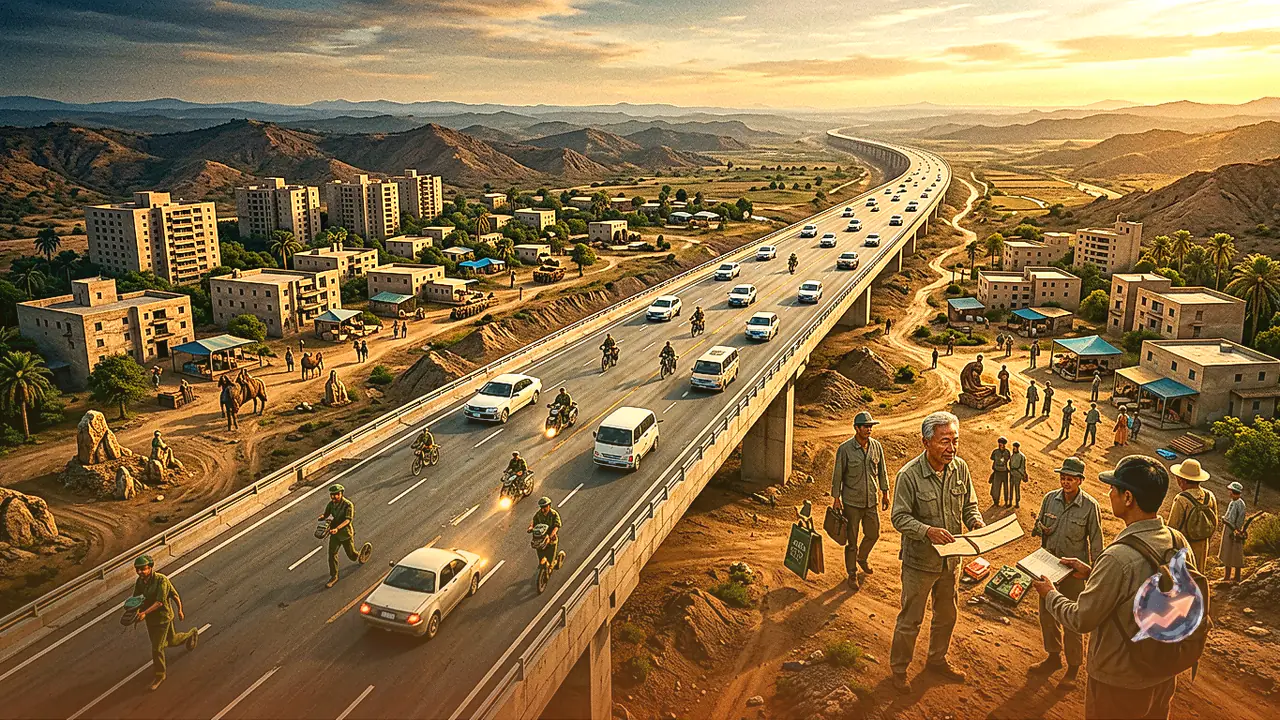

India has laid out a comprehensive roadmap to construct a massive 5,000 kilometer highway network along its international borders over the next 3 to 5 years. Announced by the Ministry of Road Transport and Highways, this strategic infrastructure initiative carries a total budget of 2 lakh crore rupees. The planned highways will thread through sensitive border belts adjoining five neighboring countries: China, Pakistan, Nepal, Bhutan, and Myanmar. Designed to strengthen national defense preparedness, the project will drastically simplify logistics for the armed forces while creating new avenues for commerce, healthcare access, and regional tourism across remote frontier regions.
Strengthening Defense and Rapid Military Mobility
The core objective of this mega highway scheme is to establish reliable, all-weather connectivity to sensitive and hard-to-reach border sectors. Built through a joint partnership between the central and state governments, the network will feature modern bridges and reinforced roadways capable of handling heavy military hardware. Improved terrain accessibility will ensure that troops, supplies, and defensive armaments can be deployed rapidly to forward positions during emergencies. Beyond strategic military gains, the infrastructure will bridge the geographical divide for remote populations, making it easier to deliver essential healthcare, educational facilities, and commercial opportunities to isolated communities.
State-Wise Distribution and High-Priority Zones
The largest portion of this border highway will be built in Arunachal Pradesh, given its long and sensitive frontier with China. A massive 740 kilometer segment is earmarked for Arunachal Pradesh alone. Other key border states and union territories will also receive substantial road lengths under the plan
- Jammu and Kashmir: 355 kilometers of strategic border roads will be constructed.
- Uttarakhand: 266 kilometers of highways planned along critical northern zones.
- West Bengal: 265 kilometers of road infrastructure covering key frontier corridors.
- Manipur: 241 kilometers allocated to enhance connectivity near the eastern border.
The comprehensive road building program also extends to border regions across Punjab, Rajasthan, Ladakh, Himachal Pradesh, Sikkim, Nagaland, Mizoram, Meghalaya, and Tripura, establishing an unbroken network along India's outer frontiers.
Ongoing National Highway Projects and Infrastructure Stats
This border project forms part of a broader nation-wide push to upgrade India's road network. According to official data from the Ministry of Road Transport and Highways, 1,191 highway projects are currently active across the country, spanning a total distance of 25,917 kilometers with an aggregate financial allocation of 7.15 lakh crore rupees. Out of these ongoing works, roughly 3,100 kilometers are being developed specifically within border zones. The expansion aligns with the national PM Gati Shakti master plan aimed at streamlining multimodal infrastructure. Infrastructure experts emphasize that upgrading these corridors will relieve freight congestion on major routes while ensuring seamless rapid response routes for defense forces.
The Frontier Highway and Broader Economic Impact
In addition to the 5,000 kilometer border network, a separate 1,748 kilometer Frontier Highway is under construction in Arunachal Pradesh, running parallel to the Line of Actual Control (LAC) near the Chinese border. This frontier corridor will directly connect isolated border villages to commercial market hubs, providing local farmers and traders direct market access and giving a major push to regional tourism. Road infrastructure remains the backbone of Indian logistics, carrying over 65 percent of the country's total freight movement and facilitating more than 90 percent of passenger traffic. Building robust high-altitude highways is therefore vital for securing national frontiers while sustaining long-term economic growth.