























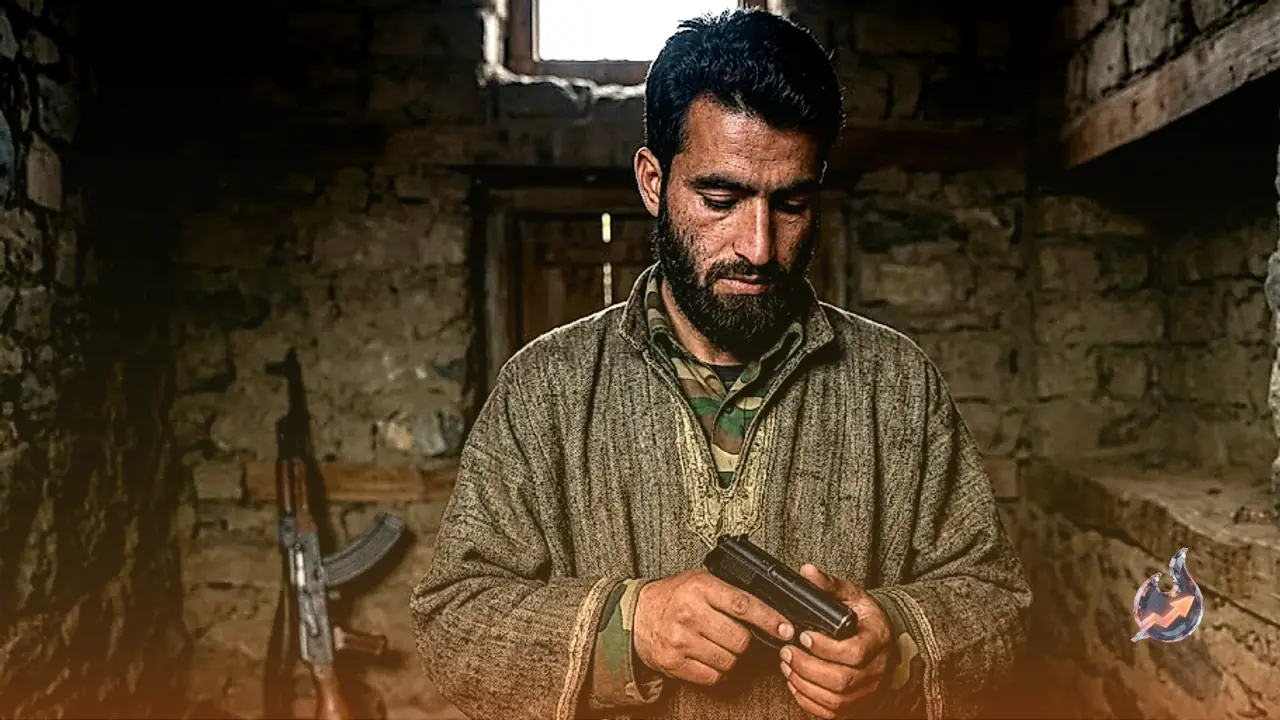

Security and intelligence agencies investigating the recent targeted terror attack in Kulgam district of South Kashmir have uncovered critical details regarding the perpetrator and the tactical motives behind the assault. According to investigative findings, the attack was executed by Latif, a local terrorist affiliated with Lashkar-e-Taiba (LeT). During the incident, approximately 250 people were present at the scene when terrorists intercepted the crowd, demanded their names, and forcefully verified their religious identity. Upon establishing their Hindu identity, the attackers selectively targeted two individuals and opened fire. One victim died on the spot, while another sustained severe injuries. Formal security assessments have subsequently corroborated the direct involvement of Lashkar-e-Taiba in orchestrating this targeted strike.
Tactical Shift from AK-47 to Concealable Firearms
Investigating agencies are conducting an in-depth operational analysis of terrorist Latif's changing attack methodologies. Intelligence sources reveal that Latif traditionally relied on heavy weaponry, specifically an AK-47 assault rifle, which he had previously deployed during targeted shootings across Anantnag. However, during the Kulgam assault, he altered his established pattern by using a small, easily concealable firearm. Investigators are piecing together evidence to understand why Latif deliberately abandoned his signature assault rifle in favor of a compact handgun. Officials suspect that the shift was designed to evade intense security checkpoints and facilitate a quick escape in densely populated areas.
Elimination of Commander Zakir Ganai and Latif's Desperation
Latif operated as the primary field lieutenant to Zakir Ganai, a top A++ category commander of Lashkar-e-Taiba who oversaw operations across Kulgam, Shopian, and Anantnag districts. During a recent joint Cordon and Search Operation (CASO) launched by security forces in Shopian, Zakir Ganai was neutralized, and his body was recovered two days later. However, Latif managed to breach the security perimeter and flee the encounter site. Intelligence agencies believe that following the elimination of his chief commander, Latif faced immense pressure to demonstrate operational viability and maintain relevance within the outfit, prompting him to launch retaliatory targeted strikes in Anantnag and Kulgam.
Pakistani ISI Strategy and Dread of 'Operation Sindoor' Escalation
Intelligence assessments have highlighted two primary strategic factors driving the recent surge in small-scale, targeted strikes across South Kashmir. Firstly, Pakistan's Inter-Services Intelligence (ISI) is attempting to sustain continuous operational turmoil in the Kashmir Valley. This tactic aims to deflect mounting domestic security pressure within Pakistan caused by escalating unrest in Balochistan and Pakistan-occupied Kashmir (PoK).
Secondly, militant outfits are deliberately choosing low-intensity targeted killings over high-casualty events. This allows them to mark an operational footprint while avoiding massive counter-terror responses akin to 'Operation Sindoor'. Security officials note that with 250 civilians available at the location, the attackers possessed the capacity for mass casualties. However, they consciously restricted the attack to selective targets specifically to prevent triggering a large-scale military crackdown.
Dwindling Local Terrorist Footprint in South Kashmir
Recent intelligence reports indicate that sustained counter-terrorism operations have drastically reduced the local militant presence in South Kashmir to just five remaining local terrorists. Following the death of Zakir Ganai, Latif stands as the most active local militant still evading security forces. Of the remaining local operatives, two terrorists are currently in deep hiding to avoid detection by security agencies, while one active militant remains under continuous surveillance by intelligence networks as forces close in on the remaining cell.