























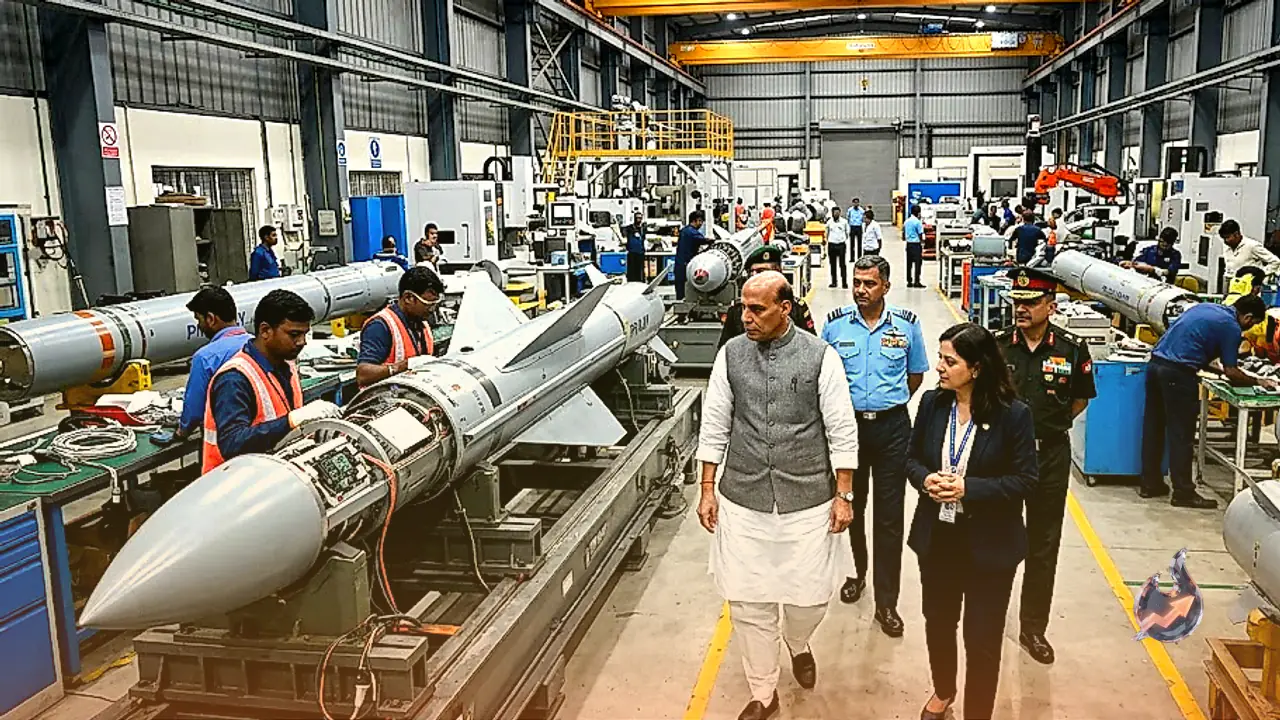

In a landmark policy shift aimed at strengthening India’s long-term military readiness, Defence Minister Rajnath Singh has approved the transfer of technology (ToT) for all conventional missile systems developed by the Defence Research and Development Organisation (DRDO) to eligible Indian private defense manufacturers. While this step visibly opens the door for private enterprise in complex missile assembly, its underlying strategic rationale lies in expanding India’s missile replenishment capability and establishing robust surge production capacities for future high-intensity conflicts.
Adapting to the Reality of Prolonged Modern Warfare
Recent global military confrontations have reshaped modern war doctrines, proving that conflicts between peer or near-peer combatants rarely end in swift, short engagements. From Eastern Europe to the Middle East, recent geopolitical clashes demonstrate that initial stockpiles of high-tech munitions can be rapidly exhausted. In extended warfare, national endurance depends not merely on pre-war inventories, but on how rapidly a nation can manufacture and replace sophisticated weaponry expended on the battlefield.
Responding to these global lessons, Indian defense planners are shifting focus from static stockpile figures to dynamic manufacturing responsiveness. The central question facing the defense establishment is no longer just the immediate quantity of missiles in military depots, but how fast domestic industry can scale up production when consumption rates skyrocket during an emergency. The newly sanctioned DRDO-private industry synergy directly addresses this vulnerability.
Production Scalability Trumps Fixed War Reserves
During large-scale military engagements, the consumption of surface-to-surface, air defense, anti-ship, and long-range precision strike missiles escalates exponentially. Emergency war reserves accumulated before the outbreak of hostilities provide only a temporary cushion. As warfare drags on, operational sustainment pivots entirely to the throughput speed of the defense industrial ecosystem.
By transferring DRDO’s proven missile technologies to multiple private Indian defense manufacturers, India is building a broad-based defense industrial supply network. Having multiple commercial entities equipped to produce identical or complementary missile lines ensures that total national output can be rapidly expanded during wartime crises, mitigating single-point supply chain bottlenecks.
Crucial Takeaways from the US-Iran Conflict
The military engagement between the United States and Iran in 2026 underscored the severe strain high-intensity missile defense operations place on advanced munitions stockpiles. During that confrontation, US forces expended substantial volumes of critical interceptors to protect regional assets and support Israeli missile defense networks. Official Pentagon assessments indicated that American forces deployed over 200 THAAD interceptors and more than 100 SM-3 and SM-6 missiles, effectively expending nearly half of the global US THAAD inventory.
This massive expenditure triggered intense scrutiny over strategic reserves. Detailed evaluations in August 2026 revealed that the US had drawn down up to 80 percent of its critical missile-interceptor stockpiles, putting immense operational stress on Patriot interceptor supplies as well. Although senior US defense officials contested assertions that reserves had dropped to dangerously low levels, the crisis highlighted a stark reality: interceptor quantity alone is insufficient without immediate, high-volume production lines ready to replenish depleted stocks.
Patriot Shortages in the Russia-Ukraine War
The ongoing war between Russia and Ukraine offers an equally compelling lesson on the perils of missile depletion. Russian forces have sustained high-volume cruise missile, ballistic missile, and drone barrages, while Ukrainian defensive operations suffered due to severe shortages of Patriot interceptors.
By August 2026, assessments revealed that Ukraine faced a critical shortage of Patriot missiles. During a massive Russian aerial assault on August 20, 2026, Ukrainian air defenses intercepted 39 out of 44 incoming cruise missiles, but their interception capability against ballistic missiles was severely constrained, resulting in only 1 ballistic missile interception recorded for that entire month. Conversely, Russia successfully expanded its domestic manufacturing lines. Ukrainian military intelligence data from August 2026 indicated that monthly production for key Russian missile systems was running 10 to 20 percent above targeted capacity.
Transitioning from Single-Agency Output to Multi-Center Resilience
Historically, India’s missile manufacturing landscape relied predominantly on defense public sector undertakings and specialized government production agencies. While private companies increasingly supplied sub-assemblies and components, their participation in end-to-end missile integration remained limited. The decision by Defence Minister Rajnath Singh fundamentally expands the scope of private industrial participation.
Establishing a decentralized, multi-facility manufacturing model offers vital strategic resilience. If a primary defense production facility faces operational disruption, technical delays, or targeted strikes during wartime, secondary and tertiary manufacturing nodes can sustain the supply flow. India’s doctrine is visibly shifting from asking how many missiles are currently stored in armories to determining how rapidly depleted arsenals can be replenished.
Dividing Roles Between DRDO and Private Industry
Under the Technology Transfer framework, DRDO will share complete design parameters, technical know-how, and manufacturing blueprints with qualified domestic companies. These commercial partners will then set up production lines under strict defense regulatory frameworks and quality control standards.
This structural arrangement optimizes the core strengths of both sectors. DRDO will concentrate its resources on advanced research, development, and next-generation defense technologies. Private industry will leverage its capital efficiency, manufacturing scale, and supply chain optimization to deliver high-volume production, ensuring long-term defense sustainability for the nation.