



















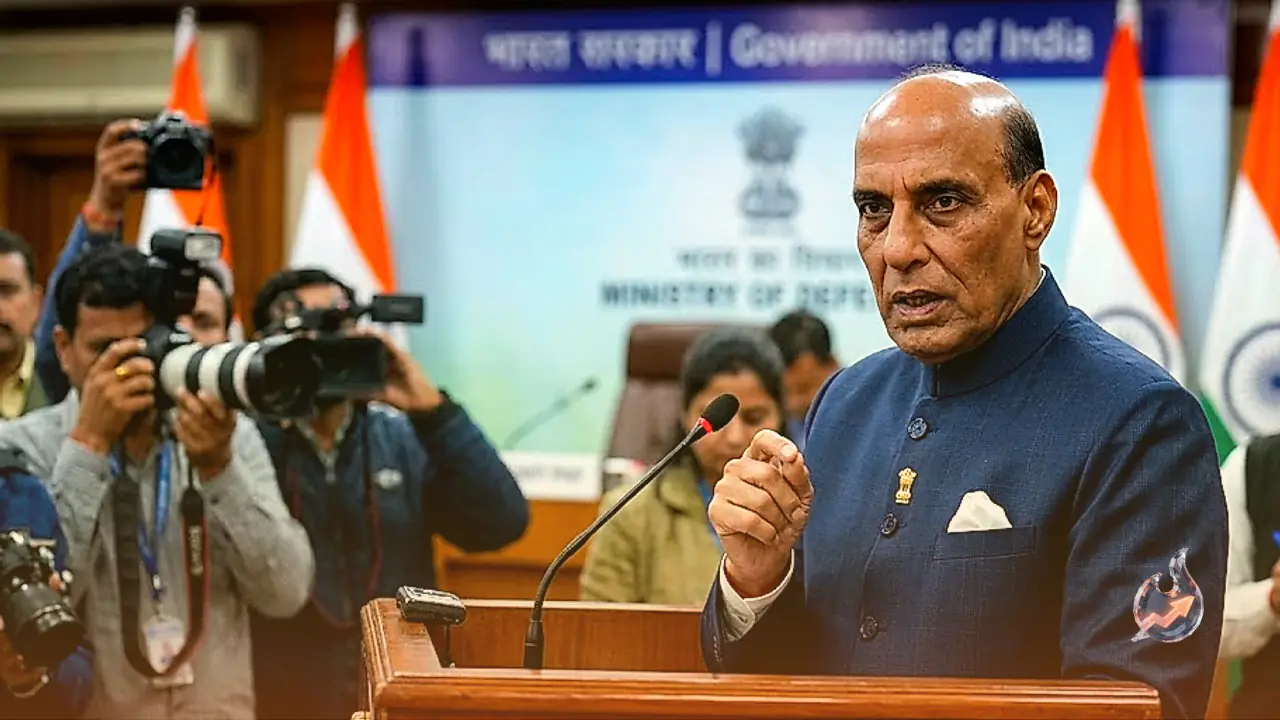

Defence Minister Rajnath Singh said on Monday that India's armed forces now have both the freedom and the resources to deliver a decisive response to any threat, including striking inside enemy territory when required.
Peace Is Not the Same as Weakness
Speaking at an event, Singh argued that equating peace with weakness would be a serious mistake, since the two are worlds apart. He made clear that if any country is found backing terrorism against India, there will be no talks, only a crushing response from the armed forces. According to the minister, India does not believe in war or seizing anyone's territory and always prefers peace, but peace secured through fear is shameful, while a war fought to protect peace deserves respect.
Plots to Mislead Kashmir's Youth Foiled
Singh listed several ways hostile actors have tried to undermine India's security, from misleading young people in Jammu and Kashmir to funding anti-India activities, spreading terror and sowing divisions within society. He credited the government led by Prime Minister Narendra Modi with defeating these attempts through rehabilitation programmes, efforts to steer youth away from radicalisation, and by creating job opportunities. He added that Jammu and Kashmir has witnessed progress on a scale never seen before since Article 370 was scrapped.
From Surgical Strikes to Operation Sindoor
Explaining India's counter-terrorism approach, the defence minister pointed to the surgical strikes, the Balakot air strike and Operation Sindoor as examples where both terrorists and their handlers were directly targeted. He also referred to the suspension of the Indus Waters Treaty, saying it sent a firm message that blood and water cannot flow together.
Space and Cyberspace Emerge as New Battlegrounds
On how warfare itself is evolving, Singh said combat is no longer confined to land, air and sea, with space and cyberspace now emerging as fresh battlefronts. Technologies such as artificial intelligence, drones, autonomous systems and precision-guided weapons are reshaping the nature of the battlefield. The government's aim, he said, is for India to develop its own modern technology, which is why defence policy has been shifted from a "reactive" posture to a "proactive" one.
Defence Production and Exports See a Sharp Rise
Citing figures, the minister said defence production has climbed from roughly Rs 40,000 crore before 2014 to nearly Rs 1.80 lakh crore now, while exports have jumped 56 times to cross Rs 38,000 crore. The government is targeting Rs 50,000 crore worth of defence exports by 2029. This progress is reflected in indigenous platforms such as Astra, the Akash missile, Akashteer, Pinaka, the Tejas fighter jet, the Arjun tank, the Prachand and Dhruv helicopters, and INS Vikrant. He noted that all 16 defence public sector undertakings are now profitable, and the defence budget has grown from Rs 2.5 lakh crore to nearly Rs 8 lakh crore over the last 12 years.