























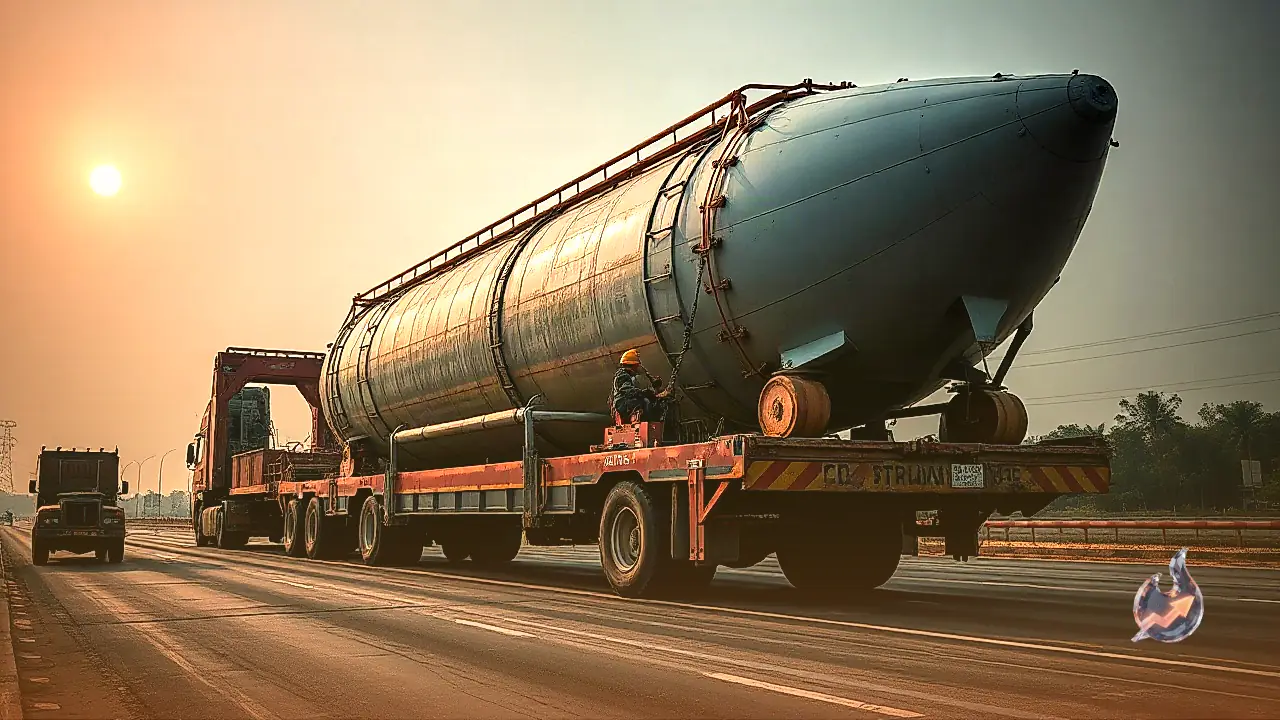

A colossal movement of heavy machinery is currently navigating Indian highways as an enormous industrial cargo journeys across state borders. Transporting an industrial vessel weighing around 200 tonnes from the port city of Paradip in Odisha to a Kumbhi facility in Uttar Pradesh's Lakhimpur Kheri has demanded extraordinary logistics. Instead of conventional freight vehicles, logistics planners commissioned a specialised 308-wheel multi-axle hydraulic modular transport system. Deploying such an immense number of tyres is not an aesthetic choice; it represents an exacting engineering approach designed to disburse concentrated tonnage across dozens of support points while keeping the platform stable along challenging highway routes.
The Engineering Logic of Dispersing Heavy Tonnage
Moving a 200-tonne solid apparatus over long distances poses major structural threats to transit infrastructure. If such an enormous mass were placed upon a standard flatbed trailer supported by few axles, the ground pressure would concentrate into destructive focal zones capable of punching through tarmac or overstressing bridge spans. The physical concept can be illustrated with a simple human lifting example. If a 200-kilogram weight is lifted by only four individuals, each shoulder must support an exhausting 50 kilograms. Conversely, if 20 people share the exact same burden, the load per person drops to a manageable 10 kilograms. Modular transport platforms apply identical load-spreading principles. By multiplying the wheels and structural axles, the vehicle distributes ground contact stress across dozens of points, ensuring that neither the roadbed nor critical bridges bear unsafe concentrated strain.
Modular Platforms and Structural Axle Alignment
Industrial vessels bring complex physical challenges because their physical dimensions and center of mass are rarely uniform. Under Government of India technical regulations governing modular hydraulic trailers, heavy cargo operators are permitted to connect individual modules into custom configurations tailored to specific payloads. On this 308-wheel transporter, the tyres do not simply sit at the rear; they run continuously beneath the vast loading frame in coordinated longitudinal rows. While the exact axle-by-axle blueprint of this specific transporter has not been published in detail, systems of this scale are structurally comparable to SPMTs, or self-propelled modular transporters. Operators frequently join modular units featuring four, six, or eight axle lines either end-to-end to add length or side-by-side to expand deck width, producing a rigid, tailor-made cradle for the oversized structure.
Clarifying Tyres, Wheels, and Structural Axle Lines
Observers seeing an oversized transporter often confuse wheels, axles, and axle lines, treating the terms as interchangeable when technical definitions differ significantly. A tyre and wheel assembly constitutes the rolling perimeter touching the highway surface, whereas an axle represents the central transverse shaft on which opposing wheels rotate. In heavy transport parlance, an axle line refers to an engineered transverse grouping across the modular width. Major modular equipment manufacturers, such as Goldhofer, often build heavy-duty modules utilizing twin-tyre configurations across assemblies ranging between two and eight axles. Consequently, calculating exact axle numbers solely by counting 308 visible tyres is inaccurate without an official technical spec sheet detailing how many tyres sit on each specific axle assembly.
The Six Core Functional Assemblies of the Transporter
Rather than viewing this behemoth as a solitary monolithic lorry, it must be understood as an integrated network of specialized mechanical modules working together. Its operations depend on six essential components
- Towing and Propulsion Elements: High-powered ballast prime movers attach to the modular bed using specialized drawbars to supply pulling and pushing traction across steep gradients.
- Platform Module Framework: The backbone of the vehicle consists of the primary steel modules containing the extensive grid of rolling wheel assemblies.
- Hydraulic Suspension and Compensation: Uneven road cambers and surface dips are instantly counteracted by hydraulic compensation systems that adjust the ride height at each wheel station, keeping the payload level.
- Customized Cargo Bed: Specialized flatbeds or drop-deck vessel carriers are bolted between modules to accommodate the specific geometry and center of gravity of the industrial cargo.
- Multi-Directional Steering Control: Negotiating sharp highway bends with a wide, lengthy frame requires multi-mode steering systems that swivel wheels independently at programmed angles.
- Heavy-Duty Braking Assemblies: Managing inertia and securing smooth deceleration for a rolling mass exceeding hundreds of tonnes requires high-capacity pneumatic and hydraulic braking systems.
Overcoming Highway Bottlenecks and Route Adjustments
Traversing thousands of kilometres with such an oversized platform demands exhaustive route surveying and municipal coordination. The transport moves at minimal speeds to ensure safety around structural obstacles, roundabouts, and overhead electrical lines. During its progression, the mammoth convoy experienced delays navigating constrained passages around Chandauli. In urban bottlenecks such as Varanasi, civic agencies drew up elaborate contingency procedures, including evaluating the temporary removal of portions of overhead pedestrian footbridges to permit the clearance of the towering vessel. The entire transit illustrates why this 308-wheel solution was engineered: protecting vital civil infrastructure while safely shifting an immense industrial asset.