























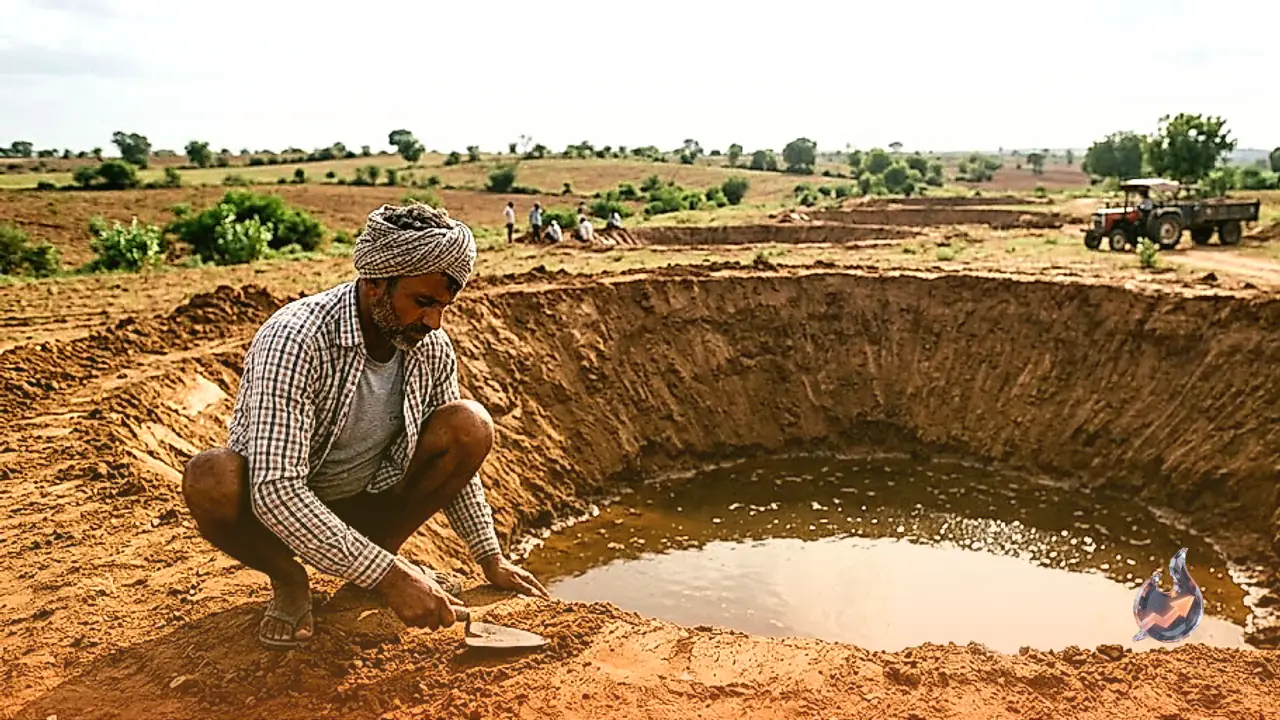

Rajasthan's government is pushing water conservation efforts beyond villages and directly onto individual farms, with plans to build around 18,000 new farm ponds across the state in the current financial year. The project carries a price tag of more than ₹185 crore, and its central goal is simple: stop rainwater from running off farmland unused and instead store it on site for later irrigation.
Officials are not treating this purely as a water-harvesting exercise. It is being positioned as a core piece of rural agricultural infrastructure, particularly in areas where farming still depends heavily on monsoon rainfall and farmers have few other water sources to fall back on during dry spells.
A safety net for monsoon-dependent farming
Large parts of Rajasthan still farm at the mercy of the monsoon. When rains arrive late or there is a long gap between spells, crops suffer. Farm ponds are meant to soften that blow. Rainwater that would otherwise run off the surface of a field is instead collected in a small reservoir-like structure built right on the farm, which the farmer can later draw on to irrigate when needed. That means not just more water on hand overall, but also the option of giving crops a life-saving irrigation dose during a long dry stretch between rain spells.
What exactly is a farm pond
A farm pond is a water-storage structure built directly within a field. During rain, surface runoff from the farm is channelled into this pit-like structure rather than being allowed to drain away. Later, when the crop needs water, the farmer draws on that stored supply for irrigation. Its biggest advantage is that water doesn't need to be carried to some distant large reservoir or dam, the entire storage infrastructure sits right at the farm level. That also puts farmers themselves in charge of managing rainwater on their own land.
₹185 crore, roughly 18,000 new structures
The government has earmarked more than ₹185 crore in the current financial year specifically for building farm ponds. That budget is meant to fund the construction of about 18,000 new farm ponds statewide. Under the scheme, eligible farmers receive a subsidy toward construction, meaning they don't have to bear the full cost themselves. These small water-storage structures are expected to be particularly useful in areas that get low or erratic rainfall, where conventional irrigation sources are limited.
35,893 farm ponds already built in two and a half years
Agriculture department figures show this isn't a fresh start but the next phase of an ongoing effort. Over the past two and a half years, Rajasthan has already built 35,893 farm ponds. Farmers who built them have collectively received ₹328 crore in subsidies so far. Under the scheme's rules, a farmer building a single farm pond can receive anywhere from ₹63,000 to ₹1,35,000 in subsidy, with the exact amount depending on the pond's size and the specified standards. That makes clear the government is steadily pushing forward a subsidy-driven model to build up water-storage capacity on farms, and once the new target is met, the total number of such structures across the state will climb further still.
Relief for both the kharif and rabi seasons
The benefit of water stored in a farm pond isn't limited to a single cropping season. If soil moisture starts dropping once the rains stop, farmers can use the stored water to give crops a life-saving irrigation. That helps kharif crops as well as crops grown in the rabi season. Holding rainwater on the farm also slows its immediate runoff, which can help curb problems like soil erosion to some extent. On top of that, farmers become less entirely dependent on other irrigation sources such as borewells or canals.
A new building block for rural infrastructure
Rural development in Rajasthan is closely tied to water availability and the stability of farming. Seen that way, small water-storage structures like farm ponds function as the smallest but most effective unit of rural infrastructure. The government's latest target is an attempt to extend that thinking further, aiming for every individual farm to have its own arrangement for holding rainwater. Once around 18,000 new farm ponds are built, a large number of farms will gain this facility, and that is expected to strengthen water conservation, irrigation management and farm productivity at the local level.