



















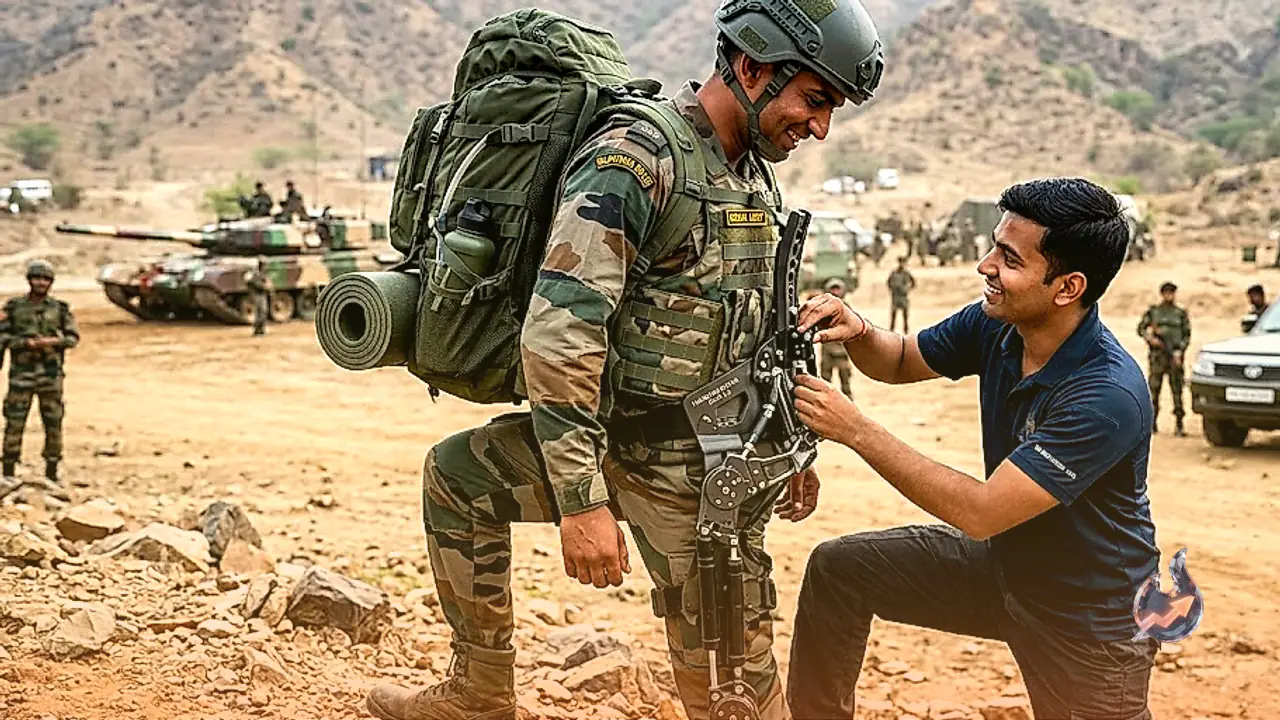

In a major boost to the combat capability and physical endurance of Indian soldiers, a specialized human exosuit being developed in Kota, Rajasthan, has now reached an advanced version. Utilizing this advanced technology, military personnel will be able to carry heavy equipment, weapons, and ammunition ranging from 100 to 200 kilograms with significantly reduced fatigue. This technology is considered particularly vital for soldiers deployed in harsh and challenging terrains where marching long distances with heavy military gear is physically exhausting. The human exosuit has been designed and built by a team led by engineer Gaurav Rai from Kota, under the Ministry of Defense's iDEX project and ADITI program. Soldiers guarding the nation in deserts, snowy mountains, and rugged forests often patrol for hours while carrying heavy weapons and supplies. Bearing up to 60 kilograms of weight for prolonged periods frequently leads to severe physical ailments like knee and back pain among troops.
The Hanumantha Exo-1 and Significant Weight Reduction
To alleviate this persistent physical challenge, engineer Gaurav, a native of Kota, originally designed the 'Hanumantha Exo-1' protective body frame. It is claimed that this device can decrease the weight pressing down on a soldier's shoulders by an impressive 80 to 90 percent. Consequently, a soldier carrying a 60-kilogram load would experience a burden of only about 10 kilograms after strapping on the equipment. This innovative device has already been presented to the Indian Army and the Defence Research and Development Organization through the officials of the National Defence University. Army officials have acknowledged its practical utility and recommended integrating artificial intelligence into the system. The formal patenting process for the innovation is also slated to begin soon. Engineer Gaurav's team successfully developed its advanced version, named 'Hanumantha Exo 1.2', in a span of just a month and a half. Initial trials of this upgraded iteration have already been completed, and the technology is being continuously refined to meet the evolving operational requirements of the armed forces.
Advanced Version Developed in Record Time
The research and development team working on this project successfully constructed the new advanced version of the human exosuit within roughly forty-five days. Designated as 'Hanumantha Exo 1.2', reports confirm that successful trials have already been conducted. A notable highlight of this development is that the initial model weighed approximately 11.1 kilograms, which has now been successfully reduced to 7.5 kilograms through systematic technical optimizations. Despite this substantial reduction in the overall weight of the suit, its core load-bearing capacity has been meticulously calibrated to support soldiers in carrying heavy military inventory and enduring extended physical exertion without premature exhaustion.
Enabling Soldiers to Carry Up to 200 Kilograms
The human exosuit is structured in such a manner that once donned, soldiers can comfortably walk and even run while carrying loads between 100 and 200 kilograms. This total capacity can accommodate firearms, ammunition caches, and various other tactical field gear. Mitigating the severe physical strain imposed by heavy loads on military personnel is regarded as the standout feature of this innovation. In border regions, troops are frequently required to traverse difficult geographical landscapes while hauling necessary logistics supplies over extended lengths. Under such grueling conditions, this exosuit technology can prove instrumental in amplifying troop mobility and overall operational efficiency.
Manufacturing in Kota and Testing in Sonipat
The physical fabrication of this human exosuit takes place in Kota, while its laboratory testing and technical refinements are conducted in Sonipat. According to available details, the core team is collaborating closely with the Atal Incubation Centre associated with IIT Delhi, located in Sonipat. This facility serves as the primary hub where rigorous laboratory testing and engineering modifications are executed. The team continues to formulate newer models keeping the specialized tactical demands of the military at the forefront. Thus, the technology is not restricted merely to reducing physical weight, but is being progressively upgraded in alignment with real-world military applications.
Inspiration Derived from Family Background
The underlying framework of the 'Hanumantha Exo-1' operates on a delta spring system. This mechanism channels the heavy load resting on the spine directly down toward the ground through the boots, functioning analogously to an electrical grounding system. Built entirely from specialized springs, this apparatus operates like a mechanical muscular system that adapts seamlessly to the movement of the legs, aiding significantly in load alleviation. Work on its manufacturing commenced in 2023 at the Atal Incubation Centre on the IIT Delhi Sonipat campus and has now reached fruition. Engineer Gaurav derived the core inspiration for building this device from his father, Satendra Rai, who served as an army officer. Due to prolonged patrolling sessions carrying heavy rucksacks during his military tenure, his father continues to suffer from chronic knee and back ailments. Witnessing the physical hardships endured by soldiers firsthand motivated Gaurav to engineer a viable technical solution.
Emphasis on Indigenous Defense Technology
The continuous evolution of the human exosuit is also perceived as a crucial step toward promoting indigenous defense technology within the country. Flourishing under the iDEX and ADITI frameworks, this technological breakthrough exemplifies how home-grown engineering solutions are being engineered to address core national security requirements. At present, the primary objective centers on lessening the physical burden on military personnel while elevating their load-bearing endurance. Moving forward, subsequent models will be engineered based on further tactical feedback and rigorous technical evaluations from the armed forces. Consequently, this human exosuit taking shape in Kota promises to emerge as an indispensable technological asset for soldiers in the years ahead.